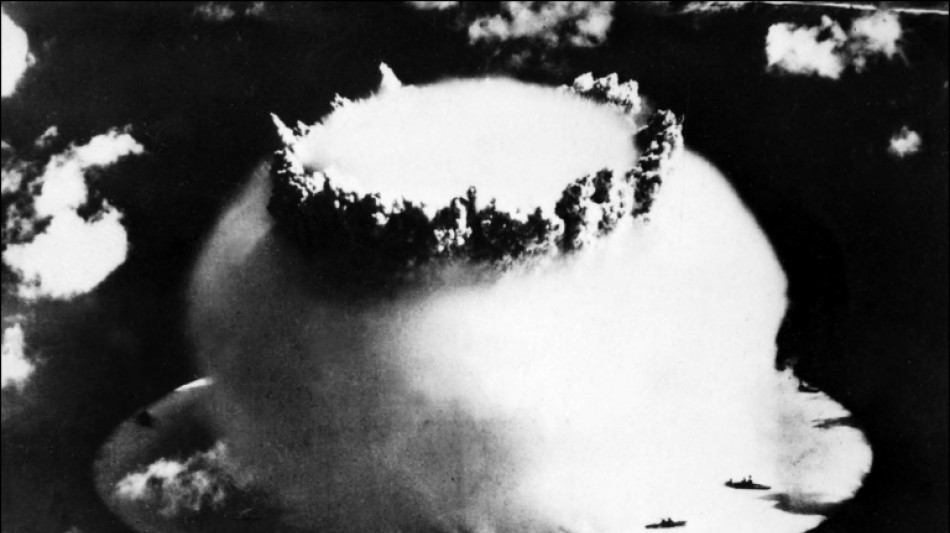
'Not interested': Analysts sceptical about US, Russia nuclear talks / Photo: © US Defense Nuclear Agency/AFP

 Stocks sink, yields at multi-decade highs and oil spikes on Mideast flare-up
 US defends Trump Venezuela oil deal as energy secretary lands in Caracas

 Jubilant Monfils celebrates birthday with US Open win

 The Japanese idealist behind the last deradicalisation NGO in Somalia

 Rybakina, Gauff advance as Zverev launches US Open campaign
 Macron in Britain to help unveil tapestry, hold Burnham talks
 China's Xi to hold talks with Sisi in rare visit to Egypt
 Confident Gauff reaches US Open 2nd round with straight-set win

 US postal whistleblower warns ballot system could disrupt midterms

 John Ternus takes over as Apple enters era of AI, foldable phones
 Second-ranked Rybakina eases into US Open 2nd round
 Man City sign Fernandez, Ndiaye as Premier League clubs set new spending record
 Alcaraz aims to step it up in round two of US Open title defense
 Honduran judge drops corruption charges against ex-leader Hernandez

 Mudryk joins Spurs on loan from Chelsea after doping ban ends
 What's next after judge strikes down New York's landmark climate fund law

 Cobolli claws out five-set victory at rain-hit US Open
 Ndiaye seizes 'chance of a lifetime' in Man City move

 Global bond sell-off, surging oil prices send markets into the red

 Zuckerberg, Musk make plea at G20 for more AI data centers

 'Discomfort' at G20 finance talks as US hosts Russian minister
 Man City set to sign Fernandez for record fee, Ndiaye on deadline day
 Back-to-school in Cuba a grim day with shortages of everything
 Canadian minister says Russia's G20 presence sparked 'discomfort'

 IMF reaches agreement with Senegal on new $2.2 bn loan programme

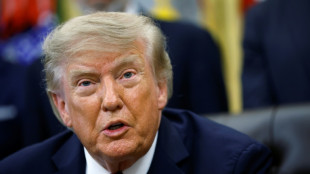
The United States and Russia have pledged their readiness to resume nuclear disarmament talks after years of confrontation, but analysts are sceptical that Donald Trump and Vladimir Putin can or even want to reach a breakthrough new agreement.
Days after returning to the White House for a second term, Trump said he would like to see "denuclearisation" and called for China to join the talks between Russia and the United States, the world's two biggest nuclear powers.
The Kremlin immediately confirmed its interest in launching talks "as soon as possible", saying last week that French and British nuclear weapon stockpiles should also be taken into account.
But China has indicated it is not interested at this stage, while analysts dismissed the US and Russian statements as posturing.
Moscow in particular has no interest in reducing its arsenal of nuclear warheads as its invasion of Ukraine is set to enter its fourth year next month, analysts say, suspecting Putin sees any potential future talks as an attempt to break out of Western isolation and even try to negotiate the fate of Ukraine.
The last remaining strategic arms control agreement between Russia and the United States is set to expire in a year.
The Bulletin of the Atomic Scientists, an organisation which informs the public about threats to humankind, appears to also be deeply sceptical.
The scientists on Tuesday shifted their "doomsday" clock to 89 seconds to midnight, the closest it has ever been.
- 'Redistribution of influence' -
"It's hard to imagine China, Russia or the United States undertaking the exacting negotiations required at this point in good faith," said Adam Mount, a nuclear expert at the Federation of American Scientists.
"Donald Trump thinks of himself as a deal maker, but historically hasn't had the patience, proficiency, or credibility," he said, adding that most people in the Trump administration are "arms control skeptics".
Maxim Starchak, a fellow at the Centre for International and Defence Policy at Queen's University in Canada, said Moscow's statements should not be taken at face value.
"Russia is not interested in arms control, it is interested in the redistribution of influence in Europe," Starchak said.
"The so-called arms control negotiations are a way for Moscow to achieve negotiations on broad issues of European security," he added.
"It is important for Putin to show that he is not against negotiations, and in the end declare that the United States has failed them."
Olivier Zajec, director of France's Institute for Strategy and Defence Studies, said he thought it would be in Russia's interest to hold talks on a new agreement.
"Nuclear power is the only thing that gives Russians the ability to talk to the Americans on an equal footing in the world," he said.
If the last arms control agreement between Russia and the United States is not replaced, Moscow and Washington will find themselves without a bilateral nuclear arms control agreement for the first time since 1972, Zajec added.
The last remaining strategic arms control agreement between Russia and the United States -- the New START Treaty -- is set to expire in February 2026.
The treaty restricted the former Cold War rivals to a maximum of 1,550 deployed warheads each.
Moscow said it was suspending its participation in New START in 2023, a year after Putin's invasion of Ukraine, which has raised fears of Russian use of nuclear weapons, though it has kept to the limits set by the agreement.
In 2019, the two powers withdrew from the landmark 1987 Intermediate-Range Nuclear Forces (INF) treaty concluded by US president Ronald Reagan and Soviet leader Mikhail Gorbachev, which limited the use of medium-range missiles, both conventional and nuclear.
- 'Lack of transparency' -
Washington has embarked on a costly modernisation of its nuclear triad of air, land and sea-based weapons, estimating that China's nuclear stockpile is expected to increase to about 1,500 warheads by 2035.
On Monday, Trump signed an executive order to start planning for an "Iron Dome" air defence system for the United States.
China, which is still a long way from achieving nuclear parity with Russia and the United States, has regularly rejected Washington's invitations to join US-Russian nuclear talks.
On Tuesday, China called on Washington and Moscow to "further reduce" their nuclear arsenals as a precondition for its participation in negotiations.
Zajec said China had no interest in engaging in nuclear arms control talks.
"If it did that, even though its arsenal is quantitatively smaller, it would lose the advantage that a certain lack of transparency over its arsenal gives it," he said.
H.Gerber--VB