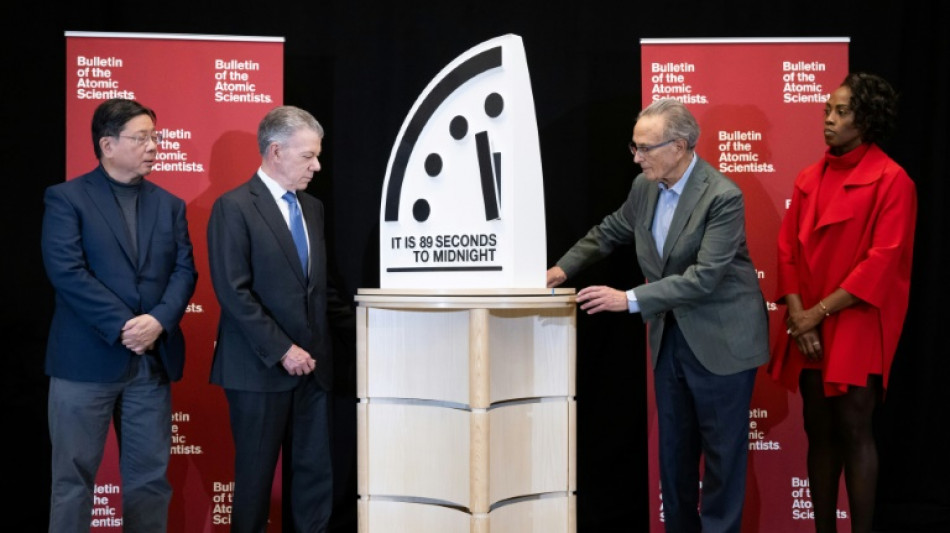
Doomsday clock ticks one second, closest ever to midnight / Photo: © AFP

 China expands Egypt investments in first Xi visit in a decade
 Messi departure leaves Argentina facing rebuild after golden era
 Ourbit SuperCEX Launches "Cosmic Wheel Season 3. Oracle Realm" on September 2 with 3M USDT Prize Pool

 Ebola death toll passes 3,000 in DR Congo: official data
 Hong Kong democracy activist Wong pleads guilty to foreign collusion
 World record prize winner Romantic Warrior retires from horse racing
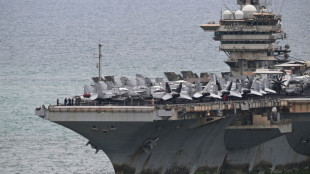 5,000 US sailors arrive in Thailand after months at sea
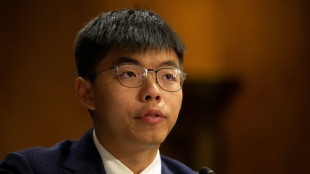 Joshua Wong, Hong Kong's pro-democracy poster child
 Nepal tunnel rescuers seek trapped workers but hit dead ends
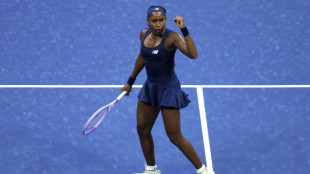
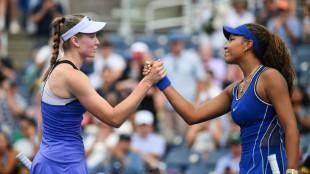
 Zverev wins wild five-setter, Rybakina and Gauff ease through at US Open
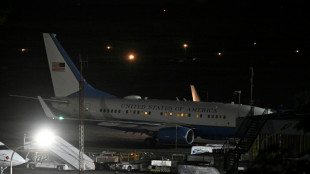 US energy secretary arrives in Venezuela to discuss oil deal
 Meloni government becomes Italy's longest-lasting
 Funerals in Nepal for missing, a week after deadly floods
 US aircraft carrier arrives in Thailand after months at sea
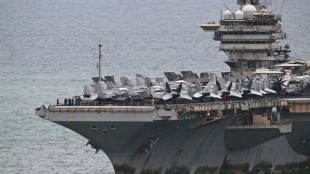 US aircraft carrier approaches Thai port after months at sea
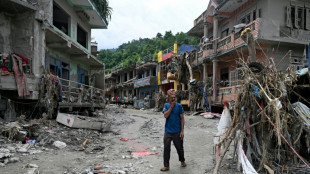 Nepal's young PM faces gravest test after flood catastrophe
 What rainbow? LGBTQ Indonesians on edge as hostility mounts
 O'Connor eyes Wallabies World Cup swansong after Force return
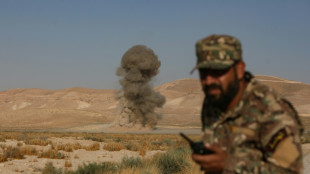 Syria UXO causing death, injury every six hours: charity
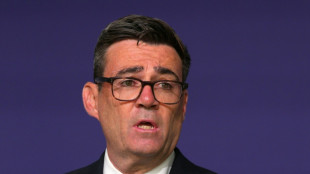
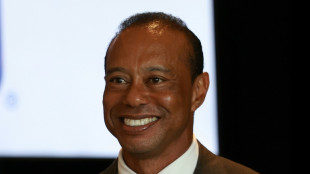 Tiger Woods set to change not guilty plea in DUI case: court documents
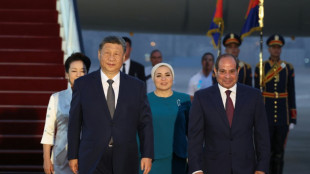
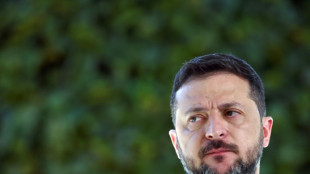 Zelensky warns airlines Russian skies not safe due to Ukraine drones
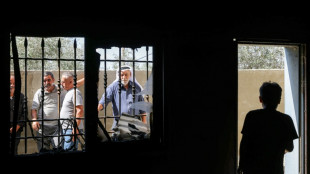 UK vows anti-settler measures as Israel warns of retaliation
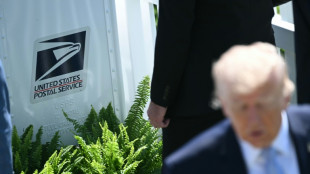
 New pro Koivun among US Presidents Cup picks
 G20 finance leaders close talks marked by US welcoming Russia
 From Hollywood to big time tennis: teen makes US Open debut
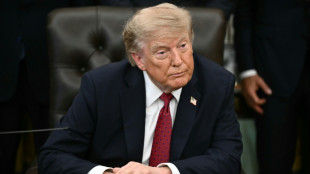
The "doomsday clock" symbolizing how close humanity is to destruction ticked one second closer to midnight Tuesday as concerns on nuclear war, climate and public health were jolted by US President Donald Trump's return.
The Bulletin of the Atomic Scientists, which set up the clock at the start of the Cold War, shifted the clock to 89 seconds to midnight, the closest it has ever been, a week after Trump's inauguration.
The clock was last moved to 90 seconds to midnight over nuclear-armed Russia's invasion of Ukraine in 2022. It was originally placed at seven minutes to midnight in 1947.
"At 89 seconds to midnight, the doomsday clock stands closer to catastrophe than at any moment in its history," said former Colombian president and Nobel Peace laureate Juan Manuel Santos, chair of The Elders, a group of major former leaders.
"The clock speaks to the existential threats that confront us and the need for unity and bold leadership to turn back its hands," he told a news conference in Washington to present the findings from the board of experts.
"This is a bleak picture. But it is not yet irreversible," he said.
Just days into his second presidency, Trump has already shattered norms on international cooperation.
Santos welcomed Trump's pledges for diplomacy with Russia and China. Trump has vowed to end the Ukraine war, which has raised fears of Russian use of nuclear weapons, by pressing both sides.
But Santos said that the US withdrawal from the Paris climate accord and World Health Organization set back the planet on two top risks.
The world just experienced another record-breaking year of high temperatures and major disasters.
Other countries could soon say that if the United States, the world's largest economy, "is not going to make an effort to limit the carbon emissions, why should I?" Santos said.
And with many people's memories fading of Covid-19, "we have to remind them what happened -- and what will happen will be worse, according to all the scientists," Santos said.
- Threats, and benefits, from AI -
Suzet McKinney, a public health expert on the board of Bulletin of the Atomic Scientists, said the risks of infectious disease was confounded by advances in artificial intelligence, which increase the risks that rogue actors could unleash biological weapons.
"As nation-states around the world and even our own government engage in practices that are sure to encourage rogue behavior and/or cripple our ability to curb the spread of infectious diseases, novel or otherwise, we cannot hide our heads in the sand," she told the news conference.
But Robert Socolow, a physicist who also serves on the board, said that the unveiling of Chinese intelligence firm DeepSeek -- which has rattled the United States -- could ultimately also pay dividends by reducing energy demand from the fast-growing field of AI.
The Chinese breakthrough may mirror "the kind of progress in semiconductor chips that reduce the energy demands of ordinary computing" in the analogue era.
But the experts also warned that artificial intelligence risked worsening disinformation.
"All of these dangers are greatly exacerbated by a potent threat multiplier -- the spread of misinformation, disinformation and conspiracy theories that degrade the communication ecosystem and increasingly blur the line between truth and falsehood," said Daniel Holz, chair of the board.
H.Weber--VB