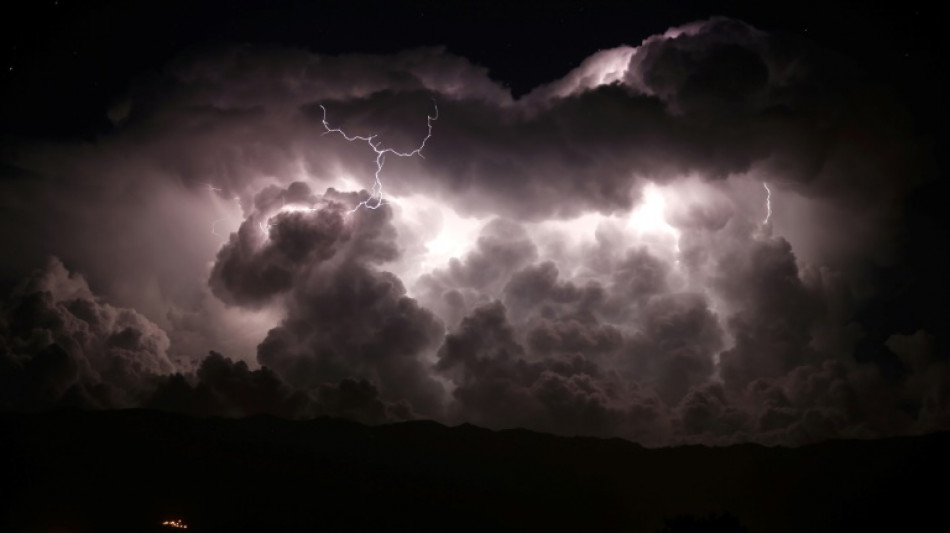
770-km US megaflash sets new lightning record: UN / Photo: ©

 Climate-threatened Fijian utopia rejects calls to relocate

 Bolsonaro's party says it recognizes Lula's election win in Brazil

 Meghan on TV menu for 'Junior MasterChef Australia'

 South Korea's chip boom fuels forecast-beating third-quarter growth

 US-brokered truce begins in Ukraine city occupied by Russia

 Qatar launches Fashion and Crafts Council to connect talent with global markets

 Jordan strikes militant groups in Syria after church attack

 FIA chief praises Middle East motorsport volunteers and officials

 Australia warns of 'unprecedented' AI threat

 Qatar Amir arrives in Moscow for eighth GECF summit

 Kane beats Yamal and Mbappe to taste Ballon d'Or glory

 Ballon d'Or crowns Putellas's return to top of women's game

 Godts stars as PSG beat Lyon to go top of Ligue 1

 NBA inks deal with Kalshi and Polymarket, citing safeguards

 US rapper Macklemore launches 'Free Palestine Tour' after Ed Sheeran fallout

 Venezuela leader criticizes Machado over dramatic return from exile

 Brazil markets battered after Lula win, AI in focus elsewhere

 Lula savors Brazil win as Bolsonaro rejects result, markets tumble

 Canadian youths ask court to impose binding climate protections

 Walter Koenig, who played original Chekov on 'Star Trek,' dies at 90

 Netanyahu, rivals trade attacks over Iran as clock counts down to Israel vote

 Townsend urges Scotland to use Nations Championship as World Cup springboard

 Microsoft offers voluntary exit packages to 60,000 staff

 S.Africa ambassador calls for talks with US over 'tense' ties

 'Smells of freedom': Serbians hopeful after landmark election

A single flash of lightning in the United States nearly two years ago cut across the sky for nearly 770 kilometres, setting a new world record, the United Nations said Tuesday.
The new record for the longest detected megaflash, measured in the southern US on April 29, 2020, stretched a full 768 kilometres, or 477.2 miles, across Mississippi, Louisiana and Texas.
That is equivalent to the distance between New York City and Columbus, Ohio, or between London and the German city of Hamburg, the UN's World Meteorological Organization (WMO) pointed out in a statement.
That lightning bolt zig-zagged some 60 kilometres further than the previous record, set in southern Brazil on October 31, 2018.
The WMO's committee of experts on weather and climate extremes also reported a new world record for the duration of a lightning flash.
A single flash that developed continuously through a thunderstorm over Uruguay and northern Argentina on June 18, 2020 lasted for 17.1 seconds -- 0.37 seconds longer than the previous record set on March 4, 2019, also in northern Argentina.
- 'Even greater extremes' -
"These are extraordinary records from single lightning flash events," Randall Cerveny, the WMO rapporteur of weather and climate extremes, said in the statement.
"Environmental extremes are living measurements of the power of nature, as well as scientific progress in being able to make such assessments," he said.
The technology used to detect the length and duration of lightning flashes has improved dramatically in recent years, enabling records far greater than what was once the norm.
The previous "megaflash" records, from 2018 and 2019, were the first verified with new satellite lightning imagery technology and were both more than double the prior records using data collected from ground-based technology.
"It is likely that even greater extremes still exist, and that we will be able to observe them as lightning detection technology improves," Cerveny said.
The WMO highlighted that the new record strikes happened in the Great Plains in North America and the La Plata basin in South America, known as hotspots for so-called Mesoscale Convective System (MCS) thunderstorms, which enable megaflashes.
It stressed that the flashes that set the new records were not isolated events, but happened during active and large-scale thunderstorms, making them all the more dangerous.
"Lightning is a major hazard that claims many lives every year," WMO chief Petteri Taalas said in the statement.
"The findings highlight important public lightning safety concerns for electrified clouds where flashes can travel extremely large distances."
WMO pointed out that the only lightning-safe locations are big buildings with wiring and plumbing, or fully enclosed, metal-topped vehicles.
The UN agency maintains official global records for a range weather and climate-related statistics, including temperature, rainfall and wind.
All such records are stored in the WMO Archive of Weather and Climate Extremes.
The archive currently includes two other lightning-related extremes.
One is for the most people killed by a single direct strike of lightning, when 21 people died in Zimbabwe in 1975 as they huddled for safety in a hut that was hit.
The other is for an indirect strike, when 469 people died in Dronka, Egypt when lightning struck a set of oil tanks in 1994, causing burning oil to flood the town.
D.Schneider--BTB