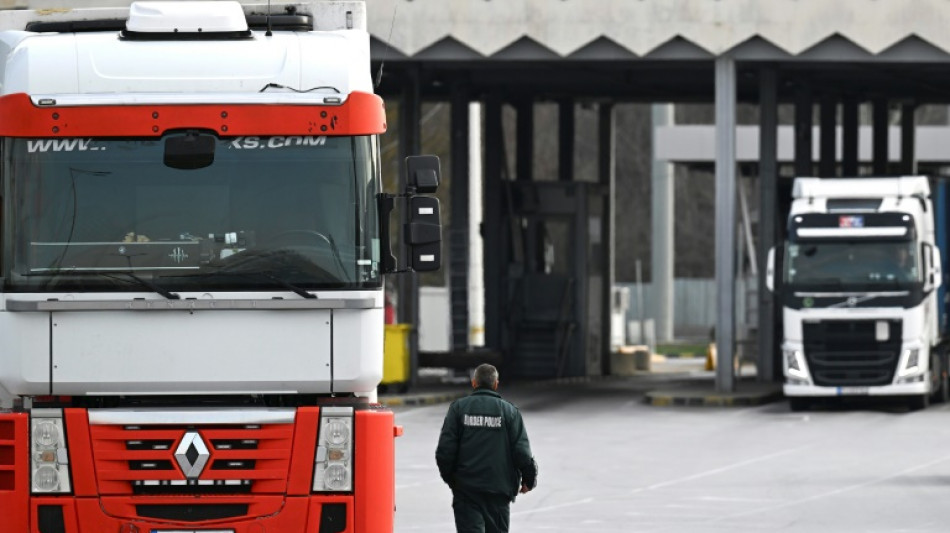
Romania, Bulgaria join borderless Schengen zone / Photo: © AFP

 Qatar Airways Launches Bogotá-Caracas-Doha Route Linking Energy Markets

 Marc Almond to Close Soft Cell Era After Final 'Danceteria' Tour

 London Museum Granted 24/7 License Ahead of November Opening

 Dana White Confirms Flight to Washington for Trump Meeting on Press Secretary Role

 Dengue Fever Expands Into High Himalayas as Climate Change Warms Nepal

 IoT Refrigerator Hacks Disrupt Blood Labs and Supermarkets Across Europe and US
Romania and Bulgaria became full members of the Schengen zone on Wednesday, expanding the borderless area to 29 members and ending a 13-year wait for the two eastern European countries.
The expansion, made possible when Austria and other members dropped their objections to the former communist countries joining, officially took place at midnight (2200 GMT) on January 1, marked by ceremonies at various border posts.
Romania and Bulgaria, both members of the European Union since 2007, were partially included in the Schengen zone in March, eliminating border checks at ports and airports.
But Austria had threatened to veto their full entry over migration concerns, which meant that controls still applied at land border crossings.
Vienna backed off its veto threat in December after the three countries reached a deal on a "border protection package", clearing the way for Romania and Bulgaria, two of the EU's poorest countries, to join Schengen.
Created in 1985, the zone will now include 25 of the EU's 27 members, as well as Switzerland, Norway, Iceland and Liechtenstein, covering a total population of more than 400 million people.
Romania and Bulgaria had met the Schengen zone's technical requirements for membership since 2011.
But "member states objected every time" they tried to join, analyst Valentin Naumescu told AFP.
That became "a source of frustration exploited by anti-EU parties, which alleged Romania was being treated unfairly", he said.
The resentment came into play in Romania's recent presidential elections, in which far-right candidate Calin Georgescu surged to a surprise first-round win, before the polls were cancelled amid claims of Russian interference.
Now, "that feeling of being second-class citizens" should fade, Naumescu said.
- Truckers celebrate -
Leaders on both sides hailed the expansion as "historic".
Austria had for years complained about hosting a disproportionate number of undocumented migrants as a result of poorly protected external Schengen borders.
It dropped its objections to Romania (population 19 million) and Bulgaria (6.5 million) joining Schengen after the three countries signed a border protection agreement in November.
The deal provides for the joint deployment of guards to the Bulgarian-Turkish border and temporary controls at land crossings for an initial period of six months.
Joining the zone will boost Romania's and Bulgaria's gross domestic product (GDP) by at least one percentage point, analysts estimate.
Lorry drivers, who currently wait up to 20 hours at border crossings, celebrated the news.
"It was a pure waste of time for drivers, who couldn't even stop to rest because they had to move their vehicles every 10 minutes," said Beniamin Lucescu, head of a Romanian transport federation.
Poor road and railroad infrastructure in Bulgaria could limit the positive impact there, however.
The countries' tourism sectors are meanwhile expecting a surge in visitors from the two countries to nearby Greece.
"It's excellent news," said 46-year-old sales manager Ivailo Kirkov, who owns a house in northern Greece.
"We'd been waiting impatiently."
Greek teacher and tour guide Gueorgui Grantcharov predicted a rush of Romanian and Bulgarian tourists to Greece.
With no queues at the border, "it takes just over four hours to get from Sofia to Thessaloniki", he said.
B.Wyler--VB


