
Some Americans in Panama reject Trump's canal threat / Photo: © AFP

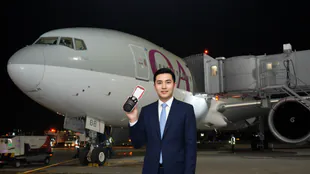 Qatar Airways Launches Bogotá-Caracas-Doha Route Linking Energy Markets

 Marc Almond to Close Soft Cell Era After Final 'Danceteria' Tour

 London Museum Granted 24/7 License Ahead of November Opening

 Dana White Confirms Flight to Washington for Trump Meeting on Press Secretary Role

 Dengue Fever Expands Into High Himalayas as Climate Change Warms Nepal

 IoT Refrigerator Hacks Disrupt Blood Labs and Supermarkets Across Europe and US
For dozens of US tourists watching a cargo ship pass along the Panama Canal, Donald Trump's threat to possibly wrest back control of the waterway is nonsensical.
"I think it is 100 percent Panama, yeah, and it should stay such," said one, Natalia Glusack, a 47-year-old accountant from California vacationing with her mother.
She was among around 50 Americans standing in a viewing area at a visitors' center to watch a 266-meter (870-foot) Danish-flagged freighter move along the canal.
None of those interviewed backed President-elect Trump in his repeated threats that he could seize control of the canal after he returns to the White House next month.
Trump has claimed that American ships are charged "unfair" fees for passing through the canal, and made unsubstantiated allegations that China controls it.
Panama's government has resolutely rejected Trump's accusations and his threat.
So too did all the US citizens asked at the canal viewing area, on the Atlantic Ocean entrance to the cross-continent channel.
"Donald Trump claims a lot of things, and that doesn't make them true," said Mindy Holland, a retiree from New York.
"He likes to bring up dramatic things and get people riled. But it belongs to Panama.... because that was part of the agreement" the two countries signed in 1977, said Paola Metzner, a 74-year-old retiree also from New York.
- 'Only cares about money' -
Canal construction was started in 1881 by French companies, but in the face of daunting conditions -- tropical diseases ran rampant in rugged and steamy terrain, and thousands of workers died -- they abandoned the project.
The United States later took it over, and the canal was finally inaugurated in 1914, its 50-mile (80-kilometer) channel under US administration.
But in 1977, under President Jimmy Carter, the United States signed a treaty ceding the canal to Panama's control in return for a guarantee that the waterway would stay neutral in perpetuity.
Some analysts see Trump's threats as simply a negotiating tactic to force Panama to lower transit fees.
Others, though, remember how US forces invaded Panama in 1989 to depose the country's military leader Manuel Noriega, who had been indicted in the US on charges of drug smuggling and money laundering.
Some of the US tourists in Panama favored the first hypothesis, that Trump was posturing as a business tactic.
Trump "is, to the core, a businessman who only cares about money... There is a lot of benefit potentially if he can argue that he is saving US companies money," said Alan Muller, a retired financial consultant from Washington.
Muller, 75, said Trump "understands that most people are not going to study the history and truth of the Panama Canal treaty. They're only going to say, yay, he is standing up for us."
Panamanian President Jose Raul Mulino on Thursday ruled out negotiations with Trump over the canal and denied that China interferes in its operation.
He said there would be no reduction in tolls for US vessels using the canal.
Trump started the mini-firestorm when he slammed what he called "ridiculous" transit fees for US ships and said that if Panama could not ensure "the secure, efficient and reliable operation" of the channel, "we will demand that the Panama Canal be returned to us, in full, and without question."
An estimated five percent of global maritime traffic passes through the canal, which allows ships traveling between Asia and the US East Coast to avoid the long, hazardous route around the southern tip of South America.
The United States accounts for 74 percent of cargo transiting the canal, followed by China, with 21 percent.
Ed Bein, Metzner's husband, said he understands Trump's concern.
"But if the ships didn't save money by paying the tolls, they wouldn't come this way," he said, "so the tolls must be reasonable."
N.Schaad--VB


