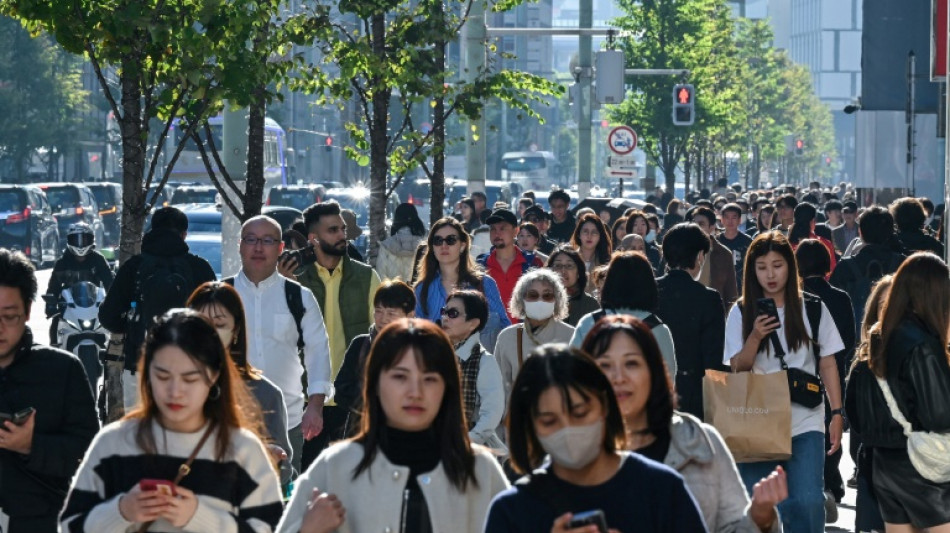
Japan govt approves record budget for ageing population, defence / Photo: © AFP

 Qatar Airways Launches Bogotá-Caracas-Doha Route Linking Energy Markets

 Marc Almond to Close Soft Cell Era After Final 'Danceteria' Tour

 London Museum Granted 24/7 License Ahead of November Opening

 Dana White Confirms Flight to Washington for Trump Meeting on Press Secretary Role

 Dengue Fever Expands Into High Himalayas as Climate Change Warms Nepal

 IoT Refrigerator Hacks Disrupt Blood Labs and Supermarkets Across Europe and US
Japan's government on Friday approved a record budget for the next fiscal year, ramping up spending on social welfare, as the population ages, and defence to tackle regional threats.
The 115.5 trillion yen ($730 billion) budget for the year from April 2025, greenlighted by the Cabinet, includes 8.7 trillion yen in defence spending.
It also includes social security spending of around 38.3 trillion yen -- up from 37.7 trillion the previous year.
The defence ministry said in a briefing document that Japan was facing its "toughest and most complex security environment" since World War II, repeating a warning from Prime Minister Shigeru Ishiba.
Japan has a pacifist post-war constitution, which limits its military capacity to ostensibly defensive measures.
But it updated key security and defence policies in 2022, explicitly outlining the challenge posed by China, and committed to double its defence spending to the NATO standard of two percent of GDP by 2027.
The 8.7 trillion yen approved Friday will help pay for measures to help attract recruits to Japan's Self-Defense Forces, and to improve relations between the US and Japanese militaries with locals in Okinawa.
It will also go towards a system to collect satellite information on ballistic missiles, such as those fired by North Korea, and the movement of vessels in waters around Japan, including territories disputed with China.
"Strengthening our defence capabilities is something we're actively working on," Ishiba said at an event organised by the Yomiuri newspaper on Thursday.
"Now matter how great our military tanks or vehicles are, it's pointless if we don't have enough people to move them," said the prime minister, who has pledged to fix a shortage of new troops.
Another challenge facing the country is its ageing population caused by chronically low birth rates and a cautious approach to immigration.
Japan is one of the world's oldest societies, and this year the proportion of its people aged 65 or over reached a record 29.3 percent.
The draft budget needs to be approved by the parliament, and the ruling Liberal Democratic Party and its smaller coalition partner Komeito will need cooperation from opposition parties, having lost their majority in an October snap election.
Ishiba has stayed on as prime minister despite leading the coalition to its worst general election result in 15 years.
A vote to elect parliament's upper house will be held in summer 2025.
L.Stucki--VB


