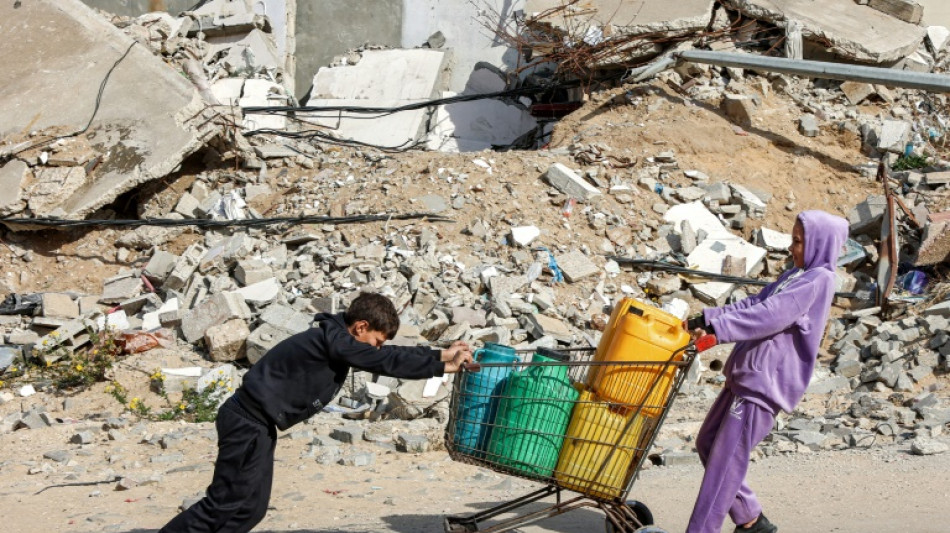
Key public service makes quiet return in Gaza / Photo: © AFP/File

 Sabalenka edges Noskova, keeps US Open treble bid alive

 Real Madrid win Champions League opener as Haaland stars for Man City
 Gambian leader vows power boost after violent blackout protests

 Newcastle battle past Millwall to reach League Cup fourth round
 Mourinho's Real Madrid make winning start against Inter Milan

 Villa take 'big step forward' with win over Brugge

 Yaya Toure hails 'new era' for African coaches ahead of Champions League bow

 Lawes and Marchant told to prove themselves in quest for England recalls

 Smithsonian secretary to retire as Trump exerts control over institution
 Atletico have work to do to reach home Champions League final: Simeone

 Villa end goal drought to beat Brugge in Champions League opener

 McIlroy says 'we'll keep our heads down and play' in event of Trump golf visit

 Sabalenka holds of Noskova to reach US Open semi-finals

 Netanyahu under fire over report UAE warned of October 7 attack

 Wasim Akram urges 'fair treatment' for jailed Imran Khan

 No. 1 in reach as Rybakina battles for US Open semi-final spot

 Putin and Trump discuss Ukraine in 'extremely frank' call

 French police hunt Renoir thieves after lightning museum heist
 World Cup final scorer Torres leads Ballon d'Or nominees
 Carney touts Canada 'pivot' away from US as tariffs rise

 Spanish stars Cruz, Bardem play strained on-screen couple in new film
 The "Everlasting Battery" Inside Your Joints:UConn Professor's Self-Powered Healing Material just Got Acquired

 Visionary or conman? Elon Musk enigmatic star of Venice documentary

 Trial opens in France over deadliest Channel migrant crossing disaster

 England skipper Root says it's wrong to accuse Pakistan of lacking fight
The quiet resumption of operations at a desalination plant in the Gaza Strip last month marked a small but significant step toward restoring public services in the Palestinian territory ravaged by more than 14 months of war.
The process of restarting the plant in Deir el-Balah, in central Gaza, involved both Israeli and Palestinian stakeholders who could have a hand in the territory's future, especially amid renewed hopes for a ceasefire in recent days.
While its reopening has had a limited tangible impact so far, diplomats close to the project suggest it could offer a tentative roadmap for Gaza's post-war administration.
Since being reconnected to Israel's electricity grid, the station has been producing approximately 16,000 cubic metres of water per day, according to UNICEF.
It serves more than 600,000 Gaza residents through tankers or the networks of Deir el-Balah and Khan Yunis governorates in central and southern Gaza, respectively.
"Its production capacity remains limited in the face of immense needs," an official within the Palestinian Energy and Natural Resources Authority (PENRA) told AFP.
Residents of the devastated Palestinian territory have struggled since the early days of the war between Israel and Hamas to secure even basic necessities, including food and clean water.
Human Rights Watch last week accused Israel of committing "acts of genocide" in Gaza by restricting water access -- a claim denied by Israeli authorities.
The WASH Cluster, which brings together humanitarian organisations in the water sector, reports that distribution of water has become very complex in Gaza.
The pipelines transporting water have been damaged, leaving Gazans -- many of whom are living in makeshift shelters after being displaced by bombardments -- without any means of storing the essential resource.
The plant is one of three such seawater processing facilities in the Gaza Strip, which before the war met around 15 percent of the 2.4 million residents' needs.
In the months following the outbreak of war, sparked by the Hamas attack on Israel on October 7, 2023, the plant operated at minimal capacity, relying on solar panels and generators amid a persistent scarcity of fuel in Gaza.
It could fully resume operations only after reconnecting to one of the power lines supplied by Israel, which charges the Palestinian Authority for the electricity.
- Practical solutions -
UNICEF, which provides technical support for the Deir el-Balah plant, indicated in late June that it had reached an agreement with Israel to restore electricity to the plant.
Subsequently, COGAT, a division of Israel's defence ministry overseeing civilian affairs in the Palestinian territories, announced that the desalination plant had been reconnected to the Israeli grid.
But the line meant to supply the plant was heavily damaged.
"It took five months to repair the line from Kissufim" in Israel, said Mohammed Thabet, spokesman for Gaza's electricity company. "These are emergency, temporary solutions."
Several diplomatic sources told AFP that the episode showed the Palestinian Authority had proven it was in a position to have a hand in the future governance of Gaza, as its institutions were fixing the electricity line on the ground, coordinating with all actors.
The Authority aims to play a central role in post-war Gaza, seeking to strengthen its influence in the territory after it was significantly weakened when Hamas took control in 2007.
An Israeli security source told AFP that the Israeli partners involved had acted on "instructions from the political echelons", and that the project was part of an effort to prevent an outbreak of disease, which could endanger the lives of hostages still held in Gaza.
When Hamas militants attacked Israel last year, they abducted 251 hostages, of whom 96 are still held in Gaza, including 34 the Israeli military says are dead.
Israel "facilitated the connection of the electric line specifically to the desalination plant", the source said, adding that a mechanism was in place to track usage to "prevent electricity from being stolen".
Israeli authorities' cooperation on the plant's reopening comes soon after it agreed to work with a UN-led polio vaccination drive, pausing its bombing campaign in Gaza in areas where children were receiving the doses.
S.Gantenbein--VB