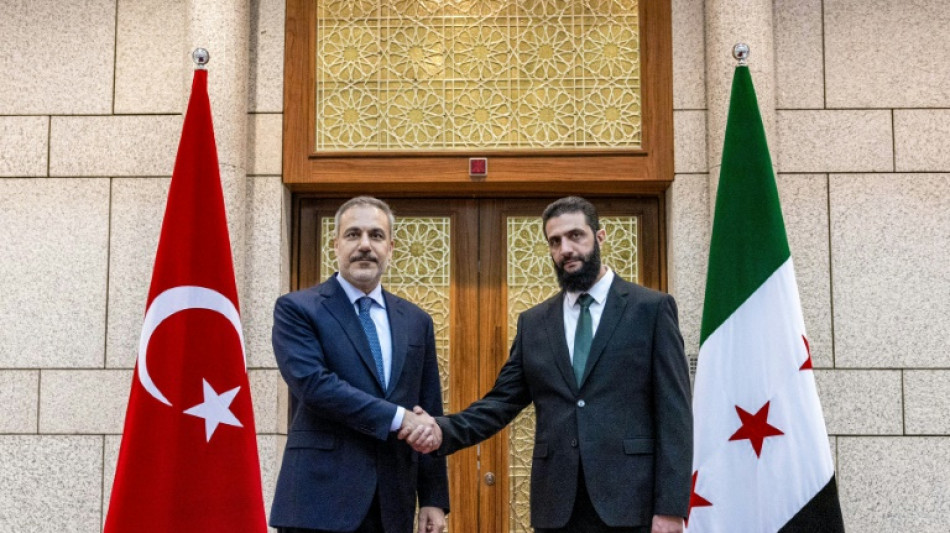
Syria's new leader says all weapons to come under 'state control' / Photo: © TURKISH FOREIGN MINISTRY/AFP

 Iran, US trade blows as Hormuz impasse deepens
 The round-the-clock monitors protecting Bhutan from glacier risk
 'Hell': Father of surfers killed in Mexico testifies at trial

 Travellers in UK face more chaos after air traffic control glitch

 Crude pushes towards $100 on Mideast flare-up, fanning inflation fears
 Record rain forces Asian Games athletes to evacuate accommodation
 Amusing or addictive? The algorithms powering our social feeds

 Norway bids farewell to King Harald V, 'grandfather' of the nation
 NFL breaks new ground as 100,000 set to pack MCG in Australia
 EU faces revolt over social media ban for children
 Canada eyes researchers looking to leave 'hostile' US
 Tiafoe escapes Michelsen to reach US Open semi-finals

 Carney touts Canada 'pivot' away from US as Trump levels new threat

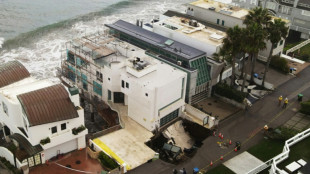 Pounding waves open up sinkhole in swanky Malibu
 LIV Golf files for bankruptcy protection

 Argentina launches legal action against oil firms for Falklands drilling

 Haaland double powers Man City to victory over Porto

 Sabalenka survives Noskova to return to US Open semi-finals
 'South Park' changes name in dig at Trump
 OpenAI says AI solved one of math's hardest problems in days
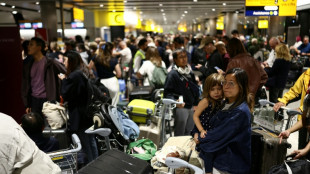 Nearly 1,100 flights cancelled after UK air traffic control glitch
 Sabalenka holds off Noskova to keep US Open three-peat bid alive

 Rein in social media not children, say over 130 groups, experts
 Hong Kong's first post-colonial leader Tung Chee-hwa dies aged 89

 Rangers captain Shankland sidelined for up to four months
Two weeks after seizing power in a sweeping offensive, Syria's new leader Ahmed al-Sharaa on Sunday said weapons in the country, including those held by Kurdish-led forces, would come under state control.
Sharaa spoke alongside Turkish Foreign Minister Hakan Fidan, after earlier meeting with Lebanese Druze leaders and vowing to end "negative interference" in the neighbouring country.
Ankara-backed rebels played a key role in supporting Sharaa's Islamist group Hayat Tahrir al-Sham (HTS), which headed a rebel alliance and seized Damascus on December 8, ousting longtime ruler Bashar al-Assad.
During a press conference with Fidan, Sharaa said Syria's armed "factions will begin to announce their dissolution and enter" the army.
"We will absolutely not allow there to be weapons in the country outside state control, whether from the revolutionary factions or the factions present in the SDF area", he added, referring to the Kurdish-led Syrian Democratic Forces.
Sharaa -- also known as Abu Mohammed al-Jolani -- had traded in the olive-green military shirt he sported just days ago for a suit and tie during his meetings Sunday at the presidential palace.
He also said "we are working on protecting sects and minorities from any attacks that occur between them" and from "external" actors exploiting the situation "to cause sectarian discord".
"Syria is a country for all and we can coexist together," he added.
Fidan said sanctions on Syria must "be lifted as soon as possible". He called for the international community to "mobilise to help Syria get back on its feet and for the displaced people to return".
Syria's nearly 14-year civil war killed more than half a million people and displaced more than half its population, many of them fleeing to neighbouring countries, including three million in Turkey.
Turkey has maintained strong ties with Syria's new leaders, and Ankara's intelligence chief Ibrahim Kalin was in Damascus just four days after Assad fell.
Ankara has meanwhile continued operations against Kurdish-held areas in northeastern Syria, with a Britain-based war monitor reporting on Saturday that a Turkish drone strike killed five civilians in the area.
Ankara regards the People's Protection Units (YPG), the main component of the SDF, as being linked to the militant Kurdistan Workers' Party (PKK) at home, which both Turkey and Western allies deem a "terrorist" organisation.
- 'Respect Lebanon's sovereignty' -
Regional powerhouse Saudi Arabia is also in direct contact with Syria's new authorities, having supported the opposition to Assad for years during Syria's civil war. Riyadh will send a delegation to the country soon, Syria's ambassador in the Saudi capital said.
During his meeting with visiting Lebanese Druze chiefs Walid and Taymur Jumblatt, Sharaa said Syria will no longer exert "negative interference in Lebanon at all".
He added that Damascus "respects Lebanon's sovereignty, the unity of its territories, the independence of its decisions and its security stability".
Syria "will stay at equal distance from all" in Lebanon, Sharaa added, acknowledging that Syria has been a "source of fear and anxiety" for the country.
Walid Jumblatt, long a fierce critic of Assad and his father Hafez who ruled Syria before him, arrived in Damascus Sunday at the head of a delegation of lawmakers from his parliamentary bloc and Druze religious figures.
The Druze religious minority is spread across Lebanon, Syria and Israel.
Walid Jumblatt accuses the former Syrian authorities of having assassinated his father in 1977 during Lebanon's civil war.
The Syrian army entered Lebanon in 1976, only leaving in 2005 after enormous pressure following the assassination of former prime minister Rafic Hariri, a killing attributed to Damascus and its ally, Lebanon's Iran-backed Hezbollah group.
- 'Insecurity' -
Assad was an adherent of the Alawite offshoot of Shiite Islam and projected himself as a protector of the country's religious and ethnic minorities.
The seizure of power by the Sunni Islamists of HTS -- proscribed as a terrorist organisation by many governments including the United States -- has sparked concern, though the group has in recent years sought to moderate its rhetoric.
Despite worries over Syria's future, global powers including the United States and the European Union have stepped up contacts with the war-ravaged country's new leaders, urging them to guarantee protections for women and minorities.
The foreign leaders have also stressed the importance of combating "terrorism and extremism".
The supreme leader of Iran -- a major backer of Assad's administration before it fell -- on Sunday predicted "the emergence of a strong, honourable group" that would stand against "insecurity" in Syria.
Ayatollah Ali Khamenei said Syria's young men would "stand with strength and determination against those who have designed this insecurity and those who have implemented it, and God willing, he will overcome them".
Assad had long played a strategic role in Iran's "axis of resistance", a loose alliance of regional proxy forces, particularly in facilitating the supply of weapons to Hezbollah in neighbouring Lebanon.
That axis has suffered heavy blows over the past year with Israel's decimation of the leadership of Hezbollah in Lebanon and Hamas in Gaza.
Khamenei nonetheless denied that these armed groups acted as proxies, adding that: "If one day we want to take action, we do not need a proxy force."
burs-jsa/it
T.Ziegler--VB