Credit Suisse collapse probe slams banking regulator / Photo: © AFP

 Cyberattack ruled out in UK air traffic glitch as more flights axed

 Ekiden Launches Canton Network’s First Order Book-Based Derivatives Exchange

 Germany's Merz accuses AfD of promoting 'ethnic cleansing'

 Japanese director Kore-eda's manga film charms critics in Venice

 As African space race heats up, Senegal pursues homemade satellites

 UK's little-known Bayeux Tapestry replica steps into spotlight

 Shelton stuns Alcaraz in 3:34 am US Open finish, Sabalenka battles on

 Alcaraz falls to Shelton in epic latest-ever US Open finish

 Tradition Announces Partnership With Affin Moneybrokers to Support Malaysian Market Data

 Protesters urge South Korea to stay out of Iran war

 Africa's informal economy: a burden and lifeline

 Kenyan start-up makes robotic limbs to sign for deaf kids

 Iran, US trade blows as Hormuz impasse deepens

 The round-the-clock monitors protecting Bhutan from glacier risk

 'Hell': Father of surfers killed in Mexico testifies at trial

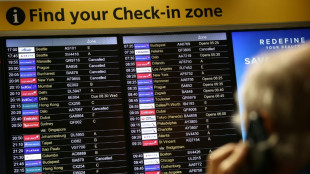 Travellers in UK face more chaos after air traffic control glitch

 Crude pushes towards $100 on Mideast flare-up, fanning inflation fears

 Record rain forces Asian Games athletes to evacuate accommodation
 Amusing or addictive? The algorithms powering our social feeds

 Norway bids farewell to King Harald V, 'grandfather' of the nation

 NFL breaks new ground as 100,000 set to pack MCG in Australia

 EU faces revolt over social media ban for children

 Canada eyes researchers looking to leave 'hostile' US

 Tiafoe escapes Michelsen to reach US Open semi-finals

 Carney touts Canada 'pivot' away from US as Trump levels new threat

Switzerland's financial regulator was ineffective in tackling the scandals at Credit Suisse, where executive mismanagement scuppered the bank and nearly triggered a global financial crisis, a Swiss inquiry concluded Friday.
However, after an 18-month investigation raking over the dramatic collapse of one of the world's biggest banks, the rarely-used parliamentary commission of inquiry found no evidence that the implosion of Credit Suisse was caused by misconduct on the part of the authorities.
"Credit Suisse's long-term mismanagement is the cause of the crisis," the inquiry said.
"The board of directors and management of Credit Suisse in recent years are responsible for the loss of confidence in the bank."
Credit Suisse was among 30 international banks deemed too big to fail due to their importance in the global banking architecture.
But the collapse of three US regional lenders in March 2023 left Credit Suisse looking like the weakest link in the chain and its share price plunged more than 30 percent on March 15 last year.
The Swiss government, the central bank and the Financial Market Supervisory Authority (FINMA) then strongarmed the country's biggest bank UBS into a $3.25-billion takeover announced on March 19 before the markets reopened the following day.
The government feared Credit Suisse would have quickly defaulted and triggered a global banking crisis that would also have shredded Switzerland's valuable reputation for sound banking.
- Global crisis avoided -
The authorities' actions "avoided a global financial crisis", according to the more than 500-page report.
The commission levelled numerous criticisms at the financial market regulators, saying it "deplores the partial ineffectiveness of FINMA's supervisory activity".
It said it did not understand why, back in 2017, FINMA granted "vast capital relief" without which Credit Suisse would have "had difficulty meeting regulatory requirements" four years later, and "would have been absolutely incapable of doing so from 2022".
FINMA had issued several warnings and launched numerous procedures against the bank, the commission said, but found Credit Suisse's managers had been "reticent" when the regulator intervened.
The inquiry regretted that at the time, FINMA did not withdraw the certificate that banks need to operate in Switzerland.
However, the inquiry "has not identified any misconduct by the authorities that caused the Credit Suisse crisis".
- Merger raised concerns -
The merger raised serious concerns in Switzerland around jobs, competition and the size of the resulting bank relative to the Swiss economy.
The inquiry was set up in June 2023, tasked with tasked with investigating the role of Swiss authorities in the emergency merger of Switzerland's second-biggest bank into its larger domestic rival UBS.
It was composed of 14 lawmakers -- seven from each house of parliament -- with all the major parties represented.
It was only the fifth parliamentary committee inquiry ever held in Switzerland and the first since 1995.
The commission looked at events from 2015 onwards to identify the factors that led to the bank's downfall, and examined more than 30,000 pages.
- Recommendations on regulations -
The inquiry criticised the rules applicable to banks deemed too big to fail, finding that the government and parliament had placed "too much importance" on the demands of the big banks.
The commission made 20 recommendations to the government.
It said the regulations on "too big to fail" banks should be placed within an international framework, to clarify the rules for cooperation between the authorities responsible for financial stability in Switzerland.
In April, UBS chairman Colm Kelleher said he was concerned about a looming tightening of the rules, warning that the bank risked being penalised compared to its international competitors.
He said the fall of Credit Suisse was down to a crisis of confidence, but said trust in a bank was not something that could be regulated.
The Swiss Bank Employees Association has called for greater resources to supervise banks, saying the collapse of Credit Suisse was down to a few unscrupulous senior managers, with junior staff paying the price.
I.Stoeckli--VB