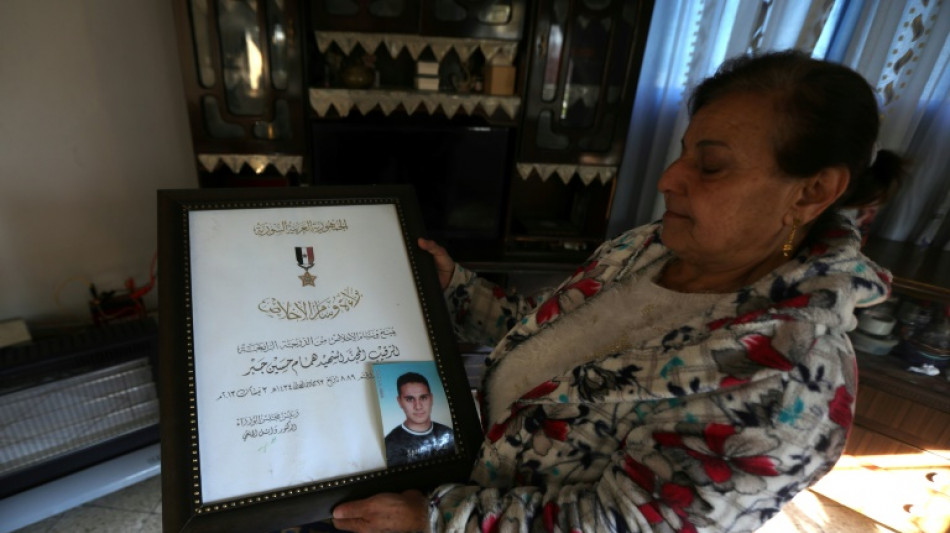
Defeat of Syria's Assad stirs a mother's bitterness / Photo: © AFP

 IC Markets Australia Wins People's Choice Forex Broker Innovation Award at the 2026 Finder Innovation Awards
 Brent oil tops $100 on Mideast flare-up, fanning inflation fears
 EU wants to edge out China in public contracts
 Google unveils 13 bn euro AI expansion in Finland

 Singapore's hefty ministerial pay hikes draw mixed feelings
 Cyberattack ruled out in UK air traffic glitch as more flights axed

 Ekiden Launches Canton Network’s First Order Book-Based Derivatives Exchange

 Germany's Merz accuses AfD of promoting 'ethnic cleansing'
 Japanese director Kore-eda's manga film charms critics in Venice

 As African space race heats up, Senegal pursues homemade satellites

 UK's little-known Bayeux Tapestry replica steps into spotlight

 Shelton stuns Alcaraz in 3:34 am US Open finish, Sabalenka battles on

 Alcaraz falls to Shelton in epic latest-ever US Open finish

 Tradition Announces Partnership With Affin Moneybrokers to Support Malaysian Market Data

 Protesters urge South Korea to stay out of Iran war
 Africa's informal economy: a burden and lifeline

 Kenyan start-up makes robotic limbs to sign for deaf kids

 Iran, US trade blows as Hormuz impasse deepens

 The round-the-clock monitors protecting Bhutan from glacier risk

 'Hell': Father of surfers killed in Mexico testifies at trial

 Travellers in UK face more chaos after air traffic control glitch

 Crude pushes towards $100 on Mideast flare-up, fanning inflation fears
 Record rain forces Asian Games athletes to evacuate accommodation
 Amusing or addictive? The algorithms powering our social feeds

 Norway bids farewell to King Harald V, 'grandfather' of the nation
In the villages above the Syrian port city of Tartus they once hailed the sons who died fighting in Bashar al-Assad's service as martyrs.
But mothers are now nervous to display their sons' pictures, and no longer hide their bitterness towards the ousted leader for whom they sacrificed so much.
"It's true my son is dead," said Jamila Jabr, the 60-year-old mother of Humam, an army conscript who was killed in combat in 2012.
"But the important thing is that Bashar al-Assad is gone. He destroyed us and destroyed our children's futures and starved us."
A small but vigorous woman with tired eyes, Jabr lives in the hilltop village of Bait al-Marj, a poor but comfortable Alawite community nestled amid fruit and olive groves.
Assad, who fled Syria for Russian exile less than two weeks ago in fear of a lighting offensive on Damascus by Sunni Islamist fighters, himself hailed from the Alawite minority.
But, in the land once seen as the heartland of his support, the Alawites whose sons died fighting to protect his wealthy ruling clan hold no fond memories.
They are nervous that Syria's new rulers might try to impose Sunni Islamic law on their quiet villages, but do not miss the deposed dictator.
- Heartbreaking portrait -
Jabr is still proud of her son, who died aged 22 when his military service was prolonged and he was pressed into combat against the now victorious rebels.
But she does not display a photo of him in his uniform nor mourn him as a martyr, remembering instead the happy teenager who planned to start his own business.
"I would go into the living room and chat with his picture but my heart would break," Jabr told AFP, her voice breaking.
Inside her modest home, under a tree heavy with near-ripe oranges, a smiling portrait in a civilian jumper of a youthful Humam looks down.
There are bare white patches on the concrete wall where other images once hung.
Bait al-Marj has barely seen any of the violence that ravaged much of the country in 13 years of war.
This week, after Assad's fall, Israeli jets bombed a nearby Syrian bunker, rattling the windows of Alawite, Christian and Ismaili minority homes.
But otherwise, the houses remain intact. The human toll was much harsher: most households know someone lost in the fighting, many lost their sons.
And even those Alawite conscripts who survived the fighting are bitter now.
Down the hill in Tartus, a large port city on the Mediterranean that still holds a Russian naval garrison that once backed Assad, the tables have turned.
Former rebel fighters with long chin beards and no moustaches sit behind a row of tables in a governorate building handing out temporary ID cards.
Before them, the former soldiers, police and Baath party cadres who once controlled Syria, queue by the hundreds for their bureaucratic assistance.
- 'We were worth nothing' -
Demobilised soldiers from the defeated government army, now in civilian clothes, need the ID to move around or seek employment in the new Syria.
Some hope that they will find new work with the interim government, now led by the same Hayat Tahrir al-Sham (HTS) group they were fighting last week.
Others wonder if military pensions will be honoured. In the meantime, they need ID cards, and the HTS officials taking their pictures are polite and businesslike.
Senior HTS cadre Khaled Musa, 44, told AFP that things were proceeding well and that the new IDs would last three months while Syria agrees a new government.
But Musa and his HTS troops are mainly Sunni Muslims from the northern city of Idlib, and the Alawites of Tartus, while not resisting, are nervous.
A woman soldier, 41-year-old Aida Ali, was disappointed to have lost her logistics job, since she had "served a country, not a man".
HTS does not employ women in military roles.
"Young people's lives were wasted for the sake of a person who did not deserve to rule this country," declared 30-year-old Mohammed Bader.
Sitting outside the demobilisation centre in a warm civilian coat, the young Alawite said he had only learned of Assad's flight from the news.
With comrades he hitched rides back from their Damascus barracks to Tartus only to find that the Assad clan's rule had collapsed across the country.
"Since the beginning of the crisis we have seen how soldiers were killed unnecessarily. But we could not talk about it. Walls have ears," he told AFP.
"Ultimately, we realised that we were worth nothing. Our blood was shed in vain and it is as if we have offered nothing."
M.Betschart--VB