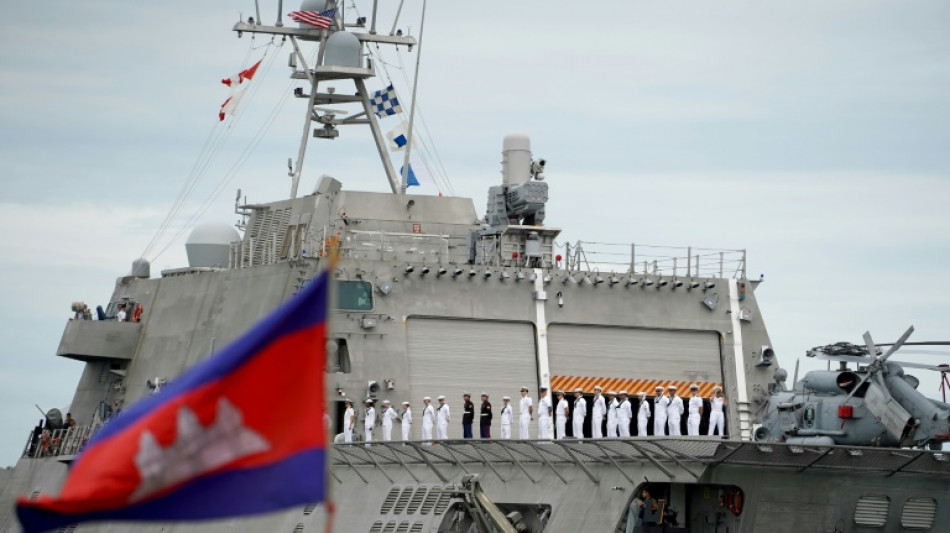
US, Chinese ships at Cambodia bases as Washington navigates diplomatic currents / Photo: © AFP

 Belgium raids illicit cigarette factory in push to stub out growing trade

 Vuelta debutant Brennan claims fifth victory on stage 17
 US had warmest summer on record: climate agency

 Meta tests fact-check replacement in Latin America

 Soviet brutality, ideology backdrop of controversial Venice film

 McIlroy predicts player exodus after LIV files for bankruptcy protection

 Global Multi-Asset Broker FP Markets Secures UAE CMA Category 5 Licence

 Brent oil passes $100 on Mideast flare-up, stoking inflation worries

 'Nothing left': thousands in Yemen flee deadly Houthi clashes
 Spain endured hottest summer on record: weather agency

 'A celebration': Amsterdam museum unveils Kusama show weeks after death

 IC Markets Australia Wins People's Choice Forex Broker Innovation Award at the 2026 Finder Innovation Awards
 Brent oil tops $100 on Mideast flare-up, fanning inflation fears

 EU wants to edge out China in public contracts

 Google unveils 13 bn euro AI expansion in Finland

 Singapore's hefty ministerial pay hikes draw mixed feelings

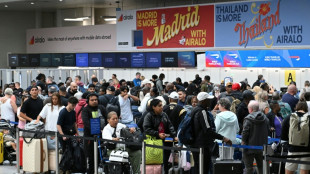 Cyberattack ruled out in UK air traffic glitch as more flights axed

 Ekiden Launches Canton Network’s First Order Book-Based Derivatives Exchange

 Germany's Merz accuses AfD of promoting 'ethnic cleansing'
 Japanese director Kore-eda's manga film charms critics in Venice

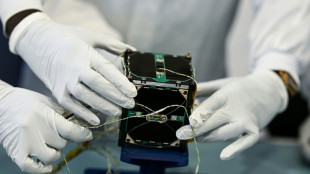 As African space race heats up, Senegal pursues homemade satellites

 UK's little-known Bayeux Tapestry replica steps into spotlight
 Shelton stuns Alcaraz in 3:34 am US Open finish, Sabalenka battles on

 Alcaraz falls to Shelton in epic latest-ever US Open finish
 Tradition Announces Partnership With Affin Moneybrokers to Support Malaysian Market Data

When a US warship docked in Cambodia this week, it moored just a few kilometres from a base where China has built an extended new pier and two of Beijing's own vessels have been berthed for about a year.
The United States has said the Ream naval base could grant China a strategic position in the Gulf of Thailand, near the disputed South China Sea, which Beijing claims almost in its entirety.
Washington is now looking to bolster its relationship with Cambodia, after Phnom Penh scrapped joint military exercises in 2017.
Cambodia has long been one of China's staunchest allies in Southeast Asia, and Beijing has extended its influence over Phnom Penh in recent years.
China's sway has taken its most concrete form at the Ream base -- once partly funded by the United States -- where the new jetty extends 363 metres (1,191 feet) into the Gulf of Thailand.
The two Type-056A Chinese anti-submarine corvettes -- number 630, the Aba, and 631, the Tianmen -- have been stationed alongside it for about 12 months, despite Cambodian leaders' insistence that the base is not for use by any foreign power.
The jetty and the ships symbolise Beijing's interests in Cambodia, which analysts say Washington is looking to counter with the port call by the USS Savannah.
- China's reach -
Under President Xi Jinping, the world's second-largest economy has hugely strengthened its military depth and reach.
The Gulf of Thailand lies between the South China Sea -- where Beijing has built artificial islands with military facilities -- and the Indian Ocean, where it has struck multiple infrastructure deals as part of its Belt and Road Initiative.
A Chinese firm acquired a 99-year lease on the Sri Lankan port of Hambantota, and Beijing has other agreements with countries including Pakistan, the Maldives, Bangladesh and Djibouti, where it has a military base.
Even if Cambodia's Ream does not become a formal Chinese base, Beijing's warships could gain preferential access to its facilities for exercises and resupply, said Timothy Heath, a senior international defence researcher at the US-based Rand Corporation think tank.
It is far from the key trade and oil transit route of the Malacca Strait, he noted. But "China could find value in establishing an intelligence collection post at Ream, which they may well seek."
US Defense Secretary Lloyd Austin visited Cambodia in June, and the combat ship USS Savannah docked at the southern port city of Sihanoukville on Monday, about 30 kilometres from the Ream base and the 1,500-tonne grey Chinese corvettes.
Ali Wyne, a researcher and adviser from International Crisis Group, told AFP the US visit "is part of Washington's effort to repair defence ties with Phnom Penh".
- 'China's little puppet' -
Analysts say Cambodia is now looking to reduce its reliance on China and develop other relationships.
The US warship's port call could be a "smart strategic move" by Phnom Penh as it sought to "shift global perception from seeing Cambodia as China's little puppet," political analyst Ou Virak told AFP.
China is Cambodia's biggest creditor and has poured billions of dollars into infrastructure investments under former leader Hun Sen.
His son, Hun Manet -- a graduate of the US military academy West Point -- has led Cambodia since 2023, although Hun Sen has retained an influential role in government after nearly four decades of rule.
Cambodia's Chinese-funded projects include a $2 billion expressway between Phnom Penh and Sihanoukville, and the $1.1 billion Siem Reap Angkor International Airport, which opened last year.
They have "helped elevate economic growth", according to Phnom Penh.
But more than half of the Southeast Asian infrastructure projects China has funded in recent years have been cancelled, reduced in scale or were unlikely to proceed, according to a March study by the Australia-based Lowy Institute.
Others in the region and elsewhere were also looking to diversify their foreign policies, Wyne said.
"Both the United States and China should appreciate" that a growing number of countries were pursuing "multialigned foreign policies that cultivate partners other than the world's two foremost powers".
N.Schaad--VB