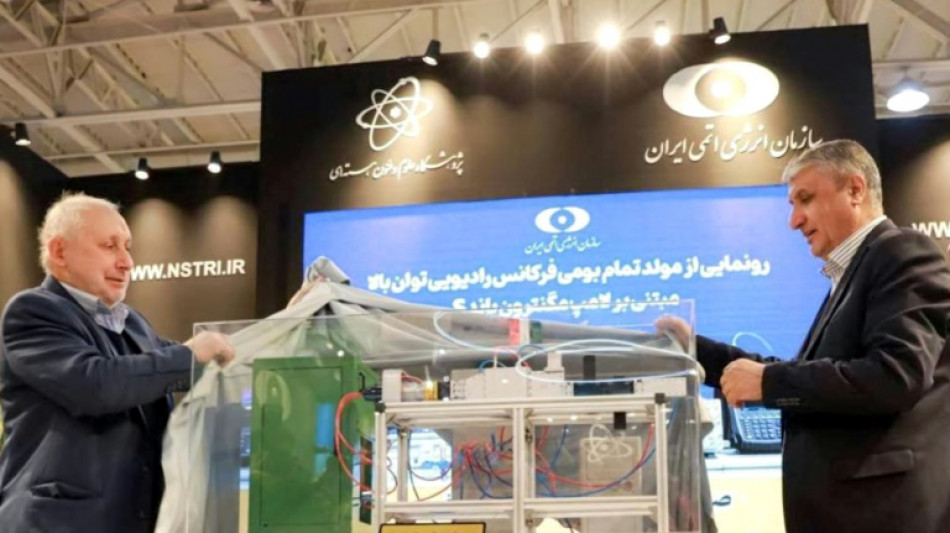
No 'credible civilian' purpose for Iran uranium: UK, France, Germany / Photo: © Atomic Energy Organization of Iran/AFP

 Qatar Airways Launches Bogotá-Caracas-Doha Route Linking Energy Markets

 Marc Almond to Close Soft Cell Era After Final 'Danceteria' Tour

 London Museum Granted 24/7 License Ahead of November Opening

 Dana White Confirms Flight to Washington for Trump Meeting on Press Secretary Role

 Dengue Fever Expands Into High Himalayas as Climate Change Warms Nepal

 IoT Refrigerator Hacks Disrupt Blood Labs and Supermarkets Across Europe and US
Britain, France and Germany accused Iran on Tuesday of growing its stockpile of high enriched uranium to "unprecedented levels" without "any credible civilian justification."
The three countries known as the E3 said in a statement ahead of a UN Security Council meeting on Tehran's nuclear program that Iran must "reverse its nuclear escalation."
Iran has increased its manufacturing of enriched uranium such that it is the only non-nuclear weapons state to possess uranium enriched to 60 percent, the International Atomic Energy Agency (IAEA) nuclear watchdog said.
That level is well on the way to the 90 percent required for an atomic bomb.
"Iran's stockpile of High Enriched Uranium has also reached unprecedented levels, again without any credible civilian justification. It gives Iran the capability to rapidly produce sufficient fissile material for multiple nuclear weapons," the trio said in the statement.
"Iran has ramped up its installation of advanced centrifuges, which is yet another damaging step in Iran's efforts to undermine the nuclear deal that they claim to support."
Last week Berlin, London and Paris raised the prospect of using a mechanism in a landmark 2015 deal on Iran's nuclear program that allows signatories to reimpose sanctions which had been eased.
That deal with Tehran traded sanctions relief for limits on its nuclear program.
It was signed by Iran on one side and France, Germany, Britain, China, Russia and the United States on the other.
But in 2018, then-US president Donald Trump pulled the United States out of the agreement and reimposed US sanctions against Iran.
Iran has retaliated by escalating its production of uranium enriched to 60 percent.
One Western diplomat described Iran as "pretty weakened" by the collapse of former Syrian president Bashar al-Assad's regime, suggesting that might push Tehran to seek a nuclear weapon to strengthen its hand.
"(But) if Iran is weakened they may be more inclined to have talks," they said.
Iran says it has the right to nuclear energy for peaceful purposes and has consistently denied any ambition of developing weapons capability.
K.Hofmann--VB


