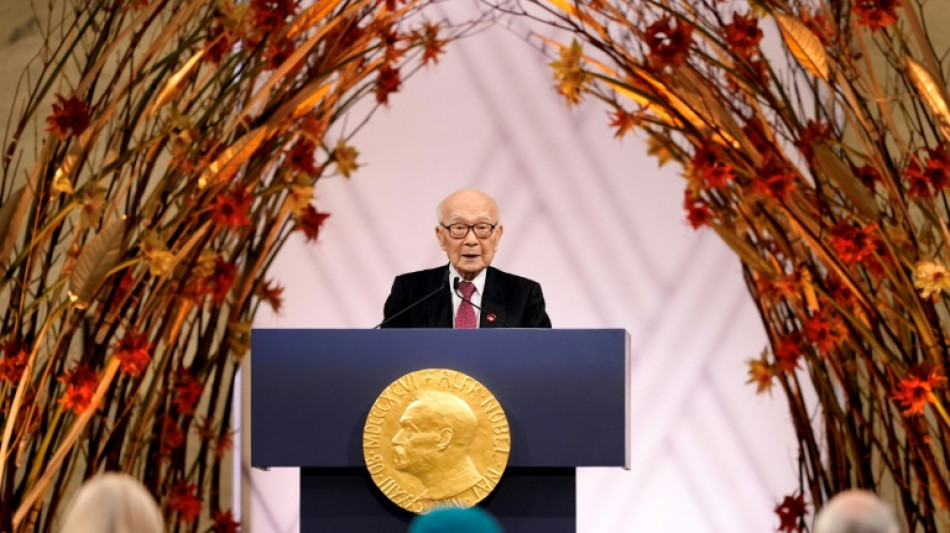
Nobel Peace Prize winner Hidankyo calls for a world without nukes / Photo: © NTB/AFP

 'Bragging rights' up for grabs at game-changing Ultimate Championship, says Coe
 ECB hikes borrowing costs to combat Mideast energy shock
 England turn screw in 3rd Test against Pakistan

 France will not support Infantino in FIFA election: federation chief

 In their words: Israeli forces describe AI-backed Gaza killing in new film
 Yemen's Houthis seize key city on Red Sea: military source
 Oil prices extend gains as markets await ECB rate outlook
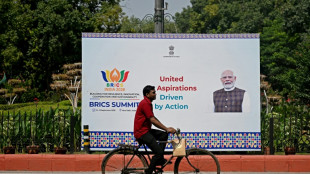 Wars pose a test as India hosts BRICS summit with China, Russia, Iran leaders
 Messi to buy second Spanish lower league club
 Pochettino calls for Chelsea to lose 2016-17 Premier League title
 North Korea leader's daughter believed to have younger sibling: Seoul
 Wars pose a test as India hosts BRICS summit with Russia, Iran leaders

 Alessio Vinassa Unveils an Emerging Technology Investment Approach Shaped by Financial Challenges
 Stocks drop as oil spike fans inflation and interest rate fears
 Portugal harvests grapes at night to beat the heat
 Philippine ferry fire kills 5, dozens missing

 Oil prices flare as Iran tightens grip on Hormuz
 Japan gymnasts under injury cloud for home Asian Games
 India trailblazer won't 'let go' of chance for Asian weightlifting glory
 Zverev cruises past van de Zandschulp into US Open semis
 Myanmar tin mega-mine restarts operations: think tank
 Online and undercover: saving trafficked wildlife in Thailand
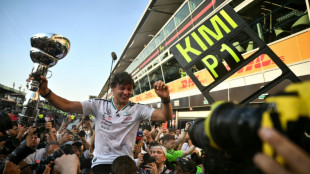 Antonelli faces new challenge after stirring triumph in Monza
 Korda leads US bid to win first away Solheim Cup since 2015
 Eurozone rate-setters to hike borrowing costs as energy prices jump
Japan's atomic bomb survivors' group Nihon Hidankyo accepted its Nobel Peace Prize on Tuesday, urging countries to abolish the weapons resurging as a threat 80 years after the Hiroshima and Nagasaki bombings.
One of the three co-chairs of Nihon Hidankyo who accepted the prize, 92-year-old Nagasaki survivor Terumi Tanaka, demanded "action from governments to achieve" a nuclear-free world.
The prize was presented at a formal ceremony in Oslo's City Hall at a time when countries like Russia -- which has the world's largest nuclear arsenal -- increasingly brandish the atomic threat.
"I am infinitely saddened and angered that the 'nuclear taboo' threatens to be broken," Tanaka told the assembled dignitaries and guests, some clad in traditional Norwegian bunads or Japanese kimonos.
Russian President Vladimir Putin has repeatedly made nuclear threats in a bid to deter the West and prevail in the war in Ukraine, and signed a decree in mid-November lowering the threshold for using atomic weapons.
In a strike on the Ukrainian city of Dnipro a few days later, the Russian army demonstratively fired a new hypersonic missile capable of carrying a nuclear warhead, although in this instance it fired a regular payload instead.
Nihon Hidankyo works tirelessly to rid the planet of the weapons of mass destruction, relying on testimonies from survivors of Hiroshima and Nagasaki, known as "hibakusha".
The US bombings of the two Japanese cities on August 6 and 9, 1945 killed 214,000 people, leading to Japan's surrender and the end of World War II.
- Burnt bodies -
Tanaka was 13 years old when Nagasaki was bombed, the hypocentre just three kilometres (1.8 miles) west of his home. Five members of his family were killed.
He was upstairs reading a book when the A-bomb was dropped.
"I heard the explosion and all of a sudden saw a bright white light, which surrounded everything and everything became silent," he recalled.
"I was really surprised. I felt my life in danger."
Rushing to the ground floor, he lost consciousness when two glass doors, blown out by the detonation, fell on him, though the glass did not break.
"A miracle."
Three days later, he and his mother left in search of their relatives. That was when they realised the scope of the disaster.
"When we reached a ridge over the hills, we could look down over the city and that was when, for the first time, we saw that there was absolutely nothing left. Everything was black and charred."
He saw gravely wounded people fleeing the city, burnt bodies on both sides of the road. He and his mother cremated his aunt's body "with our own hands".
"I was numb, not able to feel anything."
Nihon Hidankyo's ranks are dwindling with every passing year. The Japanese government lists around 106,800 "hibakusha" still alive today. Their average age is 85.
- 'Uphold nuclear taboo' -
For the West, the nuclear threat also comes from North Korea, which has increased its ballistic missile tests, and Iran, which is suspected of developing nuclear weapons though it denies this.
Nine countries now have nuclear weapons: Britain, China, France, India, North Korea, Pakistan, Russia, the United States, and, unofficially, Israel.
"Our movement has undoubtedly played a major role in creating the 'nuclear taboo'," Tanaka said.
"However, there still remain 12,000 nuclear warheads on Earth today, 4,000 of which are operationally deployed, ready for immediate launch."
In 2017, 122 governments negotiated and adopted the historic UN Treaty on the Prohibition of Nuclear Weapons (TPNW), but the text is considered largely symbolic as no nuclear power has signed it.
While all ambassadors stationed in Oslo were invited to Tuesday's ceremony, the only nuclear powers in attendance were Britain, France, India, Pakistan and the United States. Russia, China, Israel and Iran were not present, the Nobel Institute said.
Expressing concern about the world entering "a new, more unstable nuclear age", Norwegian Nobel Committee chairman Jorgen Watne Frydnes warned that "a nuclear war could destroy our civilisation".
"Today's nuclear weapons ... have far greater destructive power than the two bombs used against Japan in 1945. They could kill millions of us in an instant, injure even more, and disrupt the climate catastrophically," he warned.
This year's Nobel prizes in the other disciplines -- medicine, physics, chemistry, literature and economics -- will be awarded at a separate ceremony in Stockholm.
T.Germann--VB