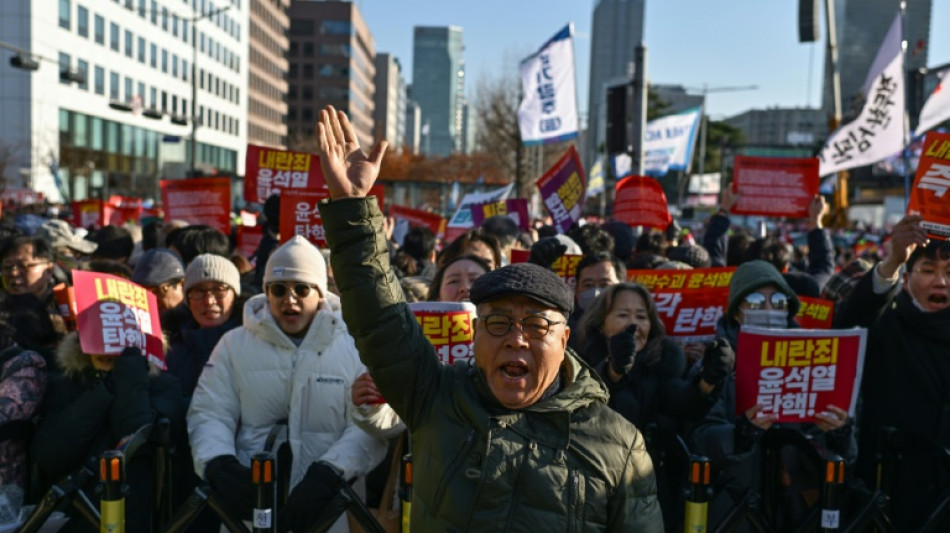
'How dare you': South Korean activist horrified by martial law / Photo: © AFP

 Man United, Bayern cruise as Como make dream Champions League start
 Musiala returns to help Bayern sink Bodo in Champions League

 Surging oil prices, higher bond yields weigh on stocks
 Russell admits he needs luck as Antonelli focuses on the job
 Canada pledges support for Ukraine air defense as Zelensky visits
 Latin America fact-check group asks Meta not to replace verification practice
 Seahawks' Darnold gets good news on hip injury: coach

 Evasive Alonso teases reporters on his F1 future
 What to know about Trump's $5,000 'dividend' pledge
 Leclerc concedes he 'went too far' in Hamilton Monza incident

 Shelton, Tiafoe in spotlight as Zverev aims to build on Grand Slam success

 England close in on Test series sweep against sorry Pakistan

 England dominate sorry Pakistan, close in on Test series sweep

 Kung wins Vuelta time-trial as Mas retains lead

 DR Congo school fire leaves at least 14 children dead

 USA and France ease into women's Basketball World Cup semis

 ECB lifts borrowing costs amid energy shock, opens door for more hikes

 France defeat China to reach women's basketball World Cup semis
 Tribal Launches Campfire, Letting Business and Technical Teams Build on Salesforce Together

 Yemen's Houthis seize key city on Red Sea

 US producer inflation tops expectations as diesel costs jump

 Rubio ends South America swing with Peru security talks

 Defiant Iran seeks to bruise Trump ahead of midterms

 France withdraws support for Infantino in FIFA presidential election

 Evolution Metals & Technologies Provides Initial Revenue Guidance of $400-460mm for Fiscal Year 2027

In 1973, when Shin Jae-hyung was a teenager, he was out in the streets being teargassed, fighting against South Korea's then-military dictator Park Chung-hee. He never thought he would have to do it again in 2024.
But when he heard the country's current president, Yoon Suk Yeol, had declared martial law this week -- the first time democratic South Korea had experienced it in 40 years -- he raced to the National Assembly thinking: "We must stop this."
"I thought we must define this as an act of insurrection," the 66-year-old told AFP at his home in northern Seoul.
Shin was convinced that Yoon, who made the stunning announcement on Tuesday night, "must be punished" for his attempt to drag South Korea back to the dark days.
For years, Shin has fought for democracy and against the successive military-led regimes of the 1970s and 1980s, having endured arrest and torture at the hands of authorities.
After South Korea became a democracy in 1987, with voters directly electing the president, Shin assumed the country's days of martial law were over.
So this week, as soon as he got to the National Assembly -- by that point surrounded by soldiers and police -- he stood on a fence to shout to fellow protesters, determined to help his country.
"I started shouting, 'Arrest Yoon for insurrection!' and kept going for nearly 30 minutes. People around me began chanting after me," he said.
And he made sure the soldiers understood what they had been ordered to do by Yoon.
"I looked each of them in the eye and said: 'Do not join this insurrection' They all avoided my gaze," he told AFP.
- 'Out of your mind' -
This week's events have evoked memories of Shin's younger years, marked by his struggle for democracy and the brutal repression he endured, including being tortured by water board -- a technique where water is poured over a cloth covering the mouth to induce a sensation of drowning.
Still, he takes pride in his past sacrifices, believing that he and countless others helped create democratic South Korea.
But the country he cherishes now seems poised to regress into what he once fought against.
As he drove towards the parliament late Tuesday, he kept thinking that Yoon "must be out of your mind".
"How dare you do this to our country?" he thought.
"You madman, who do you think you are to ruin this country? I'm going to parliament, no matter what."
- Gwangju massacre -
Born and raised in the southwestern city of Gwangju, Shin's first experience with dictatorship came in 1972, when then-president Park amended the constitution to allow himself to rule indefinitely without universal suffrage.
Protests against Park's government defined Shin's high school years and were fuelled by hope for a democratic future.
"We believed we could achieve democracy -- until Chun Doo-hwan came along," he said, referring to Park's successor, who continued authoritarian rule after a coup in 1979.
While serving in the military in 1980 -- it was and remains mandatory -- Shin witnessed the Chun military junta extend martial law nationwide and brutally crush pro-democracy protests in Gwangju, leaving hundreds dead and wounded.
The May 18 Gwangju uprising became a key symbol in South Korea's democratic struggle, and an indelible episode of history -- the subject of Nobel-prize-winning author Han Kang's novel "Human Acts".
But for Shin, it left a deep personal scar. Even 44 years later, recalling the events brings him to tears.
"I lost friends, who were killed, and others who were arrested and later died in prison."
A lingering sense of indebtedness to those who perished for democracy has stayed with him ever since.
"This question of why I was spared, simply because I was in the army at the time... it's weighed heavily on me all these years," Shin said, his voice shaking and tears filling his eyes.
- 'A good death' -
In 1983, Shin was arrested for his pro-democracy activities and interrogated for 10 days at a notorious government site -- which is now a museum on the slopes of Namsan mountain in central Seoul.
"They waterboarded me, demanding I confess to being a communist," he said.
He was released after 10 days and his captors surprised him with an offer.
"They asked me to work for them because I could read and translate several languages, including Spanish and German. They needed someone to translate books on Karl Marx."
Decades after his release and South Korea's transition to democracy, Shin remains determined to prevent the country from reverting to its authoritarian past.
Driving to the National Assembly on Tuesday night, he was ready for the worst-case scenario, he told AFP.
"I thought there wouldn't be killings by martial law troops. But even if there were, and I die from it, I thought it would be a good death."
"This is a country we've spent our entire lives building, a country no random bastard can destroy," he said.
"It will never happen," Shin added, as he prepared to join another mass rally on Sunday, calling for Yoon's impeachment.
J.Sauter--VB