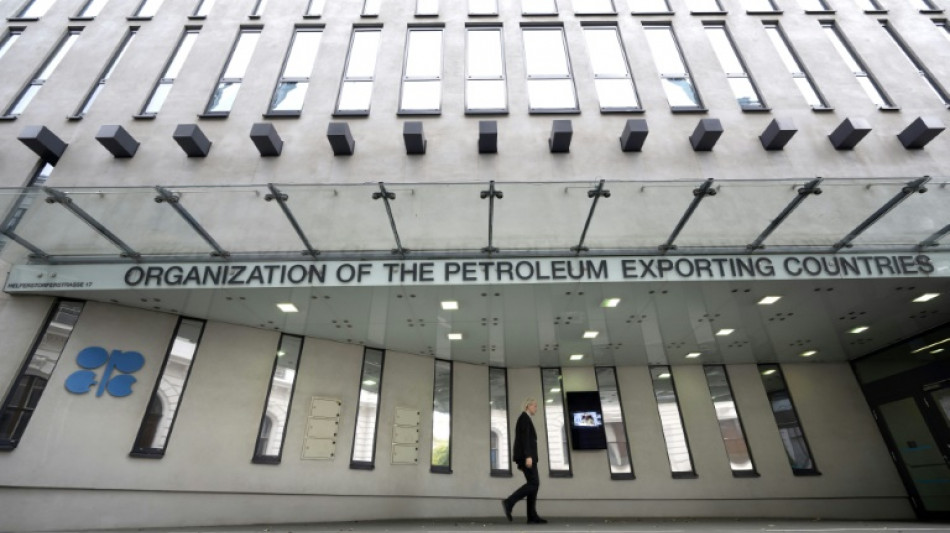
OPEC+ extends oil supply cuts through March / Photo: © AFP/File

 Qatar Airways Launches Bogotá-Caracas-Doha Route Linking Energy Markets

 Marc Almond to Close Soft Cell Era After Final 'Danceteria' Tour

 London Museum Granted 24/7 License Ahead of November Opening

 Dana White Confirms Flight to Washington for Trump Meeting on Press Secretary Role

 Dengue Fever Expands Into High Himalayas as Climate Change Warms Nepal

 IoT Refrigerator Hacks Disrupt Blood Labs and Supermarkets Across Europe and US
Several OPEC+ countries, including Saudi Arabia and Russia, agreed Thursday to extend oil supply cutsfor three months through March to avoid a sharp drop in prices in a global market awash in crude.
The decision had been widely expected, though dissension that caused the meeting to be delayed by a few days had created some doubts that the oil cartel would maintain the cuts.
Eight OPEC+ countries will extend their "voluntary adjustments" of 2.2 million barrels per day until the end of March, the Vienna-based group said in a statement following a virtual meeting.
After that, those cuts "will be gradually phased out" on a monthly basis until the end of September 2026, the group said, adding this is "subject to market conditions".
Without a new agreement, the eight countries were set to begin increasing production beginning in January to gradually return it to 2023 levels.
Algeria, Iraq, Kazakhstan, Kuwait, Oman, Russia, Saudi Arabia and the United Arab Emirates have already twice pushed back the production increases that were set to have begun in October and then in December.
- 'Buys some time' -
The supply cuts are only having a muted impact on the market, with US President-elect Donald Trump expected to adopt policies to boost US oil output while China's demand outlook is lacklustre as its economy languishes.
Thursday's decision "buys the group some time", said David Oxley, chief climate and commodities economist at research group Capital Economics.
"The backdrop of weak global oil demand means that it could easily find itself back in a similar position in three months' time," Oxley said.
"In our view, the fundamentals for oil prices remain weak."
The International Energy Agency said last month that even if the OPEC+ cuts remain place, global supply will exceed demand by more than one million barrels per day next year.
OPEC+ nations are currently holding back six million barrels of oil a day, including the 2.2 million barrels a day of output that they had been discussing putting back on the market.
On Thursday, the cartel decided to extend two other tranches of cuts by one year, until the end of 2026, the group said.
Analysts at DNB bank said before the meeting that "there is no room for additional OPEC+ oil in 2025" on the market and a boost in output would push down crude prices.
That would displease Saudi Arabia, which relies on high oil prices to fund efforts to diversify its economy.
While Saudi Arabia and Russia hold sway in OPEC+, other countries would like to increase production, in particular Kazakhstan and the UAE, and "have a lot of spare capacity", according to Rystad Energy analyst Jorge Leon.
Production limits are only effective if they are respected, and earlier in the year the cartel called out Iraq and Kazakhstan for exceeding their quotas.
In June the UAE won an additional quota of 300,000 barrels per day in 2025, raising tensions with other nations that want to expand output.
H.Weber--VB


