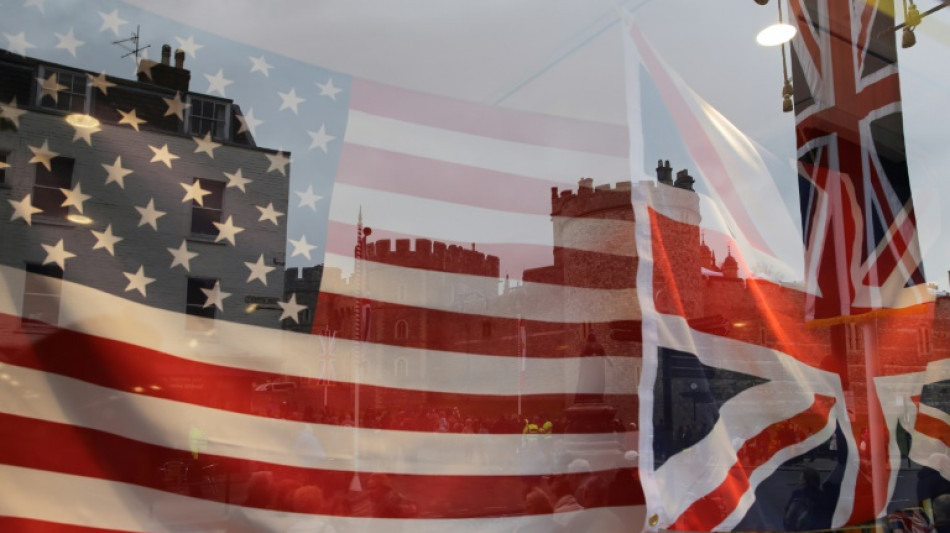
UK faces trade balancing act with Trump, EU / Photo: © AFP/File

 McIlroy hoping for 'home' comforts at Scottish, British Opens

 Noskova aims to emulate Kvitova after reaching first Wimbledon semi

 Britain's Fery becomes first wildcard to reach Wimbledon semis in 25 years

 Korda chases third major as Kim revisits Evian-winning chip

 Kooij wins Tour de France 5th stage in chaotic sprint finish

 Trump says Ukraine can make Patriot missiles

 Teenager arrested after two girls wounded in Germany school attack
 Farage vs Count Binface: hard-right leader's UK poll gambit

 Hong Kong's Robert Wun: the bold Millennial conquering Haute Couture

 IMF cuts 2026 world growth forecast, flags risks from new Mideast fighting
 Kostyuk sets up Wimbledon semi-final against Noskova
 Noskova reaches first Wimbledon semi-final

 Air Canada taps new CEO to replace chief who couldn't speak French

 Istanbul mayor ejected from court in corruption case

 Landslide kills eight at refugee school in Bangladesh

 Cleary leads NSW past Queensland to regain State of Origin crown
 MEXC Adds Nine Ondo Tokenized Stock and ETF Trading Pairs Tied to AI Infrastructure Demand

 Oil prices surge, stocks slide as Trump says Iran ceasefire over

 Sunken wrecks, hot seas threaten fishermen on Italian isle

 Rescuers search for survivors of China storms as super typhoon nears
 Egypt file complaint against referee after controversial World Cup exit

 Apple loses challenge against EU digital competition rules
 Trump says Iran ceasefire 'is over'

 Rescuers search for missing in China storms after 100,000 flee

 OpenAI to launch new model after US freeze
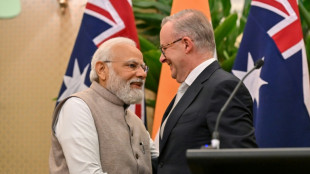
Donald Trump's presidential election victory is fuelling fears that Britain must choose between its "special relationship" with the United States and forging closer ties with the European Union regarding trade.
Prime Minister Keir Starmer insists this is not the case and that Britain can have strong ties with the United States and the EU, its main trading partner despite fallout from Brexit.
"The idea that we must choose between our allies, that somehow we're with either America or Europe is plain wrong. I reject it utterly," Starmer said in a speech Monday that spelled out also the importance of maintaining close relationships with the pair on security.
"The national interest demands that we work with both," he added.
Since Starmer's Labour party won a general election five months ago, the prime minister has set out to repair tensions with the EU after Britain's exit from the bloc and more recently has sought to get close to Trump's team.
- 'Socialism v free enterprise' -
The UK "has to choose between the Europe economic model of more socialism and the US model which is more based on a free enterprise system", Trump advisor Stephen Moore told the BBC last month after the US election.
Moore went on to say that "Britain would be better off moving towards more of the American model of economic freedom and if that were the case, I think it would spur the Trump administration's willingness to do the free trade agreement with the UK".
Britain has needed to negotiate new trade deals following its 2016 referendum vote in favour of departing the European Union.
While it has secured a number of agreements, including with Australia, New Zealand and Singapore, a much sought-after trade deal with the United States remains elusive, while hopes of one with Canada faltered earlier this year.
A major stumbling block for a US deal is reluctance by the UK to open its borders to certain American agricultural products.
Britain and the EU have yet to be included in Trump's pledge to impose hefty tariffs on major trading partners as soon as his first day in office next month.
That has so far been reserved for China, Mexico and Canada, igniting worries about a vast trade war.
- Regulatory choice -
"The UK is going to be put in a position where they're going to have to make some pretty difficult decisions," noted Marco Forgione, director general of the Chartered Institute of Export & International Trade.
The UK must consider whether it chooses "deregulation, which undoubtedly will be the approach of the Trump administration" or "align with the EU which is taking a different route,... more around regulation and compliance, particularly around environmental issues", Forgione told AFP.
"Can the UK play both sides? Yes, but it's incredibly difficult and will take a huge amount of time," he concluded.
Britain's finance minister Rachel Reeves last month announced reforms to the country's financial sector in a bid to grow the nation's economy, including a plan to allow greater risk-taking.
Rather than a broad free-trade agreement with the US, companies see the prospect of sectorial deals between London and Washington.
According to a survey published Sunday, nearly half of Britons want Starmer to prioritise closer economic ties with the EU over a trade deal with Trump's administration.
BMG Research said 49 percent of people polled preferred the EU route compared with 28 percent in favour of a US agreement. The remainder either did not wish to express an opinion or had no preference.
"America will always be important to the UK," Fiorentino Izzo, business development manager at logistics company Cargo Partner, told AFP.
"But our biggest trading partner is the EU. If I have to choose I put Europe before the US."
P.Keller--VB