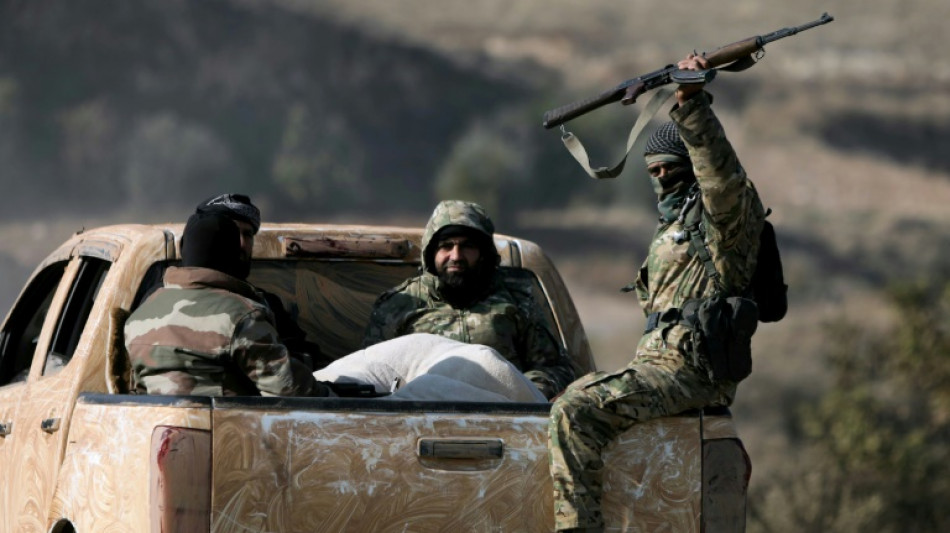
Syrian army launches counteroffensive against rebels / Photo: © AFP

 McIlroy hoping for 'home' comforts at Scottish, British Opens

 Noskova aims to emulate Kvitova after reaching first Wimbledon semi

 Britain's Fery becomes first wildcard to reach Wimbledon semis in 25 years

 Korda chases third major as Kim revisits Evian-winning chip

 Kooij wins Tour de France 5th stage in chaotic sprint finish

 Trump says Ukraine can make Patriot missiles

 Teenager arrested after two girls wounded in Germany school attack

 Farage vs Count Binface: hard-right leader's UK poll gambit
 Hong Kong's Robert Wun: the bold Millennial conquering Haute Couture

 IMF cuts 2026 world growth forecast, flags risks from new Mideast fighting

 Kostyuk sets up Wimbledon semi-final against Noskova
 Noskova reaches first Wimbledon semi-final

 Air Canada taps new CEO to replace chief who couldn't speak French
 Istanbul mayor ejected from court in corruption case
 Landslide kills eight at refugee school in Bangladesh
 Cleary leads NSW past Queensland to regain State of Origin crown

 MEXC Adds Nine Ondo Tokenized Stock and ETF Trading Pairs Tied to AI Infrastructure Demand

 Oil prices surge, stocks slide as Trump says Iran ceasefire over
 Sunken wrecks, hot seas threaten fishermen on Italian isle

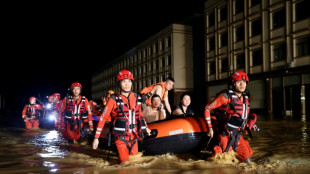 Rescuers search for survivors of China storms as super typhoon nears

 Egypt file complaint against referee after controversial World Cup exit

 Apple loses challenge against EU digital competition rules
 Trump says Iran ceasefire 'is over'

 Rescuers search for missing in China storms after 100,000 flee

 OpenAI to launch new model after US freeze
Syrian government forces launched a counterattack against Islamist-led rebels around the key city of Hama on Wednesday after suffering a string of staggering losses, a war monitor said.
Hama is strategically located in central Syria and for the army, it is key to safeguarding the capital and seat of power Damascus.
The fighting around Hama follows a lightning offensive by the Islamist-led rebels who in a matter of days seized swathes of territory from President Bashar al-Assad's control.
Key in the rebels' successes since the start of the offensive last week has been the takeover of Aleppo, Syria's second city, which in more than a decade of war had never fallen from government hands.
In Aleppo, a medical student told AFP that staff at the hospital where he worked were "largely absent, with departments working at 50 percent capacity".
"We try to tend to emergency cases that come to the hospital, using medical supplies sparingly," he said on condition of anonymity.
While the advancing rebels found little resistance earlier in their offensive, the fighting around Hama has been especially fierce.
The city was the scene of a massacre by the army under Assad's father in the 1980s targeting people accused of loyalty to the banned Muslim Brotherhood.
Decades on, the scars of the massacre that sent thousands of Syrians into exile have yet to heal, and Hama was the site of some of the biggest protests early on in the pro-democracy revolt that erupted in 2011 and sparked the civil war.
By Tuesday, rebel forces had reached the gates of Hama city, according to the Syrian Observatory for Human Rights monitor, as the fighting sparked a wave of displacement.
AFP images showed people fleeing the town of Suran, between Aleppo and Hama, many of them carrying whatever they could take aboard their vehicles.
According to the Britain-based Observatory, "regime forces launched a counterattack" in Hama province on Wednesday with air support on the Hayat Tahrir al-Sham (HTS) rebels and allied factions.
Government forces pushed HTS away from the provincial capital by about 10 kilometres (six miles), the Observatory said, reporting fierce battles as rebels failed in their bid to capture an area near the city.
- 'Nowhere to flee' -
Syrian state news agency SANA also reported the battle around Hama, saying the army was conducting operations against "terrorist organisations" in the north of the province.
Wassim, a 36-year-old delivery driver who lives in Hama city, said that "the sounds were really terrifying, and the continuous bombing could be clearly heard."
"I'll stay home because I have nowhere else to flee to," he said.
While Hama city was a bastion of opposition to Assad's rule early in the war, the province is also home to a sizeable Alawite community, followers of the same offshoot of Shiite Islam as the president.
The rebels launched their offensive on November 27, the very same day that a ceasefire took effect in the war between the Israeli military and Lebanese armed group Hezbollah.
Iran-backed Hezbollah is a key backer of Assad's government and earlier in the war helped prop up his rule.
But it suffered a stunning series of blows in its year-long war with Israel, which began after the group launched cross-border attacks in support of its Palestinian ally Hamas.
During the war in Lebanon, Hezbollah had to pull back some of its fighters from Syria to focus on its home front.
Russia has also been key to keeping Assad in power, directly intervening in Syria's war in 2015, but it too has been mired in its own war in Ukraine.
Russia, Iran and Turkey are in "close contact" over the conflict in Syria, Moscow said Wednesday.
While Russia and Iran both back Assad, Turkey has backed the opposition.
Until last week the war in Syria had been mostly dormant for several years, but analysts have said violence was bound to flare up as it was never truly resolved.
According to the United Nations, 50,000 people have been displaced by the latest fighting since it began last Wednesday.
The Observatory says the violence has killed 602 people, mostly combatants but also 104 civilians.
- 'Spread very thin' -
Since 2011, Syria's war has killed more than 500,000 people and forced millions more to flee their homes.
Many of those who took part in the initial protests that sparked the war are now dead, in jail or living in exile.
"Many policymakers thought, well, Assad won, there is no war," said Rim Turkmani, director of the Syria Conflict Research Programme at the London School of Economics.
But "we've been worrying about this for years, that the fact that there is no intense violence doesn't mean that the conflict is over," she told AFP.
While the rebels may have advanced swiftly, it does not mean they will have the capacity to hold onto the territory they have captured.
Spearheading the rebel alliance is HTS, which is rooted in Syria's Al-Qaeda branch.
"It's very well organised, very ideologically driven," Turkmani said.
"However, they spread very quickly and very thin. And I think very quickly they're going to realise it's beyond their capacity to maintain these areas and, most importantly, to govern them."
K.Sutter--VB