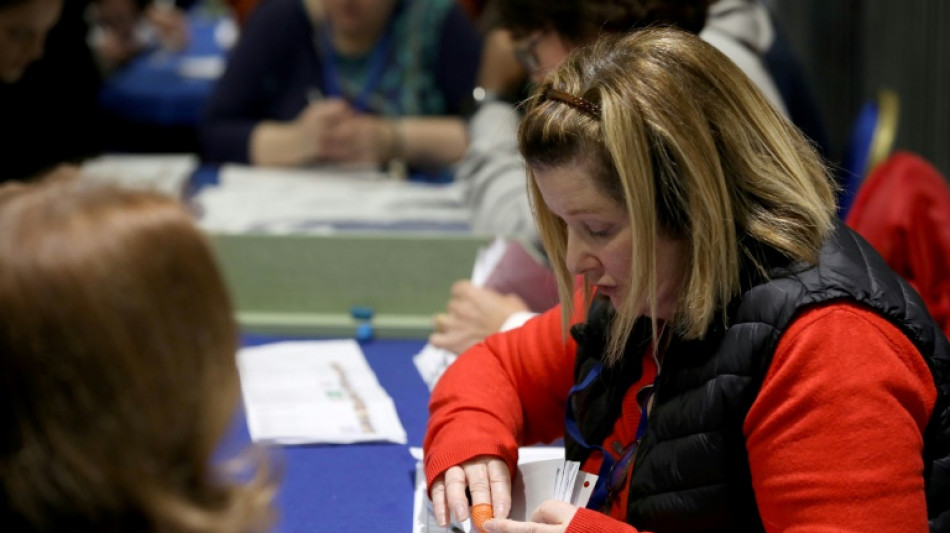
Greens, far-right among big losers in Irish vote / Photo: © AFP

 UN launches appeal for nearly $300 mn in Venezuela quake relief
 US to remove Syria from terror blacklist, in new boost to Sharaa

 Court rejects Trump request to restore his name to Kennedy Center

 MLB pitching great Verlander to retire after 2026 season

 Artificial cloud brightening could tame El Nino, but with risks: study

 Shocked and shaken, Venezuela quake survivors get psychological help

 France, Morocco kick off blockbuster World Cup quarter-finals
 Amorim hails 'ambitious' AC Milan, promises to learn Italian

 Cancer survivor Traeen takes the long road to Tour yellow
 Easing Russian Olympic restrictions 'terrible', says Wimbledon star Kostyuk
 'Unbelievable' Kooij wins Tour de France 5th stage in chaotic sprint finish

 Britain's Fery to face Zverev in Wimbledon semi-finals

 Zverev sees off Fritz to make first Wimbledon semi-final

 Barcelona sets new heat record at 40.7C: weather agencies

 'The Pitt,' 'Hacks' lead Emmy nominations

 France lose appeal against Olise booking at World Cup

 Putellas joins star cast at London City Lionesses
 Oil back at $80, stocks slide as Trump says Iran ceasefire over
 Vast crowds mourn Khamenei in Iraq's holy cities

 Uber Eats, Deliveroo say will give France drivers break when too hot

 Trump tempers fury to end NATO summit on high note

 Oil shoots back up, stocks slide as Trump says Iran ceasefire over

 Kostyuk powers into second straight Slam semi-final at Wimbledon

 Israeli jails a 'graveyard,' says freed Palestinian journalist
 Family of last woman executed in UK wins posthumous pardon
With vote-counting resuming Monday in Ireland's closely-fought general election, the Green Party and far-right candidates are among the biggest losers so far.
The incumbent centre-right parties Fianna Fail and Fine Gael look set to retain power, with 170 of 174 seats in the lower chamber of parliament decided since Friday's vote.
Fianna Fail, on 46 seats, was well ahead of the main opposition, the left-wing nationalist Sinn Fein on 37, with Fine Gael also on 37.
But support for the Green Party -- the third coalition partner of the outgoing government -- collapsed.
And far-right candidates failed to win a single seat.
The Green Party secured just three percent of the vote, down from seven at the last election in 2020 when it joined the coalition.
Its leader Roderic O'Gorman was the only one of 12 Green lawmakers to hold on to a seat, saving the party from a total wipe-out.
Analysts said the Greens were often scapegoated while in power by the big two coalition partners.
The party has "no regrets at all" about entering government in 2020, O'Gorman insisted to reporters Sunday.
But he admitted he was "very nervous" about the future of some of the "distinctly Green" policies introduced during their time in government.
While relatively successful in pushing through climate-friendly policies, the party became widely associated with higher fuel taxes.
As cost-of-living became a key voter concern, its policies became seen as an electoral liability.
"As a small party, the Greens were always in a precarious position," said Eoin O'Malley, a political scientist at Dublin City University.
"They were responsible for many of the more unpopular government policies, while for environmentalists it was blamed for the inevitable compromises that come with government," he said.
"It benefited from being flavour of the month in 2020, but that soft support left it when the party was blamed for increasing energy costs," O'Malley told AFP.
The losses mirror similar defeats for green parties across Europe.
"We've done the things we believe in, there's been a cost but that's politics," said O'Gorman.
"Those issues that focus on climate aren't going away, and as a party, we're not going away either," he said.
The Green Party was almost wiped out in 2011 after serving in government with Fianna Fail.
"Small parties in Irish coalition governments have to sacrifice more of their core policies in the government programme," said political analyst Gail McElroy from Trinity College, Dublin.
"This inability to fulfil their campaign promises leads to electoral penalties at the following election."
- No far-right breakthrough -
The election was also marked by the failure of far-right candidates to enter parliament for the first time.
Ireland is one of the few European Union members without any large established far-right party.
But for the first time, immigration became a prominent issue during this election campaign.
Some 20 percent of Ireland's 5.4-million population is now foreign-born.
Asylum applications have surged to record levels since 2002.
Around 110,000 Ukrainians have also arrived in Ireland since Russia's full-scale invasion in 2022, one of the highest per capita influxes in the EU.
Rising anti-immigration sentiment has sparked protests in working-class and rural communities that have sometimes spilled over into violence.
In June five candidates campaigning on mainly anti-immigration and ultra-conservative platforms were elected to local councils, the first ever far-right representatives in Irish institutions.
But the ultra-nationalist vote was fragmented among a wide range of micro-parties and independent candidates at the general election.
"There were so many anti-immigrant candidates that they split the vote," O'Malley told AFP.
No far-right candidate gained more than four percent of the vote in any constituency.
"So many of the candidates were too extreme, it made it difficult for someone concerned about immigration to vote on that basis," he said.
The issue also dropped in importance for voters in the run-up to the election as the main parties pledged to tighten up migration policy.
In an exit poll Friday, housing and homelessness, cost-of-living and health were all deemed more important than immigration as influencing voter decisions.
Only six percent said immigration was the biggest factor in how they voted.
R.Braegger--VB