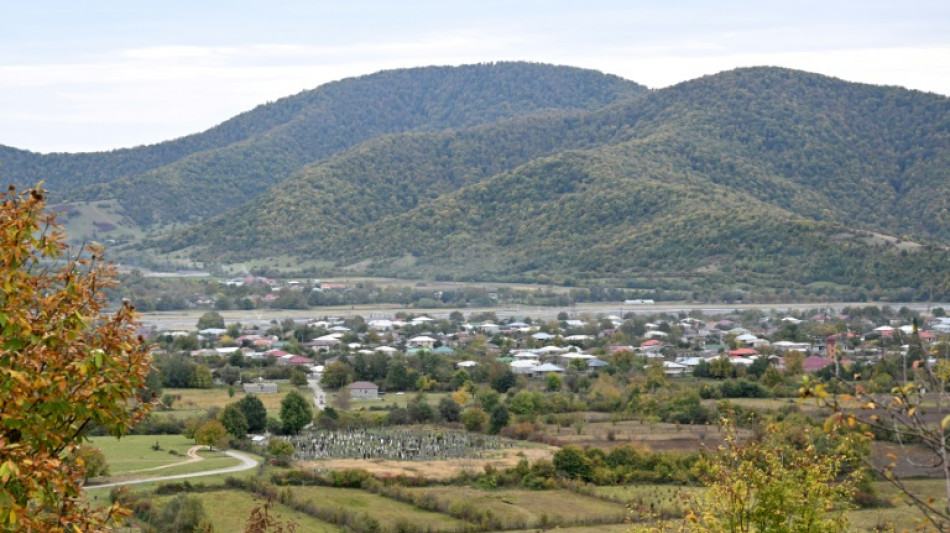
Near Chechnya, tracing the life of a Georgian-Ukrainian soldier / Photo: © AFP

 UN launches appeal for nearly $300 mn in Venezuela quake relief
 US to remove Syria from terror blacklist, in new boost to Sharaa
 Court rejects Trump request to restore his name to Kennedy Center
 MLB pitching great Verlander to retire after 2026 season
 Artificial cloud brightening could tame El Nino, but with risks: study
 Shocked and shaken, Venezuela quake survivors get psychological help
 France, Morocco kick off blockbuster World Cup quarter-finals

 Amorim hails 'ambitious' AC Milan, promises to learn Italian

 Cancer survivor Traeen takes the long road to Tour yellow

 Easing Russian Olympic restrictions 'terrible', says Wimbledon star Kostyuk
 'Unbelievable' Kooij wins Tour de France 5th stage in chaotic sprint finish
 Britain's Fery to face Zverev in Wimbledon semi-finals
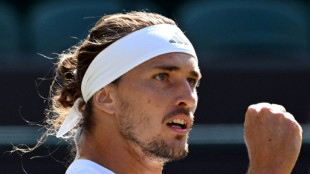 Zverev sees off Fritz to make first Wimbledon semi-final
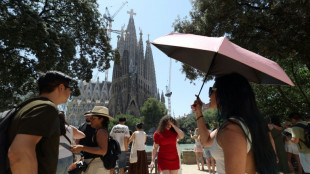 Barcelona sets new heat record at 40.7C: weather agencies

 'The Pitt,' 'Hacks' lead Emmy nominations

 France lose appeal against Olise booking at World Cup
 Putellas joins star cast at London City Lionesses
 Oil back at $80, stocks slide as Trump says Iran ceasefire over
 Vast crowds mourn Khamenei in Iraq's holy cities
 Uber Eats, Deliveroo say will give France drivers break when too hot

 Trump tempers fury to end NATO summit on high note

 Oil shoots back up, stocks slide as Trump says Iran ceasefire over
 Kostyuk powers into second straight Slam semi-final at Wimbledon

 Israeli jails a 'graveyard,' says freed Palestinian journalist
 Family of last woman executed in UK wins posthumous pardon
Baker Sergo Gornakashvili grew up near Georgia's Pankisi Gorge, haunted by echoes of the wars in nearby Chechnya, before trading his apron for a rifle and dying on Ukraine's front line.
His life and death aged 36 reflects Kyiv's battle for survival and the thunder of the 1990s conflicts in the Caucasus -- tremors of the geopolitical upheaval that began with the collapse of the Soviet Union and continued with Moscow's pursuit of its lost glory.
"He witnessed many horrors, but he did not change much. He always remained smiling, kind, and loving," said his younger brother, Dimitri Gornakashvili. "No one could make him repeat a lie."
AFP retraced the man's journey, beginning in the village of Omalo in Georgia's northeastern Pankisi Gorge, predominantly populated by the Muslim Kist minority who migrated from nearby Chechnya in the 19th century.
During the two Chechen wars of 1994–1996 and 1999–2009, the volatile region became a refuge for Islamist Chechen rebels and thousands of civilian refugees who crossed Georgia's porous mountain border to flee the conflict.
In 2004, with support from Washington, the Georgian government expelled Islamist guerrillas from Pankisi, yet by the 2010s, dozens of local Kists had joined the Islamic State group.
- Ancestors -
Hearing a journalist introduce himself in Russian, Tamaz Tsintsalashvili submitted him to a piercing gaze and vice-like handshake as he responded -- half-ironically -- "I hate Russians" in Russian.
The 69-year-old is a larger-than-life figure in the Pankisi Gorge; he claims to have been an oil entrepreneur in Grozny, the Chechen capital, where he endured Russian bombings, as well as a coach for Egypt's youth Greco-Roman wrestling team.
This spring, shortly before he was killed, Sergo Gornakashvili visited Tsintsalashvili, his father's cousin whom he knew since childhood, in Omalo, where he runs a wrestling club.
"When Sergo came with his brother, he asked me to visit the cemetery with him. He went to the graves of his ancestors," said the older man.
"It was as if he was bidding us farewell."
Born in Ukraine to a Kist father and Ukrainian mother, Sergo moved with his two brothers and sister to the Georgian town of Akhmeta and converted to Orthodox Christianity at the age of 20.
- Childhood -
Speaking to AFP in Akhmeta, a town close to the Pankisi Gorge, Sergo's teacher Mzia Sekhniashvili, 68, remembered him as an intelligent, athletic student who made his female classmates' hearts flutter.
Sergo attended school during the chaos that followed the Soviet Union's disintegration, witnessing Georgia ravaged by separatist wars, which Moscow has fuelled in its two regions of South Ossetia and Abkhazia in the early 1990s.
Thousands died and tens of thousands were displaced in the conflicts that saw the central government in Tbilisi lose control over about 20 percent of the country's territory.
In Akhmeta, as elsewhere in Georgia, life was grim at the time: poverty, power outages, and rampant drug addiction, Sekhniashvili said, sitting on a bench in a park as autumn leaves fluttered down around her.
As she showed a black-and-white class photo from 1995 featuring Sergo and a red-bound textbook she had used to teach him Georgian, the woman said she felt his death "like that of a son".
Still, she understood his choice to fight for Kyiv and shared his "deep pain" for Ukrainians.
She also spoke of her "great contempt" for Georgia's ruling party, accused of authoritarian, pro-Russian leanings.
In October, the Georgian Dream party won parliamentary elections, denounced as rigged by the pro-European opposition.
- Mountains -
In 2007, Sergo moved to Ukraine to pursue a professional football career, though he was ultimately unsuccessful, his brother Dmitri said.
On Facebook, Sergo condemned Russia's 2008 invasion of Georgia, its aggression in Ukraine and often posted photos of the Georgian mountains.
In 2021, he opened his own bakery in Kyiv, making Georgian specialities such as khachapuri bread with cheese.
When the Kremlin unleashed an all-out war on Ukraine in 2022, he first took his wife and daughter to Poland, then returned to Ukraine, joined the army, and fought in the gruelling battle of Bakhmut.
A photo from the front shows him with dark circles under his eyes, a dirt-streaked face, and a thick beard. On his uniform, he wore a patch featuring Yoda, the small but mighty master from Star Wars.
In late May 2024, he was killed while fighting in a special unit of Ukraine's military intelligence in the Kharkiv region, then under heavy pressure from Russian forces.
At his funeral in Kyiv, his widow held a four-month-old boy, his third child.
Before his death, he had helped his brother Dimitri, 34, move from Russia to Tbilisi.
"We supported each other," Dimitri said, recalling the happy moments of their childhood: playing football at the stadium, swimming in the river, going to the mountains.
"We often fought," Dimitri said with a smile. "But, as a big brother -- I didn't realise it back then -- he was also fighting to protect me."
F.Stadler--VB