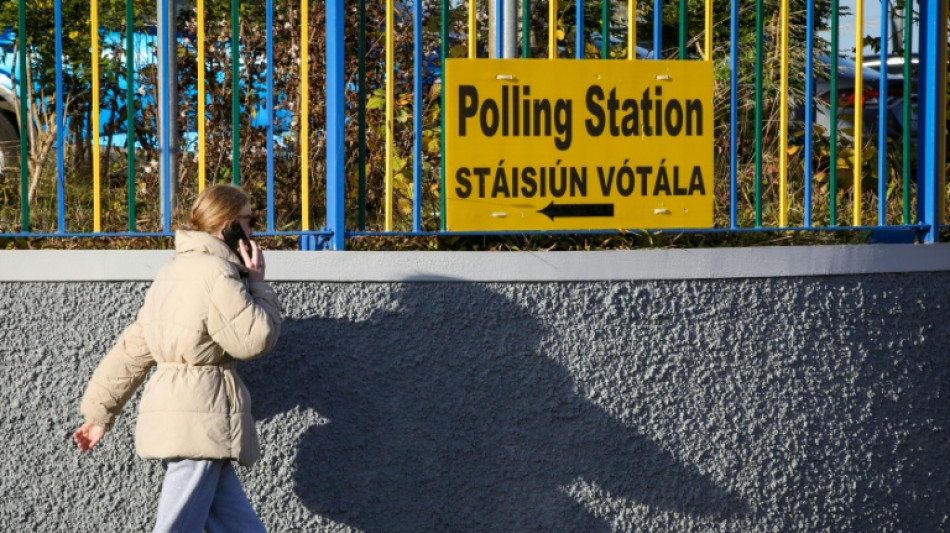
Ireland votes in closely fought general election / Photo: © AFP

 Qatar Airways Launches Bogotá-Caracas-Doha Route Linking Energy Markets

 Marc Almond to Close Soft Cell Era After Final 'Danceteria' Tour

 London Museum Granted 24/7 License Ahead of November Opening

 Dana White Confirms Flight to Washington for Trump Meeting on Press Secretary Role

 Dengue Fever Expands Into High Himalayas as Climate Change Warms Nepal

 IoT Refrigerator Hacks Disrupt Blood Labs and Supermarkets Across Europe and US
Ireland goes to the polls on Friday with the incumbent coalition parties neck-and-neck with opposition party Sinn Fein after a campaign marked by rancour over housing and cost-of-living crises.
Polls open across the country at 0700 GMT and close at 2200 GMT as voters choose new members of the 174-seat lower chamber of parliament, the Dail, in Dublin.
Counting is not due to start until Saturday morning, with partial results expected throughout the day.
A final result, however, may not be clear for days as Ireland's proportional representation system sees votes of eliminated candidates redistributed during multiple rounds of counting.
Final opinion polling put the three main parties -- centre-right Fine Gael and Fianna Fail, and the leftist-nationalist Sinn Fein -- each on around 20 percent.
Fine Gael, whose leader Simon Harris called a snap election earlier this month, held a solid lead entering the campaign.
Harris replaced his predecessor Leo Varadkar in April aged just 37 to become Ireland's youngest ever taoiseach (prime minister).
Now 38, he was credited with re-energising Fine Gael in part due to his social media savvy that earned him the moniker "TikTok Taoiseach".
But the party has lost its advantage after a viral clip of Harris in which he appeared rude and dismissive to a care worker on the campaign trail went viral.
- Status quo? -
At the last general election in 2020, Sinn Fein -- the former political wing of the paramilitary Irish Republican Army -- won the popular vote but could not find willing coalition partners.
That led to weeks of horsetrading, ending up with Fine Gael, which has been in power since 2011, agreeing a deal with Fianna Fail, led by the experienced Micheal Martin, 64.
The role of prime minister rotated between the two party leaders. The smaller Green Party made up the governing coalition.
Harris has had to defend the government's patchy record on tackling a worsening housing crisis and fend off accusations of profligate public spending.
A giveaway budget last month was also aimed at appeasing voters fretting about sky-high housing and childcare costs.
Both centre-right parties stress their pro-business credentials and say returning them to power would ensure stability, particularly with turmoil abroad and the risk of external shocks.
Ireland's economy depends on foreign direct investment and lavish corporate tax returns from mainly US tech and pharma giants.
But threats from incoming US president Donald Trump to slap tariffs on imports and repatriate corporate tax of US firms from countries such as Ireland have caused concern for economic stability.
"The current government is not ideal but they have experience, so are in a better position to address that," Gerard, a 55-year-old university lecturer who did not want to give his last name, told AFP.
- Time for change? -
Gail McElroy, a political scientist at Trinity College Dublin, said "all is still to play for" but a return of the centre-right parties was "a very realistic possibility".
Mary Lou McDonald's Sinn Fein has seen a dip in support because of its progressive stance on social issues and migration policy, as immigration became a key election issue.
But it has rallied on the back of a campaign heavily focused on housing policy and claims it is the only alternative to the Fine Gael and Fianna Fail, who have swapped power since Irish independence from Britain in 1921.
Retail worker Rachel McNamara, 22, said she plans to vote Sinn Fein because the two other mainstream parties have "had time to fix" the housing crisis.
"They only made broken promises," she added.
McNamara still lives with her parents and cannot afford her own place with her boyfriend Adam McGrath, 23. "We've talked about emigration, probably Canada," he said.
Independents from across the political spectrum together poll around 20 percent.
They could play a role in the formation of the next government if Fine Gael and Fianna Fail fall short of an 88-seat majority.
N.Schaad--VB


