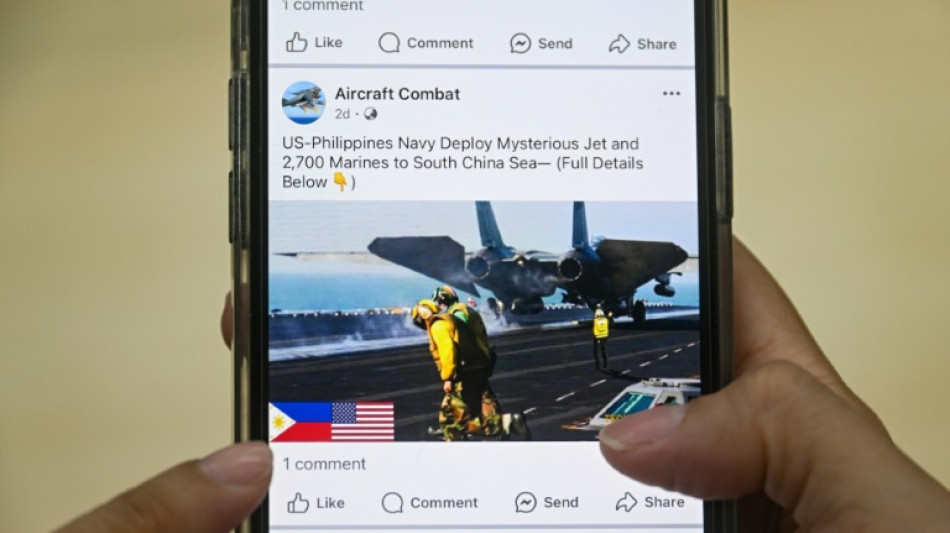
Philippines, China clashes trigger money-making disinformation / Photo: © AFP

 Trump orders new strikes on Iran over attacks on shipping in Hormuz

 PSG's Lee set to join Atletico Madrid
 Iran plays with fire, but calculates Trump will hold back

 Oil surges, stocks slide as Trump says Iran ceasefire over

 Meta to build $9 billion data center in western Canada

 Rogers backs Kane to outshine Haaland in World Cup showdown
 Some US Fed officials considered June rate hike on war fallout

 UN launches appeal for nearly $300 mn in Venezuela quake relief
 US to remove Syria from terror blacklist, in new boost to Sharaa

 Court rejects Trump request to restore his name to Kennedy Center

 MLB pitching great Verlander to retire after 2026 season

 Artificial cloud brightening could tame El Nino, but with risks: study

 Shocked and shaken, Venezuela quake survivors get psychological help

 France, Morocco kick off blockbuster World Cup quarter-finals
 Amorim hails 'ambitious' AC Milan, promises to learn Italian

 Cancer survivor Traeen takes the long road to Tour yellow

 Easing Russian Olympic restrictions 'terrible', says Wimbledon star Kostyuk

 'Unbelievable' Kooij wins Tour de France 5th stage in chaotic sprint finish

 Britain's Fery to face Zverev in Wimbledon semi-finals

 Zverev sees off Fritz to make first Wimbledon semi-final

 Barcelona sets new heat record at 40.7C: weather agencies

 'The Pitt,' 'Hacks' lead Emmy nominations

 France lose appeal against Olise booking at World Cup

 Putellas joins star cast at London City Lionesses

 Oil back at $80, stocks slide as Trump says Iran ceasefire over

Violent confrontations between Chinese and Philippine vessels in the South China Sea are being manipulated online by disinformation networks for profit, posing risks to regional security, an AFP investigation has found.
Since Philippine President Ferdinand Marcos took office in 2022 and began standing up to China over its territorial claims, social media has been awash with posts that often exaggerate the country's defence capabilities or allude to an imminent war in the region.
AFP uncovered a coordinated network of dozens of Facebook and YouTube channels that direct users to a bogus news website that appears to use artificial intelligence (AI) to rapidly churn out unfounded claims for advertising revenue.
Analysts say it is unclear if the network is directly linked to state actors, but the content often mirrors China's position on the dispute.
Together, the network's associated pages and channels have a combined following of more than 10 million people.
Elise Thomas, a senior analyst at London's Institute for Strategic Dialogue think tank, said revenue-making disinformation campaigns have emerged as a "big industry" in Southeast Asia, where labour is relatively cheap.
"It is a horrific business; a lot of it is built around preying on people," she said.
Some of the social media pages and websites claim to be American, but are in fact managed in Asian countries including Indonesia, Thailand, Bangladesh, India and Pakistan.
- 'Bogus news sites' -
AFP found at least 25 Facebook "military interest" pages that misrepresented old photos and videos of army operations to falsely claim that Washington was helping its ally Manila prepare for war.
The posts take users to a bogus news site with a history of publishing fabricated articles and YouTube videos on the South China Sea dispute and the war in Ukraine.
In one, a digitally altered picture of Ukraine soldiers transporting crates falsely suggested that the US was sending Javelin anti-tank missiles to the archipelago.
Some were accidentally published with the headline: "I am a language model AI and cannot perform tasks that require real-time information".
One post debunked by AFP has been shared more than 25,000 times.
It falsely claimed "thousands of American troops" were coming to the aid of the Philippines using a photo of British troops leaving Afghanistan in 2021.
All 25 Facebook pages shared similar posts that linked to the same news website that appeared to be American -- with most of its followers in the US -- but was actually based in the Thai capital Bangkok.
The website, which was flooded with sponsored advertisements, was further linked to dozens of other Facebook sites with a combined following of 7.1 million users.
These other pages promote topics ranging from home design to US celebrities and Catholicism.
- Earn through ads -
AFP tracked down the manager of the Thailand-based network by scouring the registrations of web domains.
Speaking to AFP on condition of anonymity, he said he does "not get paid by an individual" for sharing the posts but earns through ad placements on click-bait content created by a "group of friends".
"We focus on the potential virality that the posts can attract," he told AFP, explaining that each article can generate between $20 and $70, depending on the number of views.
He said the network can rake in as much as $1,100 a month, with about 10 percent of the content related to the South China Sea dispute.
His team does "not have a deep understanding of these issues" and often looks to other news sites for prompts.
"Sometimes it's as simple as copy pasting," he said.
AFP found that each page from the bogus news site carried dozens of ad trackers used to measure views.
Meta, which owns Facebook, declined to comment on the spread of such posts.
AFP, along with more than 90 other fact-checking organisations, is paid by Meta to verify posts that potentially contain false information.
- 'Alarming surge' -
China has for years sought to expand its presence in contested areas of the South China Sea, brushing aside an international ruling that its claim to most of the waterway has no legal basis.
It has built artificial islands armed with missile systems and runways for fighter jets, and deployed vessels that the Philippines says harass its ships and block its fishers.
Philippine military chief General Romeo Brawner issued a warning in June about an "alarming surge in disinformation campaigns" he said were designed to erode public trust "in our institutions and the government".
Brawner did not identify the perpetrators, but he has previously warned of Chinese efforts to influence the Philippine media and local governments.
Experts said that while there is no evidence directly linking the offshore network to Beijing or other state actors, its content mirrors "official Chinese talking points".
"China's longstanding counter-narrative has been that it's actually the US that is destabilising the Asia-Pacific and pushing everyone closer to conflict," said Kenton Thibaut, a senior fellow at Washington's Digital Forensic Research Lab.
Albert Zhang, an analyst at the Australian Strategic Policy Institute, told AFP the behaviour of the network behind the misinformation appears "consistent" with state-sponsored disinformation campaigns outsourced to commercial entities.
"It doesn't really matter whether it's a state actor or someone in their bedroom spreading misinformation to make money," said analyst Thomas. "The impact is the same."
Some Filipinos engaging with the disinformation expressed fear over the possibility of war breaking out.
Facebook user Edison Labasan Tejuco, who shared a false post, told AFP: "The US is fooling the Philippines into going to war with China on its behalf".
M.Vogt--VB