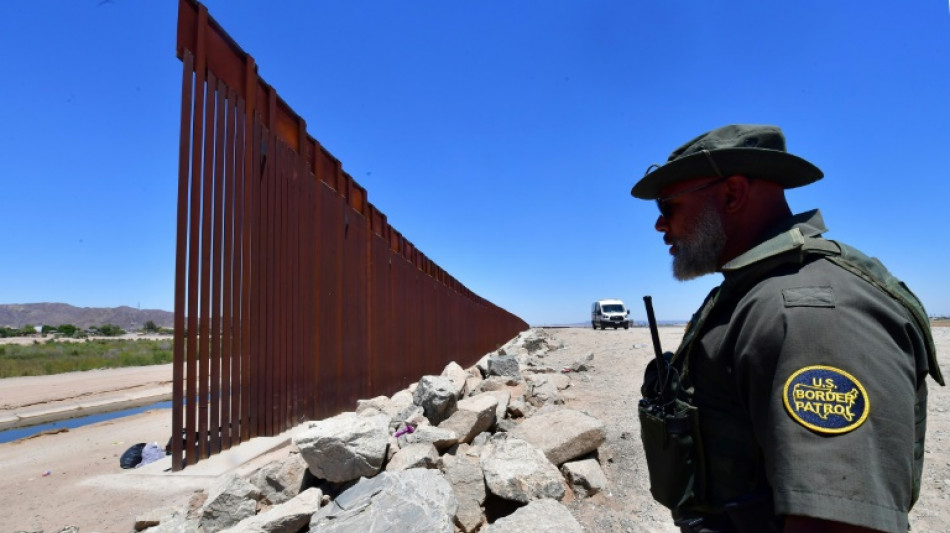
For desperate migrants, hope is in breach at US border wall / Photo: © AFP

 Monaco taken off global money-laundering 'grey list'

 Canada, EU launch new alliance with deals on Ukraine, minerals, AI

 Tears, fear, anger: relatives of Spain train crash dead await fate
 Spurs get Maddison boost ahead of Palace clash

 French authorities fear new street violence at Halloween protests

 Rickelton, Mulder centuries lift South Africa's chances in Test decider

 Maresca adamant Donnarumma can be dropped but first name selected

 EU and Canada to 'withstand shocks together' with new alliance

 Flick praises Yamal 'mentality' after missing out on Ballon d'Or

 Binance heist: How were cryptocurrency billions stolen?

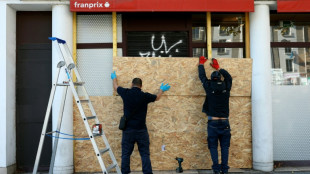 France boards up ahead of Halloween protests

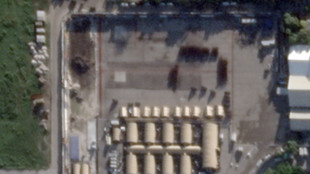 Is Bukele's troop deployment in Haiti just a rescue mission?
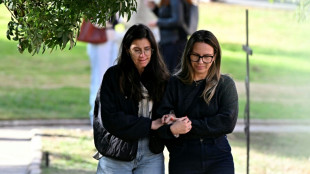 Relatives' anguish grows as Spain identifies train crash dead

 Italy inflation surges to 5.4% as economy stalls

 US jury hands win to Bayer in weedkiller cancer case
 Scotland's Kinghorn hails Toulouse move for enhancing career
 Eala aiming to finish season with bang after Tokyo exit

 Bournemouth boss Rose vows to be patient with Kroupi
 Eurozone growth holds up despite energy crunch

 Thousands of students, workers protest in Italy under heavy security

 New Zealand's Phillips hits sublime century in 87-run win over India

 'Get them there alive': Ukraine's railways under Russian barrage

 Dakar Rally moved to Portugal and Morocco following Houthi attacks in Gulf

 German economy logs 0.2% growth, faster than expected
 Crypto platform Binance confirms 'complex' $6.3 bn hack

Gladys Martinez's voice is almost lost in the crackling midday heat of Arizona as she steps onto US soil.
"We come seeking asylum," she whispers as she thrusts forward pictures she says show her murdered daughter.
Martinez, a Honduran, is one of dozens of people who arrive daily in Yuma, a small city on the Mexican border where there are gaps in the wall that separate the two countries.
She has travelled more than 4,000 kilometers (2500 miles), some of it on foot, from her native Colon, fleeing violence and poverty, desperately hoping she will be given sanctuary in the world's wealthiest country.
She has nothing but the clothes she stands up in and some documents in a small backpack.
"Here are the papers, look! look!" she says, pointing to some grisly photographs that show the lifeless face of a young woman.
"They killed my daughter, they choked her to death with a pillow and a bag," she sobs.
- Wall -
The wall that separates the United States from Mexico crosses dunes and hills as it snakes its way from the Gulf of Mexico to the Pacific Ocean.
Despite the promises of politicians, it is not solid or insurmountable.
In some places it is 30 feet (nine meters) high, but desperate migrants still climb it.
Some of them fall. Some die.
In other places, like in Yuma, there are gaps large enough just to walk through.
US border officers say -- off the record -- a gate should have been built here to allow for official access but work was halted when President Joe Biden took office.
Most of the people who arrive at the wall have come from Central or Southern America.
Many fly to Mexico or Nicaragua and then continue overland, often paying a coyote -- a human trafficker -- to get them there.
The stories they tell of their journeys are all different, but all contain the same phrase: "It is very painful".
- 'We don't like questions' -
On the Mexican side, a few meters from the opening, hardscrabble plants cling to life in shifting sand as the hot desert sun beats down.
Every few minutes, vehicles pull up on the roadside, and migrants spill out, most just carrying a small backpack.
They are guided through the blistering landscape by men and women who melt away as they near the wall.
"Everyone has their own routes here, and no one likes it when one gets in the way of the other," says one man who has paused in the shade of a tree.
He and his companion say vaguely they work in "commerce", but the conversation gets gradually less friendly as it becomes clear they are talking to a reporter.
"We don't like people asking questions here," the older man says.
"If I ask him to make you disappear, he makes you disappear," he says, pointing to his snarling younger colleague.
- 'Mommy, I want to go' -
Back on the US side, border patrol officers offer water to the thirsty migrants, a moment of humanity for people who have seen little of it for weeks or months.
Miguel, from Peru, arrived with his daughters and his wife, who was bleeding from a head wound.
"Someone threw a rock at her, this is her blood," he says, pointing to the bright red stain on her t-shirt as paramedics tend to the injury.
"Mommy, I want to go," cries a young daughter, as she hugs one of the huge steel bars that make up the wall.
"They probably got in someone's way," says a police officer, who asks not to be identified because he is not authorized to speak to the media.
On the ground nearby lie discarded pieces of clothing, half-eaten packets of cookies, plastic bottles, torn airline tickets and scraps of paper with phone numbers for people identified only as "gringo (foreigner) whatsapp" or "cousin Luis."
"Those who are not discovered by the border patrol leave everything they can to continue traveling as light as possible," says the same officer.
Under a health rule imposed by then-president Donald Trump in March 2020, border patrol officers can ignore an application for asylum.
Title 42 allows for the immediate expulsion of anyone not holding a valid visa.
The rule, ostensibly instituted to prevent people with Covid-19 from getting into the country, was supposed to lapse on Monday, but on Friday a judge ruled that it should persist.
For Carlos Escalante Barrera, a 38-year-old Honduran who arrived with his family, the reasons and the rules are unimportant.
"What we want is security," he says.
Border patrol agents don't look at the pictures and the documents he offers.
Instead, they show him the way to a van that will take him for processing and likely expulsion.
A few hundred meters away on the Mexican side of the border, more car loads of migrants are already arriving.
H.Seidel--BTB