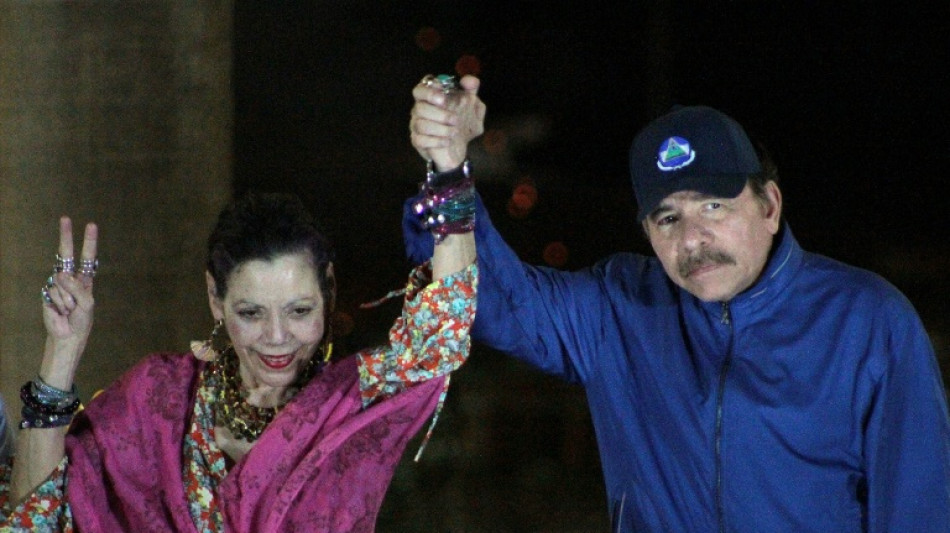
Nicaragua OKs reform to boost powers of president, wife / Photo: © AFP/File

 Bezzecchi takes pole for San Marino MotoGP
 China, Russia, Iran leaders gather in India as BRICS nations seek common ground

 Korda finally beaten as Europe grasp slender Solheim lead

 Zelensky says willing to meet Putin at G20 in Miami: interview

 Quebec Brokerage Qubit Insurance Announces New Data on Coverage Shortfalls as Rebuilding Costs Rise

 Trump asks Smithsonian to install George Washington statues, exhibition

 'A legend': Celine Dion poised for emotional comeback in Paris

 Europe eyes battle over 'pervert' AI glasses

 Philippine Muslim enclave trades bullets for election ballots

 Children in flood-hit Nepal grapple with loss, cling to hope

 Bhutan business bets on hazelnuts for farming future

 First bodies of Philippines ferry fire victims land as toll hits 35

 Gaza film, Malkovich drama vie for Venice top prize

 DR Congo school fire stampede death toll rises to 26: UNICEF

 Coastal erosion forces cancellation of California music festival

 Anthropic says UAE-linked AI op targeted UN experts over Sudan

 Rennes beat Marseille to seize top spot in Ligue 1

 Duplantis delivers masterclass for Ultimate pole vault win

 Weapons, spyware and AI scams: Anthropic exposes Claude misuse

 Gary Oldman hopes Jack Lowden is the new James Bond

 Six-stop race is best on tyre-shredding Madrid track says Russell

 Prosecutors seek up to 10 years prison over violent burglary of Donnarumma

 Solheim Cup on a knife-edge after Korda record

 Corruption probe targets Brazil presidential candidate Flavio Bolsonaro

 New No.1 Rybakina out to thwart Sabalenka US Open three-peat bid

Nicaragua's President Daniel Ortega and his wife are set to assume absolute power after loyalist lawmakers Friday approved a constitutional amendment elevating her to the position of "co-president" and boosting the pair's joint control over the state.
Under sanctions for human rights abuses, Ortega himself had proposed the change, which also increases the Central American country's presidential term from five to six years.
Nicaragua's National Assembly is under control of Ortega's ruling FSLN party, and parliament chief Gustavo Porras said Friday the measure was approved "unanimously."
It is all but guaranteed to pass a second reading in January.
Ortega, 79, has engaged in increasingly authoritarian practices, tightening control of all sectors of the state with the aid of his powerful wife, 73-year-old Vice President Rosario Murillo in what critics describe as a nepotistic dictatorship.
The ex-guerrilla had first served as president from 1985 to 1990, returning to power in 2007. Nicaragua has jailed hundreds of opponents, real and perceived, since then.
Ortega's government has targeted critics, shutting down more than 5,000 NGOs since 2018 mass protests in which the United Nations estimates more than 300 people died.
Thousands of Nicaraguans have fled into exile, and the regime is under US and EU sanctions. Most independent and opposition media now operate from abroad.
The constitutional amendment stipulates that "traitors to the homeland" can be stripped of their citizenship, as the Ortega government has already done with hundreds of politicians, journalists, intellectuals and activists, among others perceived as critical.
Ortega and Murillo accuse the Church, journalists and NGOs of having supported an attempted coup d'etat, as they describe the 2018 protests.
The change also allows for stricter control over the media and the Church, so they are not subject to "foreign interests."
And it gives the co-presidents the power to coordinate all "legislative, judicial, electoral, control and supervisory bodies, regional and municipal" -- formerly independent under the constitution.
- Guarantees succession -
Manuel Orozco, a Nicaraguan analyst for the Inter-American Dialogue, told AFP the reform "guarantees the presidential succession" of Murillo and the pair's son, Laureano Ortega.
The Geneva-based UN human rights office (OHCHR) in its annual report on Nicaragua warned in September of a "serious" deterioration in human rights under Ortega.
The report cited violations such as arbitrary arrests of opponents, torture, ill-treatment in detention, increased violence against Indigenous people and attacks on religious freedom.
The revised constitution will define Nicaragua as a "revolutionary" and socialist state and include the red-and-black flag of the FSLN -- a guerrilla group-turned political party that overthrew a US-backed dictator in 1979 -- among its national symbols.
Constitutional law expert Azahalea Solis said this change excludes other political ideologies, while Salvador Marenco, a human rights lawyer exiled in Costa Rica, said it will end political pluralism and the doctrine of separation of powers.
"Everything in the reform is what has actually been happening in Nicaragua: a de facto dictatorship," Dora Maria Tellez, a former comrade in arms of Ortega turned critic, told AFP from exile in the United States.
When it was proposed by Ortega earlier this week, Organization of American States secretary general Luis Almagro described the amendment as "an aberrant form of institutionalizing the marital dictatorship."
He also labeled the initiative an "aggression against the democratic rule of law."
J.Marty--VB