Iran to launch 'advanced centrifuges' in response to IAEA censure / Photo: © AFP

 Bezzecchi takes pole for San Marino MotoGP

 China, Russia, Iran leaders gather in India as BRICS nations seek common ground

 Korda finally beaten as Europe grasp slender Solheim lead

 Zelensky says willing to meet Putin at G20 in Miami: interview

 Quebec Brokerage Qubit Insurance Announces New Data on Coverage Shortfalls as Rebuilding Costs Rise

 Trump asks Smithsonian to install George Washington statues, exhibition

 'A legend': Celine Dion poised for emotional comeback in Paris

 Europe eyes battle over 'pervert' AI glasses

 Philippine Muslim enclave trades bullets for election ballots

 Children in flood-hit Nepal grapple with loss, cling to hope

 Bhutan business bets on hazelnuts for farming future

 First bodies of Philippines ferry fire victims land as toll hits 35

 Gaza film, Malkovich drama vie for Venice top prize

 DR Congo school fire stampede death toll rises to 26: UNICEF

 Coastal erosion forces cancellation of California music festival

 Anthropic says UAE-linked AI op targeted UN experts over Sudan

 Rennes beat Marseille to seize top spot in Ligue 1

 Duplantis delivers masterclass for Ultimate pole vault win

 Weapons, spyware and AI scams: Anthropic exposes Claude misuse

 Gary Oldman hopes Jack Lowden is the new James Bond

 Six-stop race is best on tyre-shredding Madrid track says Russell

 Prosecutors seek up to 10 years prison over violent burglary of Donnarumma

 Solheim Cup on a knife-edge after Korda record

 Corruption probe targets Brazil presidential candidate Flavio Bolsonaro

 New No.1 Rybakina out to thwart Sabalenka US Open three-peat bid

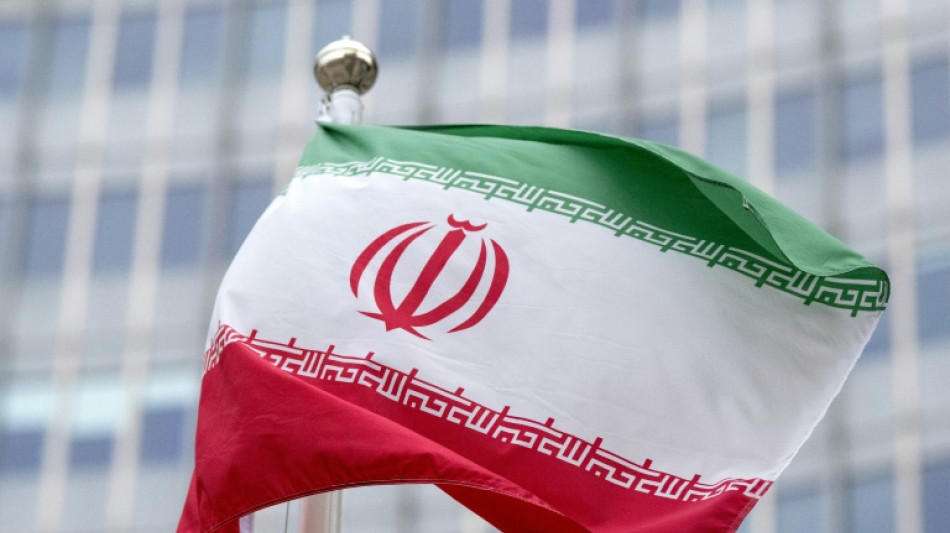
Iran said Friday it would launch a series of "new and advanced" centrifuges in response to a resolution adopted by the UN nuclear watchdog that censures Tehran for what the agency called lack of cooperation.
The censure motion brought by Britain, France, Germany, and the United States at the 35-nation board of the International Atomic Energy Agency (IAEA) follows a similar one in June.
It came as tensions run high over Iran's atomic programme, with critics fearing that Tehran is attempting to develop a nuclear weapon -- a claim the Islamic Republic has repeatedly denied.
The resolution -- which China, Russia and Burkina Faso voted against -- carried with 19 votes in favour, 12 abstentions and Venezuela not participating, two diplomats told AFP.
"The head of the Atomic Energy Organization of Iran issued an order to take effective measures, including launching a significant series of new and advanced centrifuges of various types," a joint statement by the organisation and Iran's foreign ministry said.
Centrifuges are the machines that enrich uranium transformed into gas by rotating it at very high speed, increasing the proportion of fissile isotope material (U-235).
"At the same time, technical and safeguards cooperation with the IAEA will continue, as in the past" and within the framework of agreements made by Iran, the joint Iranian statement added.
Behrouz Kamalvandi, Iran's atomic energy organisation spokesman, on Friday said the new measures are mostly related to uranium enrichment.
"We will substantially increase the enrichment capacity with the utilisation of different types of advanced machines," he told state TV.
Iran's retaliatory measures "are reversible if this (Western) hostile action is withdrawn or negotiations are opened," Tehran-based political analyst Hadi Mohammadi told AFP.
- 'Legal obligations' -
The confidential resolution seen by AFP says it is "essential and urgent" for Iran to "act to fulfil its legal obligations" under the Non-Proliferation Treaty (NPT) ratified in 1970.
The text also calls on Tehran to provide "technically credible explanations" for the presence of uranium particles found at two undeclared locations in Iran.
In addition, Western powers are asking for a "comprehensive report" to be issued by the IAEA on Iran's nuclear efforts "at the latest" by spring 2025.
The resolution comes after the IAEA's head Rafael Grossi returned from a trip to Tehran last week, where he appeared to have made headway.
During the visit, Iran agreed to an IAEA demand to cap its sensitive stock of near weapons-grade uranium enriched up to 60 percent purity.
- 'Cycle of provocation' -
"Iran did not start the cycle of provocation -- the Western side could, without passing a resolution... create the atmosphere for negotiations if it really was after talks," the analyst Mohammadi said.
In 2015, Iran and world powers reached an agreement that saw the easing of international sanctions on Tehran in exchange for curbs on its nuclear programme.
But the United States unilaterally withdrew from the accord in 2018 under then-president Donald Trump and reimposed biting economic sanctions, which prompted Iran to begin rolling back on its own commitments.
On Thursday, Iran's deputy foreign minister for legal and international affairs Kazem Gharibabadi warned of Iran's potential next step.
"Iran had announced in an official letter to European countries that it would withdraw from the NPT if the snapback mechanism was activated, and the Security Council sanctions were reinstated," Gharibabadi said in a late-night interview with state TV.
The 2015 deal contains a "snapback" mechanism that can be triggered in case of "significant non-performance" of commitments by Iran.
This would allow many sanctions to be reimposed.
Tehran has since 2021 decreased its cooperation with the agency by deactivating surveillance devices monitoring the nuclear programme and barring UN inspectors.
At the same time, it has ramped up its nuclear activities, including by increasing its stockpiles of enriched uranium and the level of enrichment to 60 percent.
That level is close, according to the IAEA, to the 90 percent-plus threshold required for a nuclear warhead and substantially higher than the 3.67 percent limit it agreed to in 2015.
C.Kreuzer--VB