Russia's missile 'warning' to Ukraine and West: what we know / Photo: © COME BACK ALIVE/AFP

 Philippine ferry fire death toll climbs to 76 as identification process begins

 BRICS nations urge 'maximum restraint' in Middle East war

 Zelensky open to meeting Putin at G20 in Miami

 England survive scare to seal 3-0 sweep against Pakistan

 Trump says Irish unification would be 'fantastic'

 Bodies of Philippines ferry fire victims brought ashore as toll hits 35

 Flick warns Barca stars to keep focus after perfect start

 Trump in Ireland for golf tournament, diplomatic pleasantries

 French police suspect train derailment was sabotage

 Trump lands in Ireland for golf tournament, PM talks

 Xi lands in India for BRICS summit overshadowed by war

 From crime to the Arctic: ultramarathoner film debuts in Toronto

 Back to the drawing board for disappointed Tiafoe

 Lady Gaga welcomes first child with fiance: US media

 Shelton tops Tiafoe to book US Open title clash with Zverev

 Shelton powers past Tiafoe to book US Open title clash with Zverev

 Venice Film Festival: A look back on the highlights

 'Widow's Bay' and 'The Pitt' are favorites for Emmys night

 'Everything different' as Zverev returns to US Open final

 Top seed Zverev holds off Khachanov to reach US Open final

 James McAvoy brings new film 'Faith' to Toronto fest

 Faultless Duplantis, hungry Ingebrigtsen shine at inaugural Ultimate

 Roblox to launch wallet to pay creators faster and will allow off-platform gaming

 Springboks wary of new-look All Blacks in Baltimore test

 Townsend, Siniakova win US Open doubles for career Grand Slam together

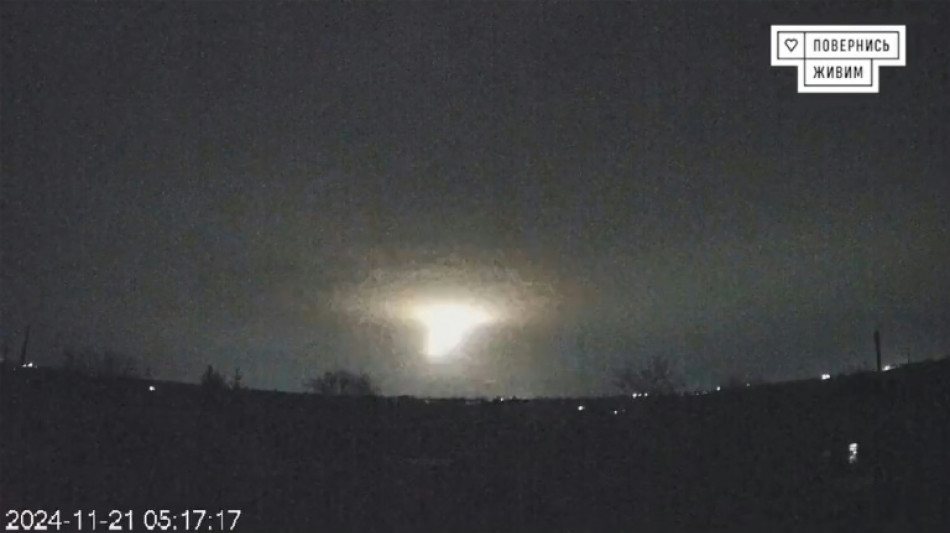
Russia on Thursday fired an experimental missile at Ukraine in a clear warning of its capabilities, officials from Western governments said, even as they pushed back against Ukrainian claims of a more provocative action by Moscow.
Ukraine initially accused Russia of firing an intercontinental ballistic missile (ICBM) in combat for the first time in history.
But a US official, who spoke on condition of anonymity, said Russia had not fired an ICBM but rather an "experimental" medium-range ballistic missile.
In an address late Thursday, President Vladimir Putin confirmed Russia had used a new, experimental "hypersonic" medium-range ballistic missile named "Oreshnik" ("Hazel") in an attack on Dnipro.
In what analysts said was intended as a warning to the countries arming Ukraine, the Russian leader hinted the missile was capable of unleashing a nuclear payload.
- What was fired?
Analysts and the United States pushed back against Kyiv's initial claims that Moscow had launched a nuclear-capable ICBM as part of a barrage towards the central city of Dnipro.
As their name suggests, intercontinental ballistic missiles are capable of striking one continent from another, with a range of at least 5,500 kilometres (3,400 miles).
Intermediate-range missiles by contrast typically have a reach of between 3,000 and 5,500 kilometres -- still long enough to make good on Putin's threat of striking the West.
In his speech, the Kremlin leader said Russia had tested one of its "newest intermediate-range missile systems in combat conditions. In this case, a ballistic missile with a non-nuclear hypersonic configuration."
Kremlin spokesman Dmitri Peskov said Moscow had informed Washington of the missile's launch half an hour before it was fired through an automatic nuclear de-escalation hotline, in remarks cited in state media.
While not naming the missile used or giving technical specifications, the US official said Russia "likely possesses only a handful of these experimental missiles".
"Ukraine has withstood countless attacks from Russia, including from missiles with significantly larger warheads than this weapon," the official said.
In London, a spokesman for British Prime Minister Keir Starmer told reporters that Russia's strike on Ukraine was a "ballistic missile" with "a range of several thousand kilometres", the first time Moscow had used such a weapon in the war.
- What is the context?
Tension has been building between Moscow and Kyiv's allies in the West since Ukrainian forces struck Russian territory with Western-supplied long-range weapons on Tuesday after getting the green light from Washington.
US President Joe Biden gave Ukraine the go-ahead to fire the missiles into Russian territory for the first time while Washington will soon provide Ukraine with antipersonnel land mines to shore up its defences against Russian forces.
On Tuesday, Putin signed a decree lowering the threshold for using nuclear weapons, a move Western powers condemned as "irresponsible".
Biden is moving to boost Ukraine's war effort in the final two months of his administration, before Donald Trump, who has repeatedly promised to end the war quickly, takes power in January.
"The United States will continue to surge security assistance to Ukraine to strengthen capabilities, including air defence, and put Ukraine in the best possible position on the battlefield," the official said.
In London, the British government spokesman said of the Russian strike: "It is another example of reckless behaviour from Russia, which only serves to strengthen our resolve in terms of standing by Ukraine for as long as it takes."
NATO spokesperson Farah Dakhlallah said Russia's use of the missile would "neither change the course of the conflict nor deter" the US-led defence alliance from backing Kyiv.
- What message is Moscow seeking to send?
Despite the initial confusion about the nature of the missile fired, it is clear the strike on Dnipro was unusual and aimed at grabbing the attention of Kyiv and its allies.
"We are really on something unprecedented, and it is much more a political act than a military act. The cost-effectiveness ratio of the attack is zero," said Heloise Fayet, a researcher at the French Institute of International Relations.
"This change of scale is significant," she said, adding this was "the first use by the Russians on the battlefield of a missile with a range greater than 2,000 kilometres".
But she said the use of this missile would "not change the situation significantly on the operational level. They obviously have very few and they are expensive."
Local authorities said an infrastructure facility was hit in Dnipro and two civilians were wounded.
For Nick Brown of British defence analysis organisation Janes, using the missile was "really about sending an escalatory message or warning, an expensive and potentially dangerous way for Russia to rattle its sabre."
According to the US official: "Russia may be seeking to use this capability to try to intimidate Ukraine and its supporters... but it will not be a game changer in this conflict."
D.Schlegel--VB