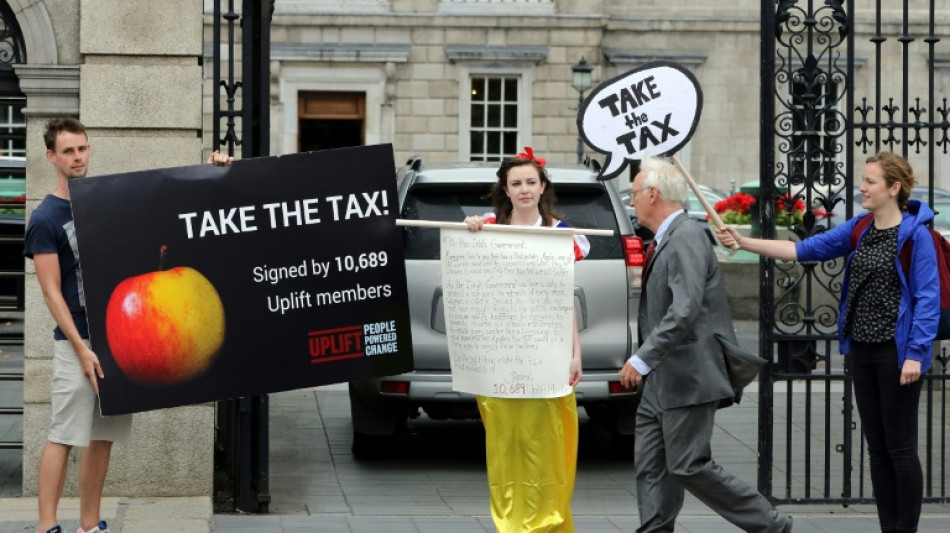
Irish economy faces the test of Trump's protectionism / Photo: © AFP

 Philippine ferry fire death toll climbs to 76 as identification process begins

 BRICS nations urge 'maximum restraint' in Middle East war

 Zelensky open to meeting Putin at G20 in Miami

 England survive scare to seal 3-0 sweep against Pakistan

 Trump says Irish unification would be 'fantastic'

 Bodies of Philippines ferry fire victims brought ashore as toll hits 35

 Flick warns Barca stars to keep focus after perfect start

 Trump in Ireland for golf tournament, diplomatic pleasantries

 French police suspect train derailment was sabotage

 Trump lands in Ireland for golf tournament, PM talks

 Xi lands in India for BRICS summit overshadowed by war

 From crime to the Arctic: ultramarathoner film debuts in Toronto

 Back to the drawing board for disappointed Tiafoe

 Lady Gaga welcomes first child with fiance: US media

 Shelton tops Tiafoe to book US Open title clash with Zverev

 Shelton powers past Tiafoe to book US Open title clash with Zverev

 Venice Film Festival: A look back on the highlights

 'Widow's Bay' and 'The Pitt' are favorites for Emmys night

 'Everything different' as Zverev returns to US Open final

 Top seed Zverev holds off Khachanov to reach US Open final

 James McAvoy brings new film 'Faith' to Toronto fest

 Faultless Duplantis, hungry Ingebrigtsen shine at inaugural Ultimate

 Roblox to launch wallet to pay creators faster and will allow off-platform gaming

 Springboks wary of new-look All Blacks in Baltimore test

 Townsend, Siniakova win US Open doubles for career Grand Slam together

With a general election next week, Ireland and its 5.4 million inhabitants fear finding themselves in the eye of a protectionist storm promised by incoming US president Donald Trump.
Ireland has a budget surplus -- a rarity in the European Union -- as well as record growth, putting its economy in rude health, despite the conflicts in Ukraine and the Middle East that have hit its nearest neighbours.
Its long-standing asset has been a corporate tax rate that has enticed major US tech giants such as Apple, Google and Facebook parent company Meta to set up European headquarters in Dublin.
Much to the annoyance of other capitals in the bloc, they send their European profits to Dublin to pay less tax, in a deal that in turn ensures Ireland billions.
"Corporate tax is a major source of revenues," said economist James Charles Stewart.
But the return of Trump is worrying the Irish.
If he follows through on a promise to lower the US corporate tax rate from 21 percent to Ireland's rate of 15 percent, fears are growing that the tech firms will pack up and head home.
- Don't panic... yet! -
Stewart, from Trinity College Dublin Business School, described the looming Trump presidency as "a matter of concern" but said "not to panic at this stage".
"The big tech companies will need to stay in Europe for their investments in the continent and Ireland is a good country to do that," he told AFP.
The main danger for Ireland's economy could be the 10-20-percent customs duties promised by Trump on imports, said Dan O'Brien, chief economist at the Institute of International and European Affairs in Dublin.
"Ireland per person sells more goods to the United States than any other European country or even Mexico and Canada," he said.
"So Ireland is hugely exposed to protectionism between the United States and Europe, and this is my biggest concern in the short-term for the Irish economy."
As an economic hub in the transatlantic economy, Ireland is particularly vulnerable, even though there has been more talk about "deglobalisation" than action, he added.
- Back-tax billions -
Pharmaceuticals and the agri-food industry are major industries in Ireland and are likely to lobby hard against any hike in US import tariffs.
Unlike other EU countries, Ireland earns more than it spends and expects to generate a budget surplus of 9.7 billion euros ($10.2 billion) by 2025.
Other countries may look on enviously. This year the surplus was 23.7 billion euros, if the 14 billion in undue tax advantages that Apple has to pay are counted, after a years-long saga between Brussels, Dublin and California.
Ireland was reluctant to accept the unexpected windfall and has since decided to place a chunk of it in a fund to finance the increasing health and pension costs of its ageing population.
"My view is that this money should be kept in reserve in case we have an economic shock and that's the time for government to invest when there is too little demand in an economy," said O'Brien.
"Hopefully we won't get to that point but it would better to keep that money and use it to boost demand if we get a fall in demand because of, for example, a transatlantic trade war."
D.Bachmann--VB