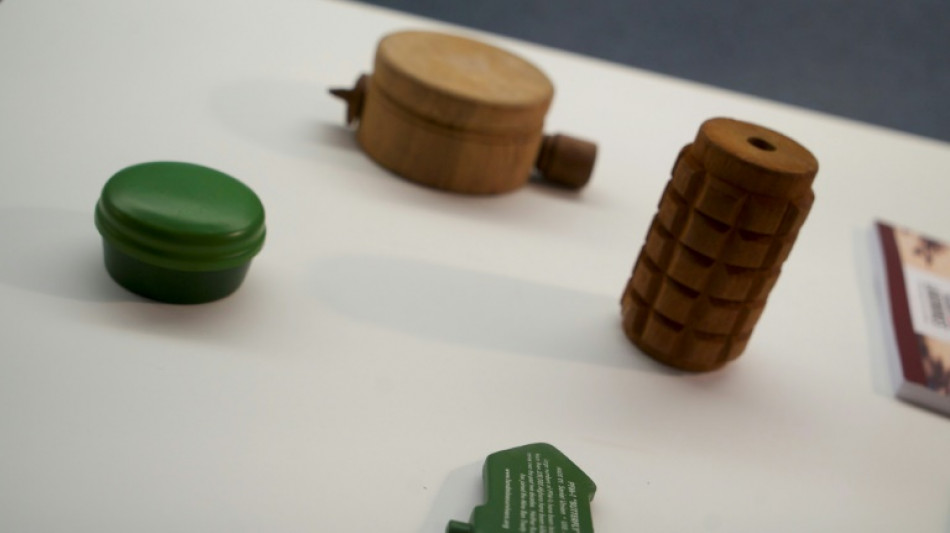
Aid groups express horror at US mines for Ukraine / Photo: © AFP

 Monaco's perfect Ligue 1 start ends with Strasbourg draw

 Ukraine's economy hobbled by Russian strikes

 France sink Germany to reach first women's basketball World Cup final

 Hull hold Chelsea, Liverpool fail to beat Fulham in Premier League

 Nmecha and Silva keep Dortmund perfect in Bundesliga

 Norris snatches thrilling Spanish GP pole from Antonelli

 'Great to have a race at home': Fans celebrate F1's Madrid return

 French IT giant Capgemini sells subsidiary after row over ICE links

 Thousands rally in Kosovo ahead of ex-leader's war crimes verdict

 Zelensky ready to meet Putin at G20 in Miami
 Gaza film, 'irreverent' Malkovich drama vie for Venice top prize

 Fit-again Bumrah needs game time, says India skipper Iyer

 Antonelli fastest again in crash-hit final practice

 From obscurity to smashing sixes: Pakistan's Razaullah rises to stardom

 Bezzecchi takes pole for San Marino MotoGP
 China, Russia, Iran leaders gather in India as BRICS nations seek common ground

 Korda finally beaten as Europe grasp slender Solheim lead

 Zelensky says willing to meet Putin at G20 in Miami: interview

 Quebec Brokerage Qubit Insurance Announces New Data on Coverage Shortfalls as Rebuilding Costs Rise

 Trump asks Smithsonian to install George Washington statues, exhibition

 'A legend': Celine Dion poised for emotional comeback in Paris

 Europe eyes battle over 'pervert' AI glasses

 Philippine Muslim enclave trades bullets for election ballots

 Children in flood-hit Nepal grapple with loss, cling to hope

 Bhutan business bets on hazelnuts for farming future

The US decision to send landmines to Ukraine is "not justifiable", aid groups have told AFP, highlighting the long-term impact on civilians of the internationally banned weapons supposed to help slow Russia's advance.
Antipersonnel mines are designed to be buried or hidden on the ground, exploding when a person approaches or touches them.
The weapons often mutilate victims who are not immediately killed.
Landmines "cannot distinguish between combatants and civilians", said Alma Taslidzan of aid group Handicap International, adding that they remain a danger to groups such as children and farmers for decades.
"In that sense, it's unethical to use landmines," added Taslidzan -- herself originally from Bosnia, where "30 years after the war we still have massive contamination, even though millions of euros have been invested in the country for (mine) clearance".
Some 164 countries and territories including Ukraine have signed the 1997 Mine Ban Treaty, which bars use of anti-personnel landmines and calls for the destruction of stockpiles.
Neither Russia nor the US have ever ratified the text.
- 'Years and decades' -
Moscow's forces have made "extensive" use of anti-personnel mines on Ukrainian territory since their February 2022 invasion, according to a report published Wednesday by the Landmine and Cluster Munition Monitor.
At least 13 different types of anti-personnel mines have been laid by Russian troops, added the Monitor -- a research body of NGO network the International Campaign to Ban Landmines (ICBL).
There is also "credible information" that Ukrainian forces have themselves used mines, it added.
According to the Monitor, at least 580 Ukrainians have been killed or wounded by anti-personnel mines or explosive debris in 2023, ranking it the fourth most affected country worldwide.
With Kyiv's forces on the back foot, those in favour of Ukraine placing its own landmines "may argue that they serve as a defence tool to slow or block invading forces," Handicap International's Taslidzan said.
But "it is not justifiable to use these weapons, landmines, for short-term advantages that will have consequences on civilians years and decades after the conflict," she argued.
The senior US official who announced the mine delivery to Ukraine said they would be "non-persistent" weapons, so called because the mines become inactive or self-destruct after a set period.
"These self-destructing mechanisms or self-deactivating mechanisms are not 100 percent reliable," Taslidzan said.
That means the munitions could explode themselves when civilians or mine clearance workers are nearby, she added.
What's more, the weapons supplied by the US will come from stockpiles that have sat on the shelf for decades, said Mary Wareham of Human Rights Watch.
Washington stopped using anti-personnel mines in 1991, halted exports in 1992 and stopped manufacturing in 1997, Wareham pointed out.
That makes the weapons being delivered in 2024 "obsolete," as "the batteries embedded in the mines deteriorate with age," she argued, asking "How on Earth are these things going to even function correctly?".
- Policy backsliding -
Wareham recalled that Barack Obama's administration forbade any extension or modification to the life of the batteries in the anti-personnel mine stock, which had been set to expire "by the early 2030s".
The Biden administration went further, saying it would not use mines outside the Korean peninsula or develop, produce or export the weapons.
"It's just astonishing that the White House now appears to be walking back its own policy to transfer to Ukraine, which is a member of the treaty banning anti-personnel landmines," Wareham said.
Taslidzan suggested that the delivery could "really weaken the treaty, deteriorate the strong norm that has been set up (and) given an excuse to other states to also violate the treaty".
US military assistance to Ukraine is "much needed" in fighting off Russia's invasion, Wareham acknowledged.
But even if mines could prove effective in preventing Russia gaining ground, "chemical weapons might help, nuclear weapons might help, but we're not going down that road," Wareham added. "There are certain weapons that have been deemed to be unacceptable."
The US decision to supply landmines to Ukraine "is unconscionable and represents a dangerous setback in the global fight against landmines," ICBL chief Tamar Gabelnick said in a statement Wednesday.
She urged "Ukraine to demonstrate its firm commitment to the Mine Ban Treaty by refusing to accept this transfer".
I.Stoeckli--VB