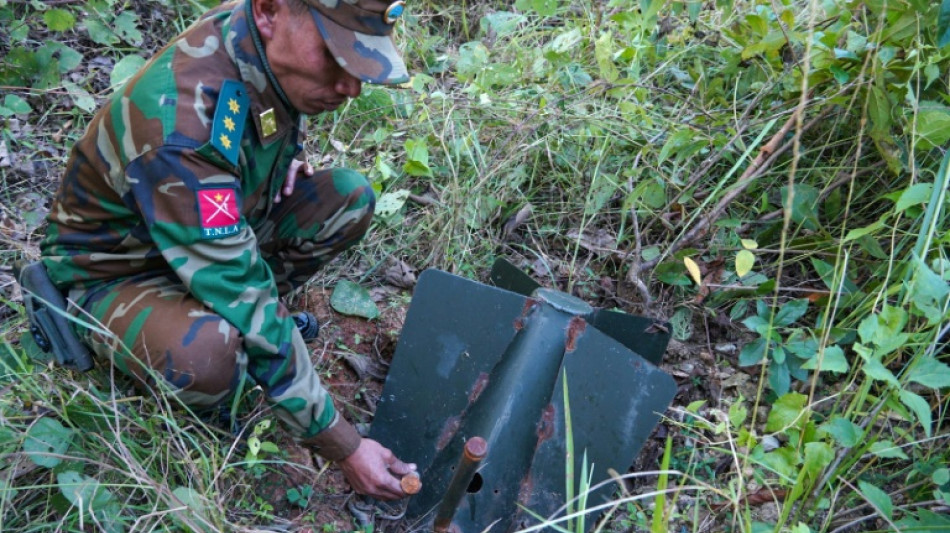
'An inauspicious day': the landmines ruining Myanmar lives / Photo: © AFP

 Harrison, Skupski win US Open men's doubles title

 Verstappen fears overtaking will be 'tough' at Spanish GP

 Argentina revives plan for South Atlantic naval base amid Falklands tensions

 Yemen government forces say hit Houthis in Red Sea city

 Dismal Spurs stay goalless after Everton stalemate

 Fire at nursing home in Chile kills 16

 Frustrated Hamilton urges Ferrari to 'work harder'

 Zelensky ready to meet Putin at Miami G20 but Kremlin refuses

 Anthropic boss calls for AI slowdown, Altman and Musk agree

 England back on track after 'chaos', says Root
 Shelton chases history in US Open title tilt with top seed Zverev

 Norris 'masterpiece' snatches Spanish GP pole from Antonelli

 Mas on brink of Vuelta triumph as Landa claims stage 20

 No Kerr clash as Ingebrigtsen pulls out of Ultimate 1,500m

 Anthropic boss calls for slowing pace of AI development

 BRICS nations call for 'maximum restraint' in Middle East war

 England v Pakistan Test series: Three talking points

 Marquez snatches San Marino MotoGP sprint ahead of Bezzecchi

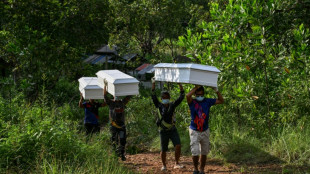 Philippine ferry fire death toll climbs to 76 as identification process begins

 BRICS nations urge 'maximum restraint' in Middle East war

 Zelensky open to meeting Putin at G20 in Miami

 England survive scare to seal 3-0 sweep against Pakistan

 Trump says Irish unification would be 'fantastic'

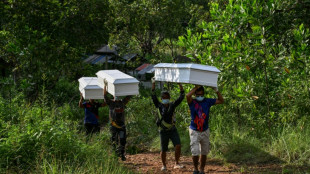 Bodies of Philippines ferry fire victims brought ashore as toll hits 35

 Flick warns Barca stars to keep focus after perfect start

It was an unlucky day in the Burmese calendar, farmer Yar Swe Kyin warned her husband in July, begging him not to go out to check on their crops.
Hours later he was dead, killed by one of the countless landmines laid by both sides in Myanmar's three brutal years of civil war.
In the evening, "I heard an explosion from the field," she told AFP at her home in the hills of northern Shan state.
"I knew he had gone to that area and I was worried."
She had urged her husband to stay home because the traditional Burmese calendar, which is guided by lunar cycles, planetary alignment and other factors, marked it out as inauspicious.
"He didn't listen to me," she said.
"Now, I only have a son and grandchild left."
Decades of sporadic conflict between the military and ethnic rebel groups have left Myanmar littered with deadly landmines.
That conflict has been turbocharged by the junta's 2021 coup, which birthed dozens of newer "People's Defence Forces" now battling to topple the military.
Landmines and other remnants of war claimed more victims in Myanmar than in any other country last year, according to the International Campaign to Ban Landmines (ICBL), with the Southeast Asian country overtaking war-ravaged Syria and Ukraine.
- 'Trees were spinning' -
At least 228 people -- more than four a week -- were killed by the devices and 770 more were wounded in Myanmar in 2023, it said in its latest report Wednesday.
In eastern Kayah state, a short journey to collect rice to feed his wife and children left farmer Hla Han crippled by a landmine, unable to work and fearing for his family's future.
He had returned home after junta troops had moved out from his village and stepped on a mine placed near the entrance to the local church.
"When I woke up I didn't know how I had fallen down and only got my senses back about a minute later," he told AFP.
"When I looked up, the sky and trees were spinning."
Now an amputee, the 52-year-old worries how to support his family of six who are already living precariously amidst Myanmar's civil war.
"After I lost my leg to the land mine, I can't work anymore. I only eat and sleep and sometimes visit friends -- that's all I can do," he said.
"My body is not the same anymore, my thoughts are not the same and I can't do anything I want to... I can eat like others, but I can't work like them."
His daughter Aye Mar said she had begged him not to go back into the village.
"When my father lost his leg, all of our family's hopes were gone," she said.
"I also don't have a job and I can't support him financially. I also feel I'm an irresponsible daughter."
- 'Nothing is the same' -
Myanmar is not a signatory to the United Nations convention that prohibits the use, stockpiling or development of anti-personnel mines.
The ICBL campaign group said there had been a "significant increase" in anti-personnel mine use by the military in recent years, including around infrastructure such as mobile phone towers and energy pipelines.
The church in Kayah state where Hla Han lost his leg is still standing but its facade is studded with bullet wounds.
A green tape runs alongside a nearby rural road, a rudimentary warning that the forest beyond it may be contaminated.
Some villagers had returned to their homes after the latest wave of fighting had moved on, said Aye Mar.
"But I don't dare to go and live in my house right now."
She and her father are just two of the more than three million people the United Nations says have been forced from their homes by fighting since the coup.
"Sometimes I think that it would have been better if one side gave up in the early stage of the war," she said.
But an end to the conflict looks far off, leaving Hla Han trying to come to terms with his fateful step.
"From that instant you are disabled and nothing is the same as before."
O.Schlaepfer--VB