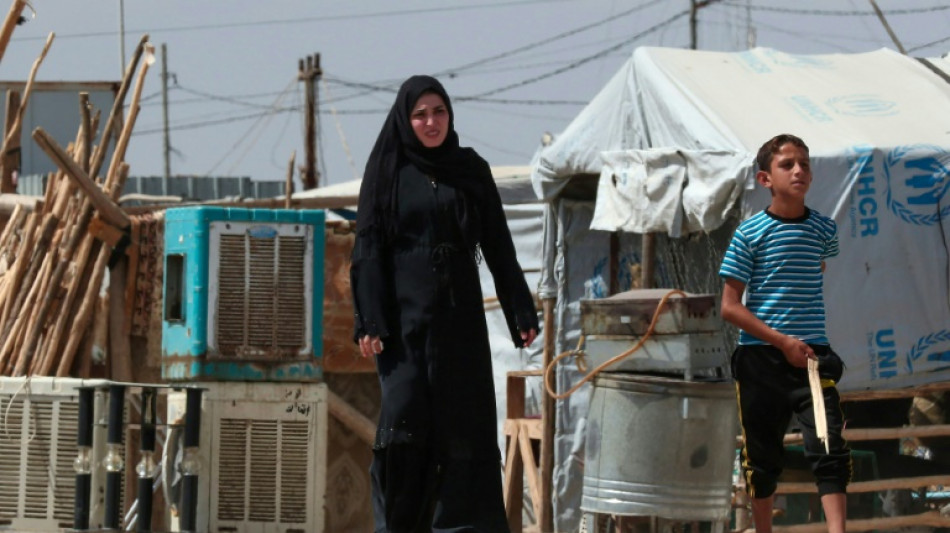
Iraqis face tough homecoming a decade after IS rampage / Photo: © AFP

 Attissogbe double inspires Pau to Top 14 summit

 Guimaraes strike lights up Arsenal win over Sunderland

 Israeli-made Gaza documentary wins Venice special jury prize

 De Zerbi apologises to fans after Spurs' stalemate extends goal drought

 Lowry takes four-shot lead as Trump jets in for Irish Open

 Harrison, Skupski win US Open men's doubles title
 Verstappen fears overtaking will be 'tough' at Spanish GP

 Argentina revives plan for South Atlantic naval base amid Falklands tensions

 Yemen government forces say hit Houthis in Red Sea city

 Dismal Spurs stay goalless after Everton stalemate

 Fire at nursing home in Chile kills 16

 Frustrated Hamilton urges Ferrari to 'work harder'

 Zelensky ready to meet Putin at Miami G20 but Kremlin refuses

 Anthropic boss calls for AI slowdown, Altman and Musk agree

 England back on track after 'chaos', says Root
 Shelton chases history in US Open title tilt with top seed Zverev

 Norris 'masterpiece' snatches Spanish GP pole from Antonelli

 Mas on brink of Vuelta triumph as Landa claims stage 20

 No Kerr clash as Ingebrigtsen pulls out of Ultimate 1,500m

 Anthropic boss calls for slowing pace of AI development

 BRICS nations call for 'maximum restraint' in Middle East war

 England v Pakistan Test series: Three talking points

 Marquez snatches San Marino MotoGP sprint ahead of Bezzecchi
 Philippine ferry fire death toll climbs to 76 as identification process begins

 BRICS nations urge 'maximum restraint' in Middle East war

A decade after Islamic State group extremists rampaged through northern Iraq, Moaz Fadhil and his eight children finally returned to their village after languishing for years in a displacement camp.
Their home, Hassan Shami, is just a stone's throw from the tent city where they had been living, and it still bears the scars of the fight against IS.
The jihadists seized a third of Iraq, ruling their self-declared "caliphate" with an iron fist, before an international coalition wrestled control from them in 2017.
Seven years on, many of the village's homes are still in ruins and lacking essential services, but Fadhil said he felt an "indescribable joy" upon moving back in August.
Iraq -- marred by decades of war and turmoil even before the rise of IS -- is home to more than a million internally displaced people.
Baghdad has been pushing for the closure of the displacement camps, with the country having attained a degree of comparative stability in recent years.
Most of the camps in federal Iraq have now been closed, but around 20 remain in the northern autonomous Kurdistan region, which according to the United Nations house more than 115,000 displaced people.
But for many, actually returning home can be a difficult task.
After getting the green light from Kurdish security forces to leave the camp, Fadhil moved his family into a friend's damaged house because his own is a complete ruin.
- 'Beautiful memories' -
"Water arrives by tanker trucks and there is no electricity," said the 53-year-old.
Although the rubble has been cleared from the structure he now lives in, the cinder block walls and rough concrete floors remain bare.
Across Hassan Shami, half-collapsed houses sit next to concrete buildings under construction by those residents who can afford to rebuild.
Some have installed solar panels to power their new lives.
A small new mosque stands, starkly white, beside an asphalt road.
"I was born here, and before me my father and mother," said Fadhil, an unemployed farmer.
"I have beautiful memories with my children, my parents."
The family survives mainly on the modest income brought in by his eldest son, who works as a day labourer on building sites.
"Every four or five days he works a day" for about $8, said Fadhil.
In an effort to close the camps and facilitate returns, Iraqi authorities are offering families around $3,000 to go back to their places of origin.
To do so, displaced people must also get security clearance -- to ensure they are not wanted for jihadist crimes -- and have their identity papers or property rights in order.
But of the 11,000 displaced people still living in six displacement camps near Hassan Shami, 600 are former prisoners, according to the UN.
They were released after serving up to five years for crimes related to membership of IS.
- Not that simple -
For them, going home can mean further complications.
There's the risk of ostracism by neighbours or tribes for their perceived affiliation with IS atrocities, potential arrest at a checkpoint by federal forces or even a second trial.
Among them is 32-year-old Rashid, who asked that we use a pseudonym because of his previous imprisonment in Kurdistan for belonging to the jihadist group.
He said he hopes the camp next to Hassan Shami does not close.
"I have a certificate of release (from prison), everything is in order... But I can't go back there", he said of federal Iraq.
"If I go back it's 20 years" in jail, he added, worried that he would be tried again in an Iraqi court.
Ali Abbas, spokesperson for Iraq's migration ministry, said that those who committed crimes may indeed face trial after they leave the camps.
"No one can prevent justice from doing its job", he said, claiming that their families would not face repercussions.
The government is working to ensure that families who return have access to basic services, Abbas added.
In recent months, Baghdad has repeatedly tried to set deadlines for Kurdistan to close the camps, even suing leaders of the autonomous region before finally opting for cooperation over coercion.
Imrul Islam of the Norwegian Refugee Council said displacement camps by definition are supposed to be temporary, but warned against their hasty closure.
When people return, "you need schools. You need hospitals. You need roads. And you need working markets that provide opportunities for livelihoods," he said.
Without these, he said, many families who try to resettle in their home towns would end up returning to the camps.
R.Braegger--VB