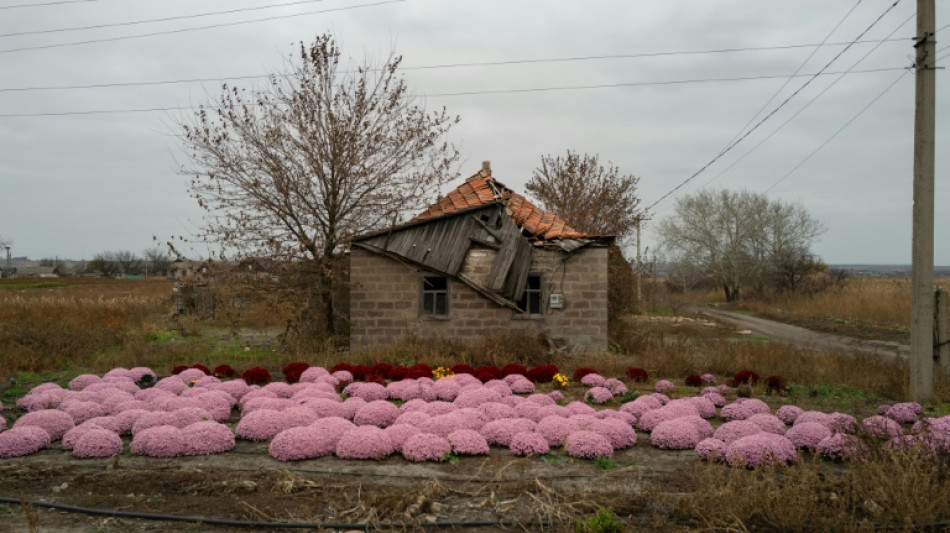
Russian net tightens around last civilians left in eastern Ukraine / Photo: © AFP

 Attissogbe double inspires Pau to Top 14 summit

 Guimaraes strike lights up Arsenal win over Sunderland

 Israeli-made Gaza documentary wins Venice special jury prize

 De Zerbi apologises to fans after Spurs' stalemate extends goal drought

 Lowry takes four-shot lead as Trump jets in for Irish Open

 Harrison, Skupski win US Open men's doubles title
 Verstappen fears overtaking will be 'tough' at Spanish GP

 Argentina revives plan for South Atlantic naval base amid Falklands tensions

 Yemen government forces say hit Houthis in Red Sea city

 Dismal Spurs stay goalless after Everton stalemate

 Fire at nursing home in Chile kills 16

 Frustrated Hamilton urges Ferrari to 'work harder'

 Zelensky ready to meet Putin at Miami G20 but Kremlin refuses

 Anthropic boss calls for AI slowdown, Altman and Musk agree

 England back on track after 'chaos', says Root
 Shelton chases history in US Open title tilt with top seed Zverev

 Norris 'masterpiece' snatches Spanish GP pole from Antonelli

 Mas on brink of Vuelta triumph as Landa claims stage 20

 No Kerr clash as Ingebrigtsen pulls out of Ultimate 1,500m

 Anthropic boss calls for slowing pace of AI development

 BRICS nations call for 'maximum restraint' in Middle East war

 England v Pakistan Test series: Three talking points

 Marquez snatches San Marino MotoGP sprint ahead of Bezzecchi
 Philippine ferry fire death toll climbs to 76 as identification process begins

 BRICS nations urge 'maximum restraint' in Middle East war

Along the road to Kurakhove in eastern Ukraine, ghost houses line the streets, their frames shattered by bombs, with peppers rotting on the vine and flower beds strewn with debris.
The region and its villages are now squeezed by Russian forces advancing from the north, south and east, forcing people to flee again and again.
The Russian army is making steady progress in the area, which includes a major lithium deposit and is located to the south of Pokrovsk, an industrial city and major logistics hub for Ukrainian forces.
It is in this region that Russia has made its biggest advances in recent months, according to an AFP analysis carried out on October 28 using data from the Institute for the Study of War (ISW), a US think-tank.
- 'Save yourself' -
In the nearby town of Andriivka, the shelves in supermarkets are as empty as the villages.
"These are the last loaves of bread, please take them," a store owner said to a customer, one of the few not to have left.
Despite Russian bombs that "fly every day", Anatoliy has stayed to run the last grocery store in the area and help elderly and disabled people from the surrounding villages who have not yet been evacuated.
"Those who have nowhere to go, those who have no money, no relatives," he said.
But when the electricity is finally cut, the 37-year-old grocer plans to join his wife and young child, who have already left, and who "have seen enough in three years of war".
The region's roads are full of minibuses carrying "evacuation" signs, while messages calling for people to flee are repeatedly sent to telephones: "Dear inhabitants of the Donetsk region! Save yourself and your loved ones! Evacuate," they read.
Fedir Gjyvin, 69, does not plan to leave. The little shelter where he seeks refuge during the daily Russian attacks is full of jarred vegetables to get him through the winter.
As for keeping warm, he defiantly says he will go to the nearby mine to get coal.
He admitted he will join his daughter, who lives 400 kilometres (250 miles) to the west, if Russian ground troops arrive.
"But I have time," he insisted, even though Russia has announced it has taken Voznessenka, about 15 kilometres away.
- Trump peace pledge welcomed -
Upstream, one of the reservoirs of the artificial lake of Kurakhove was damaged by Russian fire according to the regional governor, raising fears of flooding.
Although the river has overflowed its banks in places, an AFP reporter did not see any homes affected.
In the town of Dachne, close to the lake and the front line, the facades of the houses are blackened with soot and the sounds of artillery explosions are incessant.
As one local woman, Olga, stood in a deserted street to see a new crater left by yet another Russian shell, she said she wanted to see the "peace in 24 hours" between Ukraine and Russia promised by US President-elect Donald Trump.
"We just want peace, even if it means dealing with the devil," says the 59-year-old teacher whose school is now a pile of ruins.
About 15 kilometres to the west lies the border between the region of Donetsk and Dnipropetrovsk, towards which the Russian army is advancing.
Newly built defensive lines stretch over kilometres.
Each grove is a defensive zone, each field crisscrossed with new trenches, and barbed wire and defensive concrete blocks are springing up everywhere -- all of them raising the fear of even deeper Russian advances.
U.Maertens--VB