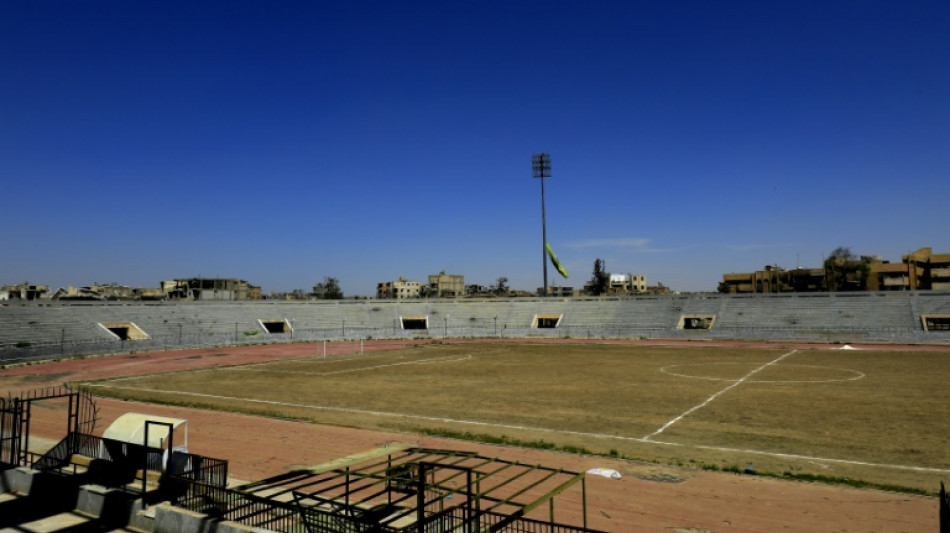
Syrians, Iraqis archive IS jail crimes in virtual museum / Photo: © AFP

 Japan's Okinawa ousts anti-US base governor

 Tech firms hit by AI slowdown call with Fed expected to hike rates
 US hosts G20 'energy abundance' talks amid Iran war shock

 Migrant workers flock to Indian Kashmir despite militant threats
 Incubator shortages, premature births strain Gaza's hospitals

 Canada's Carney seeks closer Europe ties to counter hostile US

 Polls open in Philippine Muslim enclave after deadly shooting

 DC's Kennedy Center faces bankruptcy, closure: media
 Shelton hungry for more Grand Slam chances after US Open disappointment

 Bills edge Texans while Bears beat Panthers in NFL record-setting opener

 Zverev holds off Shelton to win US Open title

 Torres fires PSG to first win of Ligue 1 season

 Toulouse back on track after hammering Bordeaux

 Referee body admits 'error' for Haaland goal in Manchester derby

 Sweden's election too close to call as far right loses ground

 Is it possible to slow down the development of AI?

 Jefferson-Wooden bags searing sprint double, Dos Santos on fire

 'Practical Magic 2' breaks Spidey spell over N. American box office
 Comedian Chris Rock returns to directing with Hollywood drama 'Misty Green'
 Spaniard Mas claims 'special' home Vuelta a Espana triumph
 Jefferson-Wooden, Bednarek claim classy Ultimate sprint doubles

 Britain's Kerr wins men's Ultimate 1,500m

 Luckless Norris wants change in safety car rules

 Spaniard Enric Mas wins home Vuelta a Espana

 Mercedes boss Wolff says long future for 'cucumber cool' Antonelli

After jihadists jailed him in 2014, Iraqi religious scholar Muhammad al-Attar said he would sometimes pull his prison blanket over his head to cry without other detainees noticing.
Islamic State group extremists arrested Attar, then 37, at his perfume shop in Mosul in June 2014 after overrunning the Iraqi city, hoping to convince the respected community leader to join them.
But the former preacher refused to pledge allegiance, and they threw him into prison where he was tortured.
In his group cell of at least 148 detainees at Mosul's Ahdath prison, at times "there was nothing left but to weep", Attar said.
But "I couldn't bear the thought of the younger men seeing me cry. They would have broken down."
So he hid under his blanket.
IS, also called ISIS, seized control of large parts of Syria and neighbouring Iraq and declared a so-called caliphate there in 2014, implementing its brutal interpretation of religion on inhabitants.
The militants banned smoking, mandated beards for men and head-to-toe coverings for women, publicly executed homosexuals and cut off the hands of thieves.
They threw perceived informants or "apostates" into prison or makeshift jails, many of whom never returned.
- 'Messages into the future' -
Attar's story is one of more than 500 testimonies that dozens of journalists, filmmakers and human rights activists in Syria and Iraq have collected since 2017 as part of an online archive called the ISIS Prisons Museum.
The website, which includes virtual visits of former jihadist detention centres and numerous tales about life inside them, became public this month.
The project is holding its first physical exhibition, including virtual reality tours, at the Paris headquarters of UNESCO, the UN's culture and education agency, until November 14.
Syrian journalist Amer Matar, 38, is director of the web-based museum.
"IS abducted my brother in 2013, and we started to look for him," he told AFP.
After US-backed forces started to expel jihadists from parts of Syria and Iraq in 2017, "I and my team got the chance to go inside certain former IS prisons," he said.
They found thousands of prison documents from the group whose caliphate was eventually defeated in 2019, but also detainee scratchings on the walls.
Etched inside the football stadium in the Syrian city of Raqa, for example, the team found prisoner names and Koranic verses, as well as lyrics from a 1996 television drama about peace eventually prevailing.
Inside one solitary cell, they discovered exercise instructions to keep fit in English.
Matar says he was detained twice at the start of the Syrian civil war, in a government jail for covering protests against President Bashar al-Assad.
"I too would write my name on the wall because I didn't know if I'd get out or if they'd kill me," he said.
"People usually write their names, cries for help or stories about someone who was killed," he added.
"They're messages into the future so that people can find someone."
- 'Ask us for evidence' -
Matar and his team decided to film the former prison sites and archive all the material within them before they disappeared.
"Many were homes, clinics, government buildings, schools or shops" that people were returning to and starting to repair, said Matar, who is now based in Germany.
They managed to capture 3D footage of around 50 former IS jails and 30 mass graves before they were transformed, he said.
In total they have documented 100 prison sites, interviewed more than 500 survivors and digitised over 70,000 IS documents.
Younes Qays, a 30-year-old journalist from Mosul, was in charge of data collection in Iraq.
"To hear and see the crimes inflicted on my people was really tough," he said, recounting being particularly shocked by the tale of a woman from the Yazidi minority who was raped 11 times in IS captivity.
Robin Yassin-Kassab, the website's English editor, said the project aimed to "gather information and cross-reference it" so it could be used in court.
"We want legal teams around the world to know that we exist so that they can come and ask us for evidence," he said.
Matar has not found his brother.
But within the coming year, he hopes to launch a sister website called Jawab, "Answer" in Arabic, to help others find out what happened to their loved ones.
L.Stucki--VB