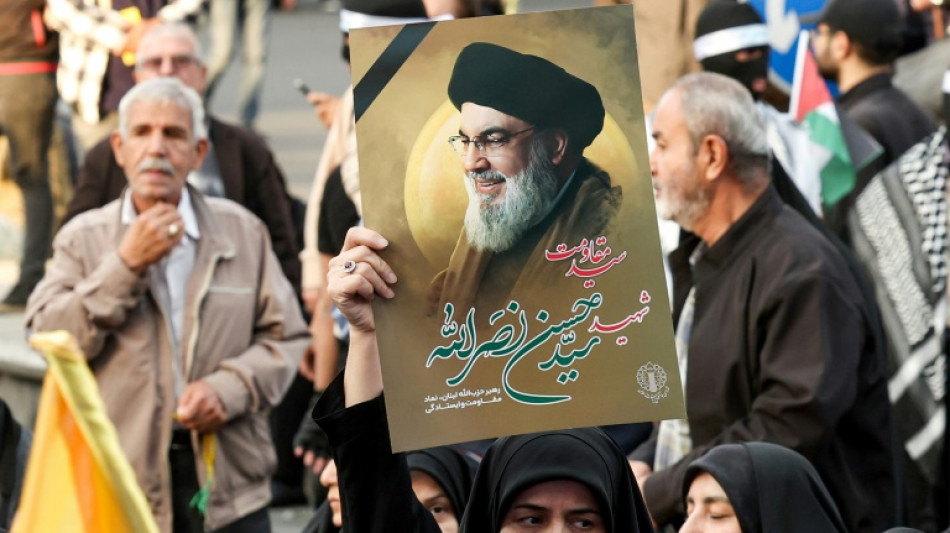
'End of an era' for Hezbollah after Israel's killed its leader / Photo: © AFP

 Trump threatens EU over 'hostile' Canada association plan
 Argentine judge orders suspension of Falklands oil project
 Carrick takes the blame as troubled Man Utd suffer League Cup misery
 Barcelona hit seven in Racing Santander rout
 Amorim's Milan beaten by Benfica, Sunderland make dream European return
 US stocks fall, dollar gains after Fed lifts interest rates
 Seahawks rule out Darnold for Sunday game at Arizona
 Mbappe explains Ceuta shirt stance after criticism

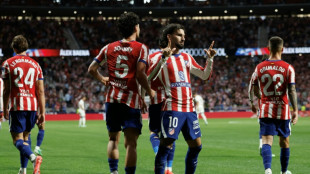 Improving Atletico cruise to comfortable win over Osasuna

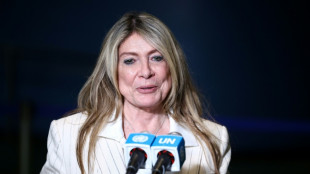 Candidate for UN chief calls for AI regulation akin to nuclear weapons
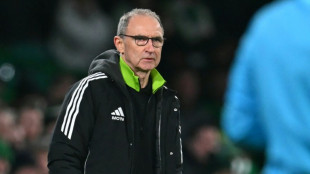 O'Neill expects Celtic recovery after Old Firm misery
 Man City midfield trio backed to emulate Rodri and Silva
 'We're losing control,' AI pioneer Yoshua Bengio tells AFP
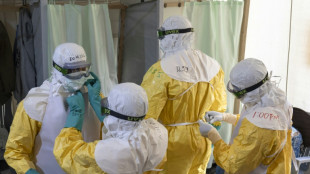 WHO eyes 'encouraging' signs in DRCongo fight against Ebola
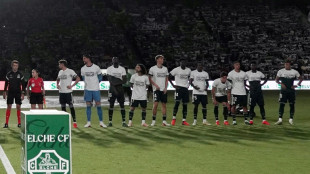 Liga boss criticises Real Madrid trio for Ceuta shirt incident
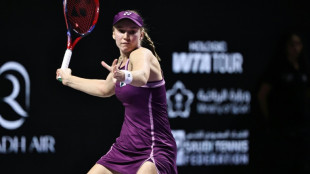 WTA Finals moved to Charlotte from 2027
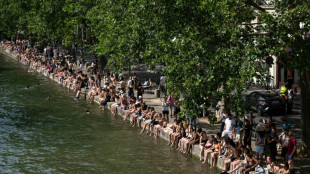 Almost 8,000 excess deaths in France's scorched summer: statistics

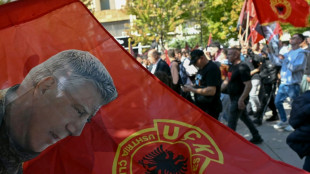 Ex-president's lengthy war crimes sentence shocks Kosovo
 US House faces test on sweeping Russia sanctions bill

 British PM says to make 'difficult decisions' as inflation rises

 TotalEnergies pumps up controversy in France with cut-price gas
 Global fuel price demos: a round-up

 Leverate Launches MCP for Traders to Connect AI Assistants With Trading Platforms

 MEXC Launches $1M "Discover Your Wall Street DNA" Campaign to Help Traders Find Their Market Fit
 Emporio Armani names Dario Vitale new creative director
The killing of Hezbollah's powerful leader Hassan Nasrallah a month ago has marked a fundamental shift for the Iran-backed Lebanese movement and revived calls for it to surrender its vast weapons arsenal.
"The death of Nasrallah marked the end of an era," said analyst Sam Heller of the US-based think tank Century Foundation.
After decades at the helm, Nasrallah's death "will necessarily mark a shift for the organisation", Heller added.
Nasrallah's influence extended far beyond his loyal Shiite Muslim support base in Lebanon.
He was a key pillar in Iran's "axis of resistance" against the United States and Israel, which includes other armed groups in the Middle East as well as Syria.
Israel dealt Hezbollah a seismic blow when it assassinated Nasrallah on September 27 in a huge air strike on Beirut's southern suburbs that has thrust the movement into a new age.
Hezbollah was already mired in a year of cross-border exchanges of fire with Israel, which it began in support of its Palestinian ally Hamas after the October 7, 2023 attack.
Last month, Israel ramped up strikes on Hezbollah strongholds and sent in ground forces while killing one member of the group's top leadership after another.
Nasrallah, who had led the group since 1992, spearheaded operations against Israel for decades, and gained cult status among his supporters during the 2006 war.
According to Heller, "he was the foremost decision-maker in the organisation as it rose to prominence in Lebanon and regionally."
The group's governing Shura Council has yet to appoint a successor.
Hashem Safieddine, a cleric tipped for the post, was killed by Israel just days after Nasrallah.
- Home turf -
Hezbollah is now run by a group of leaders, according to its deputy head Naim Qassem.
Lebanese officials, including Prime Minister Najib Mikati, have said that their contact with the group has been cut off for weeks.
Nabih Berri, Lebanon's parliament speaker who heads the Hezbollah-allied Amal Movement, is tasked with speaking on the group's behalf, Qassem said in a recent speech.
Berri is believed to be pushing for a ceasefire, according to local media reports.
Hezbollah had long linked a ceasefire in Lebanon to an end to fighting in Gaza, a position it has yet to formally reverse.
Even with the group appearing on the back foot, its fighters continue to fire dozens of rockets daily into Israel, some reaching major cities like Haifa and Tel Aviv.
This week, Hezbollah claimed a drone strike on Israeli Prime Minister Benjamin Netanyahu's home in the coastal town of Caesarea.
The group says Israeli forces have not been able to take full control of any village in Lebanon, weeks into a ground invasion.
Israeli forces operating in Lebanon "face very fierce resistance and are forced to retreat under heavy blows", said a source close to Hezbollah.
"The maximum depth the Israelis have reached is estimated at about two kilometres (1.2 miles)," said the source, requesting anonymity to discuss sensitive matters.
Hezbollah, he said, has the advantage because it is fighting on its own terrain, knowing which "trees and rocks" to hide behind.
- 'Disarm' -
Hezbollah is widely believed to be better armed than Lebanon's national military, and remains the only group that did not surrender its weapons after the 1975-1990 civil war.
After years of dominating political life in Lebanon, Hezbollah is facing new calls from its critics within the country to change.
Lebanese computer engineer Elie Jabbour told AFP he believes the only way forward is for Hezbollah to give up its weapons.
"The war cannot end before Hezbollah is disarmed," he said.
"When that happens, it can join state institutions as a political party only," said the 27-year-old.
A ceasefire in Lebanon has been tied to the implementation of a UN resolution that ended the last Israel-Hezbollah war in 2006.
UN Security Council Resolution 1701 states that only the Lebanese army and UN peacekeepers should deploy in areas south of the Litani River -- an area Hezbollah has long operated in.
But Lebanon is grappling with a prolonged crisis, leaving the country rudderless until a president is elected after a two-year void.
Many in Lebanon blame Hezbollah for blocking the vote.
Samir Geagea, leader of the Lebanese Forces party and a longtime Hezbollah opponent, said any new president must not "leave any group or weapon outside the framework of the state".
Prime Minister Najib Mikati said on Thursday that only the state should carry weapons.
But in a country long wracked by division, attempts to "marginalise Hezbollah politically will... invite a violent response" from the group, Heller said.
It "will end in intra-Lebanese conflict," he added.
S.Leonhard--VB