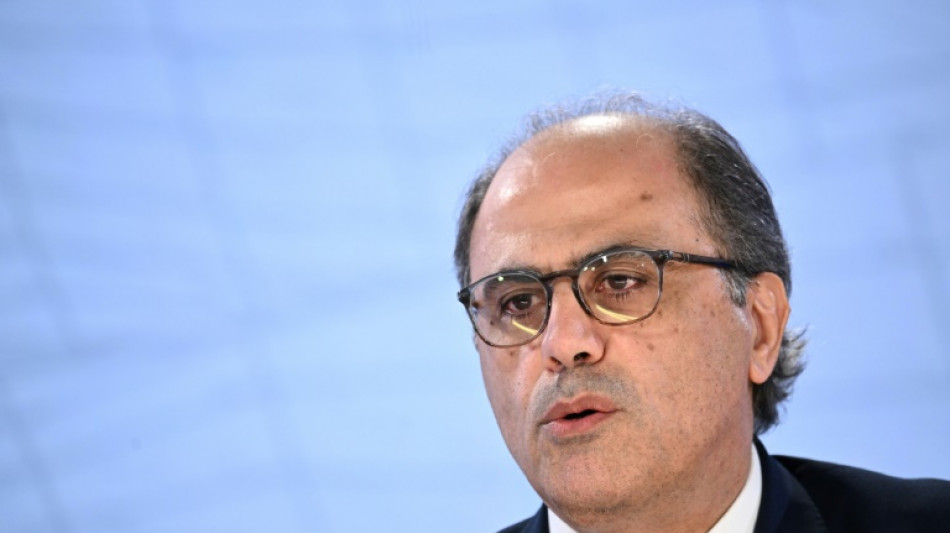
IMF official calls on international community to bring end to Lebanon conflict / Photo: © AFP

 Trump threatens EU over 'hostile' Canada association plan

 Argentine judge orders suspension of Falklands oil project
 Carrick takes the blame as troubled Man Utd suffer League Cup misery

 Barcelona hit seven in Racing Santander rout
 Amorim's Milan beaten by Benfica, Sunderland make dream European return

 US stocks fall, dollar gains after Fed lifts interest rates
 Seahawks rule out Darnold for Sunday game at Arizona
 Mbappe explains Ceuta shirt stance after criticism

 Improving Atletico cruise to comfortable win over Osasuna

 Candidate for UN chief calls for AI regulation akin to nuclear weapons

 O'Neill expects Celtic recovery after Old Firm misery
 Man City midfield trio backed to emulate Rodri and Silva

 'We're losing control,' AI pioneer Yoshua Bengio tells AFP
 WHO eyes 'encouraging' signs in DRCongo fight against Ebola
 Liga boss criticises Real Madrid trio for Ceuta shirt incident

 WTA Finals moved to Charlotte from 2027

 Almost 8,000 excess deaths in France's scorched summer: statistics

 Ex-president's lengthy war crimes sentence shocks Kosovo

 US House faces test on sweeping Russia sanctions bill

 British PM says to make 'difficult decisions' as inflation rises

 TotalEnergies pumps up controversy in France with cut-price gas
 Global fuel price demos: a round-up

 Leverate Launches MCP for Traders to Connect AI Assistants With Trading Platforms

 MEXC Launches $1M "Discover Your Wall Street DNA" Campaign to Help Traders Find Their Market Fit
 Emporio Armani names Dario Vitale new creative director
The international community should work to end the conflict in the Middle East and address the "huge" humanitarian crisis that has engulfed countries in the region, the head of the IMF's Middle East and Central Asia department said Thursday.
Jihad Azour spoke to AFP in Washington, where the annual meetings of the International Monetary Fund and the World Bank are currently taking place.
In updated economic estimates, the Fund slightly downgraded its outlook for economic growth in the Middle East and North Africa to 2.1 percent this year, while maintaining its 4.0 percent growth outlook for 2025.
However, these estimates do not take into account the economic impact of the recent escalation of conflict in southern Lebanon, where Israel has invaded to fight Hezbollah.
Azour, a former Lebanese finance minister, noted that the most severely affected places, including Lebanon and the Palestinian territories, were facing a "huge humanitarian problem" which has devastated their economies.
"You have massive loss in output, you have a massive destruction in infrastructure, and you have a huge set of needs for additional spending, for shelter, for health and so on," he said.
"We expect that growth will be negative in those cases, and we expect that the recovery would take longer to materialize," he added.
The IMF has suspended its forecasts for the Lebanese economy, citing an "unusually high degree of uncertainty." But a recent United Nations Development report estimated that the country's GDP would be 9.2 percent smaller as a "direct consequence" of the conflict.
"You have massive destruction of infrastructure in a large region, which is the south, and mass destruction of livelihood, because this is an agricultural region that was severely affected," Azour said, adding that almost 20 percent of Lebanon's population had been displaced.
"We encourage the international community, we encourage the friends of Lebanon, to provide grants," he continued, calling on the international community "to put its utmost effort in order to solve the problem, in order to reduce the suffering of people."
- Indirect impact in Egypt, Jordan -
For countries indirectly affected by the conflict, like Jordan and Egypt, the impact of Israel's ongoing military campaigns in Gaza and Lebanon has been felt differently.
While Egypt has been hit hard by a 70 percent fall in revenues from ships traversing the Suez Canal, Jordan's economy has suffered from a steep decline in tourism, Azour said.
The IMF recently expanded an existing loan program with Egypt from $3 billion to $5 billion, in return for painful and wide-ranging economic reforms, including a shift to a more flexible exchange rate and an emphasis on tackling inflation and high debt levels.
Azour said that while the Fund was currently focused on helping countries in the region address immediate concerns, it also had a role to play in bringing the region together to help with post-conflict reconstruction.
"We think that there is a regional play here, whereby countries could trade and exchange more and can grow better together," he said.
C.Bruderer--VB