EU counterparts push Hungary on Russia oil ban / Photo: © AFP/File

 Italy inflation surges to 5.4% as economy stalls

 US jury hands win to Bayer in weedkiller cancer case
 Scotland's Kinghorn hails Toulouse move for enhancing career
 Eala aiming to finish season with bang after Tokyo exit
 Bournemouth boss Rose vows to be patient with Kroupi
 Eurozone growth holds up despite energy crunch
 Thousands of students, workers protest in Italy under heavy security

 New Zealand's Phillips hits sublime century in 87-run win over India
 'Get them there alive': Ukraine's railways under Russian barrage

 Dakar Rally moved to Portugal and Morocco following Houthi attacks in Gulf
 German economy logs 0.2% growth, faster than expected

 Crypto platform Binance confirms 'complex' $6.3 bn hack
 Spanish inflation stays at three-year high before election
 Drugs giant AstraZeneca reveals higher profits, savings plan
 French economy 'headed for a wall' as GDP shrinks
 South Korea to prosecute students cheating with smart glasses
 Surging costs of living top US voter concerns

 Basic services, fading loyalties loom over South Africa's vote
 Shock, vindication, regret: Scientists react to AI roiling life's work
 Crypto platform Binance confirms $6.3 bn hack
 Boozer shines as Grizzlies top Blazers in battle of NBA unbeatens
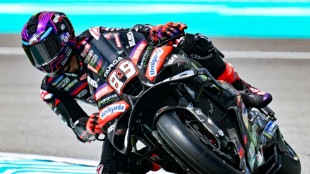 Jorge Martin confirmed to race at Malaysian MotoGP

 Bayern and Kane host Dortmund after week of 'extremes'

 Packers beat Panthers 27-19 as Watson returns from hospital

 Affordable supermarket fashion offers designer-inspired autumn alternatives
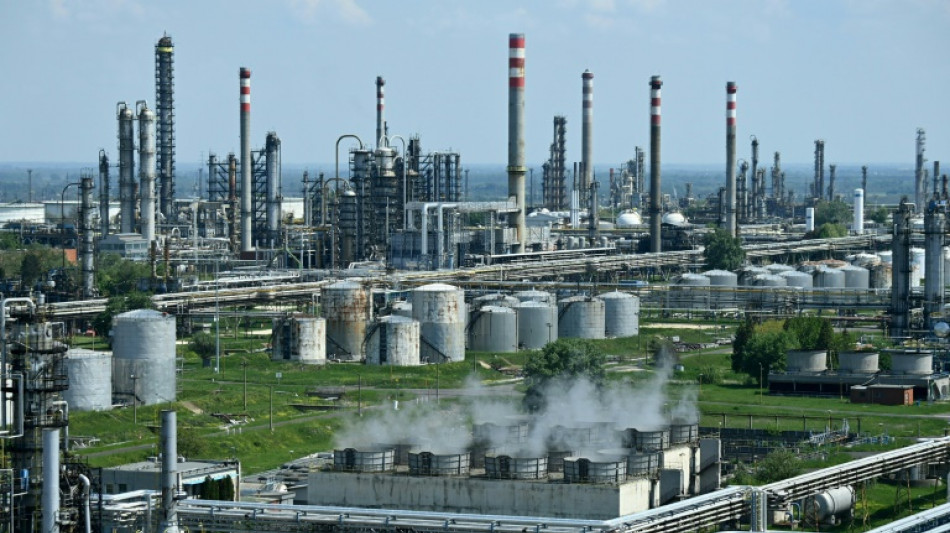
EU foreign ministers pressed Hungary on Monday to drop resistance to a proposed oil embargo to punish Russia for its invasion of Ukraine, as Budapest put a 15 billion euro price tag on making the move.
Hungary has been holding up a push by Brussels, backed by most EU member states, to ban Moscow's vital oil exports, the cornerstone of a planned sixth package of sanctions, arguing that it would hammer its own economy.
"The whole union is being held hostage by one member state who cannot help us find the consensus," Lithuanian Foreign Minister Gabrielius Landsbergis declared.
Landsbergis said the European Commission was offering landlocked Hungary until the end of 2024 to ditch Russian oil.
"That's a very, very broad, broad scope," he said. "So I think that everybody expected that this will be enough. And I cannot explain you why it isn't."
Ireland's Foreign Minister Simon Coveney conceded that a ban was a tough prospect for countries that are reliant on Russian oil but insisted that "we need to get on and do this".
"The political message is clear," he said. "The EU wants to do this, and we want to do it as soon as we possibly can."
Brussels is desperate to avoid the appearance of division in the face of the Kremlin's onslaught on Ukraine, and officials are scrambling behind the scenes to patch up a compromise after making the proposal on May 4.
EU foreign policy chief Josep Borrell said the ministers meeting in Brussels would "do our best to de-block the situation".
"I cannot ensure that it is going to happen because the positions are quite strong," Borrell said.
German Foreign Minister Annalena Baerbock said: "There are still a few things that need to be clarified in the final stages. There will be no final clarification here today."
But she added that she was confident that "in the next few days we will come to a joint result."
Portugal’s Foreign Minister Joao Gomes Cravinho estimated that it could take "a couple of weeks" to hammer out agreement on the sanctions -- a timescale that would take the debate up to the next full summit of EU leaders.
Brussels has offered Hungary, the Czech Republic and Slovakia long grace periods to phase out Russian oil imports but that has not yet convinced Budapest to budge.
- Budapest hikes cost -
Hungary's Prime Minister Viktor Orban, often the odd man out in EU decision making, has demanded to be exempted from the embargo for at least four years and wants 800 million euros ($830 million) in EU funds to re-tool a refinery and boost the capacity of a pipeline to Croatia.
And Foreign Minister Peter Szijjarto on Monday appeared to up the price tag for ditching Russian oil by saying it it would cost 15 to 18 billion euros ($16 to $19 billion) to prepare its economy for the move.
"It is legitimate for Hungarians to expect a proposal" from the European Commission to cushion that blow, Szijjarto said in comments broadcast on his Facebook page.
"A complete modernisation of the Hungarian energy infrastructure is needed to the scale of 15 to 18 billion euros."
Ukraine's top diplomat Dmytro Kuleba, in Brussels to meet the EU ministers, urged the bloc to cut off it energy payments to Moscow quickly.
"We're all curious to see how this saga ends," he said.
"Every day European countries continue paying millions of euros to Russia for gas and oil and it's exactly this money that are then being used to finance the Russian war machine."
The EU also plans to cut its reliance on Russian gas by two thirds this year, but it has been reluctant to ban imports as Germany opposes such a move.
R.Adler--BTB