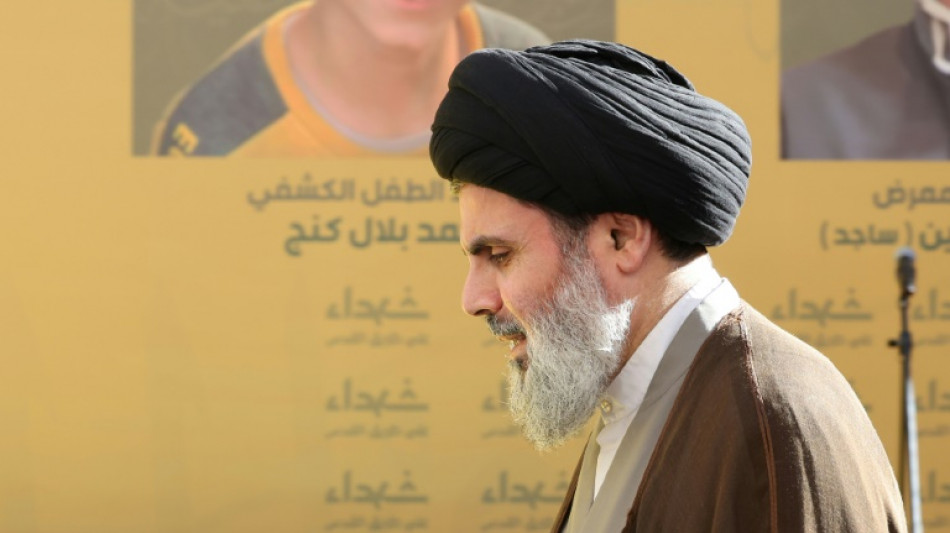
Safieddine, the apparent Hezbollah heir who was killed by Israel / Photo: © AFP

 STARPRIME Responds to Diverging Gold Market Demand with AM/PM Fixing and XAU24/7

 Ukrainian fashion designer debuts art between air raids

 Gambian businesses struggle under prolonged blackouts
 Fiji declares national HIV crisis
 Australia to cut migration to fix housing crisis: minister
 NASA scan discovers new, 'once in a century' Moon crater
 Most stocks rise as Fed hikes and indicates drive to curb inflation
 US again denies Palestinian leader Abbas visa to attend UN assembly
 Lula says he will go to UN to tell Trump to 'stay out' of Brazil's elections
 Messi heads Inter Miami to Campeones Cup triumph

 AI looms large ahead of Xi, Trump summit
 Smith still haunted by 'Sandpapergate' as he prepares for South Africa Tests
 UK-Sudanese author pens book to give children 'African history of Africa'
 Boehly and Walter sell Chelsea stake to Clearlake Capital

 US House backs data center power cost bill amid midterm backlash
 US Congress passes sweeping Russia sanctions bill
 Barca hit Racing for seven as Atletico crush Osasuna

 US Fed raises rates to tackle 'too high' inflation, irking Trump
 Man Utd misery mounts after League Cup collapse against Brighton
 Turkey releases 106 protesters, jails more LGBTQ activists
 US Fed raises rates to tackle 'too high' inflation in move sure to rile Trump
 England were 'waiting for death' in World Cup semi-final defeat: Tuchel

 NFL star fined for displaying name of slain Palestinian girl
 Witsel retires from internationals after 18-year Belgium career
 US Fed raises rates to battle inflation in move likely to rile Trump
Hashem Safieddine, whose death in an Israeli strike was announced Tuesday, was widely considered the potential successor to the group's assassinated leader Hassan Nasrallah.
Israel said he was killed along with other Hezbollah leaders in an airstrike in southern Beirut three weeks ago. Hezbollah has yet to communicate about the claim.
Contact with Safieddine had been lost after Israeli attacks targeted him on October 4, Hezbollah officials said at the time.
The deeply religious Safieddine, a cleric with family ties to Nasrallah and good relations with its backer Iran, had been the "most likely" candidate for the party's top job, officials had told AFP after Nasrallah's death September 27.
Grey-bearded and bespectacled, Safieddine bore a striking resemblance to his distant cousin Nasrallah, but was several years his junior, aged in his late 50s or early 60s.
"It can now be confirmed that in an attack approximately three weeks ago, Hashem Safieddine, the head of Hezbollah's Executive Council, and Ali Hussein Hazima, the head of Hezbollah's Intelligence Directorate, were killed along with other Hezbollah commanders," the Israeli army said in a statement.
On October 8, Israeli Prime Minister Benjamin Netanyahu suggested Safieddine had been killed, without naming him.
In an address to the people of Lebanon, Netanyahu said Israeli forces "took out thousands of terrorists, including Nasrallah himself and Nasrallah's replacement and the replacement of his replacement."
Israel's air force three weeks ago "conducted a precise, intelligence-based strike on Hezbollah's main intelligence headquarters," in the southern Beirut suburb of Dahiyeh, Hezbollah's stronghold in the Lebanese capital, the army said late Tuesday.
Safieddine, a member of the group's governing Shura Council, had strong ties to the Islamic republic after undergoing religious studies in Iran's holy city of Qom.
His son married the daughter of General Qasem Soleimani, the commander of Iran's Revolutionary Guards foreign operations arm who was killed in a 2020 US strike in Iraq.
Safieddine bore the title of Sayyed, his black turban marking him -- like Nasrallah -- as considered to be a descendant of the Prophet Mohammed.
The United States and Saudi Arabia had put him on their respective lists of designated "terrorists" in 2017.
- 'Strongest contender' -
Unlike Nasrallah, who lived in hiding for years, Safieddine continued to appear openly at recent political and religious events.
Foregoing his usual calm demeanour, he often broke into fiery rhetoric at the funerals of Hezbollah fighters killed in nearly a year of cross-border clashes with Israel.
Amal Saad, a Lebanese researcher on Hezbollah based at Cardiff University, said that for years people had been saying that Safieddine was "the most likely successor" to Nasrallah.
Nicholas Blanford, a Beirut-based Hezbollah expert and senior fellow at the Atlantic Council, also said Safieddine had "been touted as a potential successor to Nasrallah for years".
He had "the right credentials", Blanford said, being a religious figure, from Lebanon's south, from where "most of Hezbollah's leadership tends to come", and also heading Hezbollah's powerful executive council.
Hezbollah's leaders are chosen by its seven-member Shura Council
Hezbollah was created at the initiative of Iran's Revolutionary Guards and gained its moniker as "the Resistance" by fighting Israeli troops who occupied southern Lebanon from 1982 until 2000.
The movement was founded during the Lebanese civil war after Israel besieged the capital Beirut in 1982.
Following the 1990 end of Lebanon's civil war, Hezbollah was the only faction allowed to keep its weapons, in the name of "resistance" to Israel's continued occupation of southern Lebanon.
In July, in a speech in Beirut's southern suburbs, Safieddine alluded to how Hezbollah views its leadership succession.
"In our resistance, when any leader is martyred, another takes up the flag and goes on with new, certain, strong determination," he said.
But for several months, Israel has landed a succession of hard blows, eliminating one commander after the other and targeting its installations in Lebanon.
Still, Hezbollah continues to fire rockets at Israel and its troops confront Israel's ground offensive in southern Lebanon.
bur-lk-aya-lg/srm/gv/giv
I.Stoeckli--VB