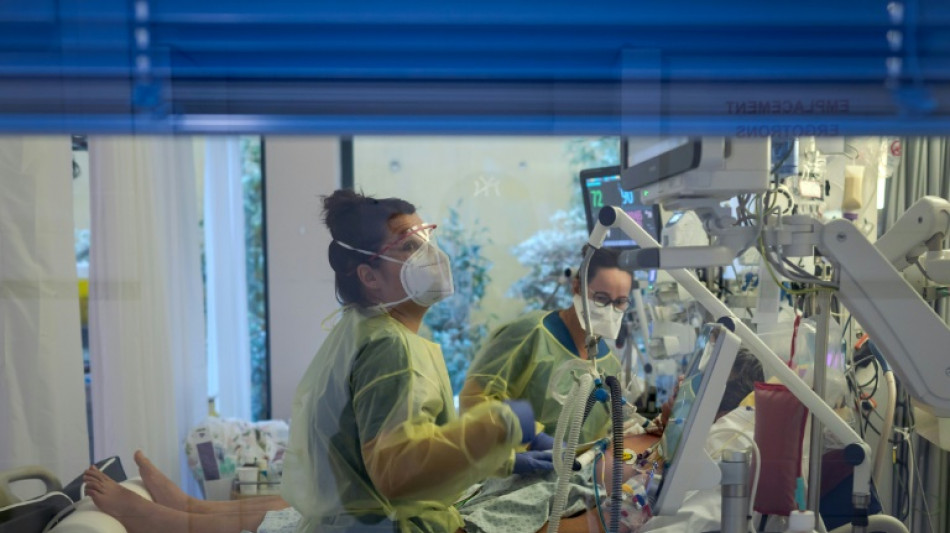
Swiss switch to 'presumed consent' on organ donations / Photo: © AFP/File

 Economic losses from natural disasters fall to $100 bn in first half of 2026: Swiss Re

 Colombia scrambles to find survivors as quake kills 132

 Singapore says AI-related demand lifting economy

 Demeter Tactical Investments (ME) Limited bolsters governance with two board appointments

 Russian barrage on Ukraine kills 9, wounds dozens
 Schools closed as Indonesia battles wildfires

 Swiatek dominates Shnaider to set up Toronto semi with Svitolina

 Oil prices rise further as hopes for Hormuz deal fade

 One year after Putin-Trump summit, 'spirit of Anchorage' dissipated

 Farage vs Count Binface: What to know about UK snap poll

 Torment of Afghan fathers as daughters deprived of education
 Return of displaced Syrian Kurds to hometown suspended after violence

 Swiatek races past Shnaider into Toronto semi-finals

 Meta pushes global AI vision amid race with OpenAI, Anthropic and China

 US judge ends graft case against India's Adani

 Anderson retires after 10 MLB seasons after 'too much pain'

 Colombia in state of emergency as quake kills 111

 Britain's Amy Hunt wins European women's 100m gold

 Trump order pushes for overhaul of childhood vaccine schedule

 Global stocks mixed while oil prices jump on Hormuz

 Turkey MPs back historic law on reintegrating Kurdish militants

 'Dreams disappear' as Gaza students await evacuation to Italy

 Third European gold for Schilder in women's shot put

 Golden relay double for Britain at Europeans as Marchand settles for silver
 US had hottest month on record in July

Switzerland voted Sunday to boost the availability of transplant organs by making everyone a potential donor after death unless they have expressly objected.
The legal change, approved by 60 percent of voters in a referendum, marks a dramatic shift from the current system.
Under the existing laws, transplants are only possible if the deceased person consented while alive -- and their wishes are often unknown.
In such cases, the decision is left up to relatives -- who in most cases opt against organ donation.
This has left many of those in need of a transplant waiting in vain for an organ.
At the end of 2021, more than 1,400 patients were awaiting transplant organs in Switzerland, a country of around 8.6 million people.
Last year, 166 deceased persons donated their organs in Switzerland, and a total of 484 organs from deceased donors were transplanted.
But 72 people died in 2021 while waiting on an organ transplant waiting list, according to the organisation Swisstransplant.
"The public have shown that they are ready to give a chance to the people who are on the waiting list," said Swisstranspant director Franz Immer.
In a bid to reduce the backlog, the government and parliament wanted to change the law to a "presumed consent" model, something already adopted in a number of other European countries.
According to that system, people who do not wish to become an organ donor after death must explicitly say so.
Those who have not made their wishes clear would be assumed to be in favour. However, relatives would still be given a say. The rules would only apply to people aged 16 and over.
The medical conditions for donation remain the same: only people who die in a hospital intensive care unit can donate their organs, and two doctors must confirm the death.
- Evolution not revolution -
Under the incoming laws, relatives can refuse if they know or suspect that the person concerned would have chosen not to donate an organ.
In cases where no relatives can be contacted, no organs may be removed.
"It's not a revolution, but an evolution," Health Minister Alain Berset said following the result.
Not everyone had agreed with the government's proposals.
A group headed by a midwife and a doctor, with support from some theologians and jurists, as well as the populist and religious right, gathered enough signatures to force the issue to a referendum.
They claimed it was ethically dubious to assume that someone who has not made their wishes clear would consent to donate an organ.
They insisted on the need for patients to provide explicit, informed consent before any and all medical procedures.
They also warned that the shift would place greater strain on relatives of the deceased, who might not dare refuse, for fear that they would be viewed as selfish.
T.Bondarenko--BTB