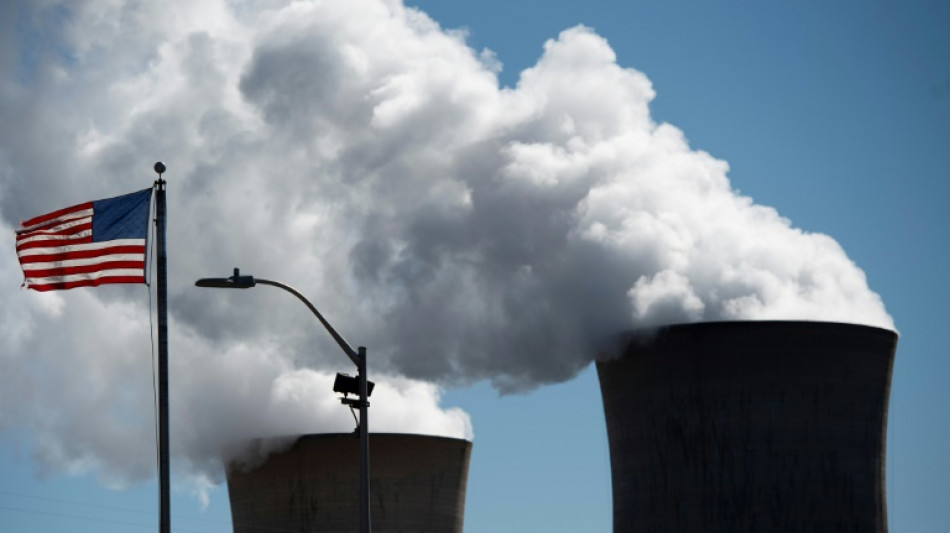
Tech giants go nuclear in AI arms race / Photo: © AFP

 Oversight Board blasts 'inadequate' Meta safeguards for AI deepfakes

 The Easter Island origins of buzzy Malkovich drama 'Wild Horse Nine'

 Third body recovered after Grand Canyon flash flood

 Harry makes first public appearance since return to UK

 Abhishek hits record T20 ton as India sweep series 3-0

 Abhishek hits record T20 ton as India sweep T20 series 3-0

 English FA calls for Infantino to release World Cup sell-off documents

 GM delivers first components for US interceptor missiles

 Trump admin overhauls key protection for endangered species

 Abhishek hits record T20 ton as India post 221-7 against Afghanistan

 Macron hosts Lebanon security talks to back 'indispensable' army

 Final rally of season in Saudi Arabia cancelled due to Middle East conflict

 Gaza documentary sparks political storm in Israel

 King Charles warns tech bosses of 'existential dangers' of AI

 French fishermen block ports over petrol prices

 AFP photo shows Trump examining image of Kennedy Center apparent demolition

 Andersson vows to take Sweden in 'new direction' after election win

 Turkey's Erdogan to run again in early 2028 vote, top adviser says

 Sweden's Andersson: a trusted, no-nonsense political operator

 Canada's Carney pushes 'new alliance' with EU despite Trump threats

 Ireland to boycott Eurovision 2027 over Gaza

 India's Tata Sons reappoints N. Chandrasekaran as chairman

 Sweden's left-wing wins election thriller

 Germany urges EU action against China to defend carmakers

 Stocks mostly rise after US Fed rate hike, oil eases
The artificial intelligence arms race has gone nuclear.
Amazon, Microsoft, and Google are now looking to outgun each other with announcements on atomic energy, which they hope will power a technology that is consuming electricity at an alarming rate.
The US tech juggernauts, convinced that AI is technology's next big chapter, are investing billions to expand data centers globally.
According to Goldman Sachs research, data centers will consume 8 percent of US power by 2030, up from 3 percent in 2022.
In Europe, their power needs by 2030 will match the current combined consumption of Portugal, Greece, and the Netherlands.
The driving force is the tech giants that want to build the best AI systems they can using bigger and bigger data centers, which incur a tremendous amount of electricity consumption and CO2 emissions.
As tech companies seek energy sources to meet these demands while maintaining their zero-carbon emission commitments, nuclear power has emerged as a compelling option.
Although expensive and politically sensitive to build, nuclear power provides consistent, zero-carbon electricity once operational.
"Tech companies aren't in love with nuclear, but they want carbon-free, reliable, and predictable energy 24/7," explained Jacopo Buongiorno, Professor of Nuclear Science and Engineering at MIT.
"The cost may be high, but it's predictable for 60 years."
- 'Huge numbers' -
Nuclear reactors are vastly more expensive to build than solar or wind power facilities, so nuclear energy really only makes sense for the tech titans that generate tens of billions in annual profits.
Rob Bittencourt of Apollo Global Management said that the cost of the industry's data center buildout was a trillion dollars and that the electricity supply needed to generate the power necessary was enormous.
"These are huge numbers, but Amazon, Meta, Microsoft, and Google can afford to play the long game," he told the Odd Lots podcast.
Several approaches are being considered.
One strategy involves extending the life of aging nuclear plants. Microsoft recently announced a 20-year agreement with Constellation Energy to restart Unit 1 at Three Mile Island, shut down five years ago for economic reasons.
The announcement struck a nerve as the 1979 partial meltdown of Unit 2 at the site caused panic in the United States and brought the expansion of nuclear energy to a standstill.
Similarly, Amazon Web Services (AWS) is turning to the 40-year-old reactor at Susquehanna Steam Electric Station to power a nearby data center complex.
- 'Unpleasant surprises' -
Another approach focuses on investing in Small Modular Reactors (SMRs), but these compact, potentially easier-to-deploy reactors are still experimental.
Amazon has announced investments in SMR projects, including a direct investment in start-up X-energy. Google is partnering with Kairos Power to develop SMRs that could be operational as early as 2030.
However, challenges remain. SMR technology may not be immediately reliable, and the tech giants lack experience in nuclear projects that could see "unpleasant surprises" along the way, according to Buongiorno.
Safety concerns also persist, given the history of nuclear accidents like Chernobyl and Fukushima, the 2011 disaster in Japan.
Despite these challenges, industry leaders remain optimistic.
Microsoft founder Bill Gates, who is investing billions in his own SMR startup Terrapower, acknowledges the difficulties but expresses confidence in making a strong case for nuclear power's role in the AI-driven future.
His project has begun construction in Wyoming, but is still awaiting approval from the US nuclear regulator.
"I'm putting billions into it because I'm quite confident we can make that case," he said at a recent event in New York.
A.Zbinden--VB