India's fireworks boom ahead of Hindu festival of lights / Photo: © AFP

 South Korea makes Asian Games complaint over Japan warlord ceremony

 US aid cuts are killing Kenyan sex workers

 October 7 survivors, families take centre stage in Israel vote
 Captain Mat Ryan axed from Socceroos squad for Brazil games

 US approves sale of 48 F-35 jets to Saudi Arabia
 Juventus, Palace cruise to Europa League wins, Bournemouth beat Sociedad

 Stocks climb as oil retreats, Fed calms inflation fears

 Russians begin voting in controlled election as war drags

 Hispanics feel 'betrayed' on immigration, Republican warns Trump

 High-scoring Bears face Vikings in battle of NFL unbeatens
 'In our lane': Fed's Warsh defies Trump but still fighting for credibility

 Trump admin makes major cut to endangered species protections

 Princess Diana's brother makes new explosive claims against Charles

 Ovechkin on Russian political video: 'I support my country'
 Can we shut down AI?
 Teenager Sullivan named in new-look US squad

 Travis Scott and Keith Richards feature on GTA VI soundtrack

 AFP photo shows Trump examining image of apparent Kennedy Center razing

 Pochettino rings changes for USA friendlies

 Alonso says Chelsea ambition 'very clear' after end of Boehly era

 Mbappe draws political fire over Ceuta t-shirt controversy

 Third malaria death in Germany from outbreak tied to Frankfurt airport
 AtlasClear Holdings Reports Preliminary Fiscal 2026 Revenue of Approximately $20.1 Million, Up 85%; Revenue Plus Interest Income of Approximately $21.9 Million
 Alonso says Chelsea ambition clear after end of Boehly era

 Micron's Taiwan workers say 68 months' bonus not enough

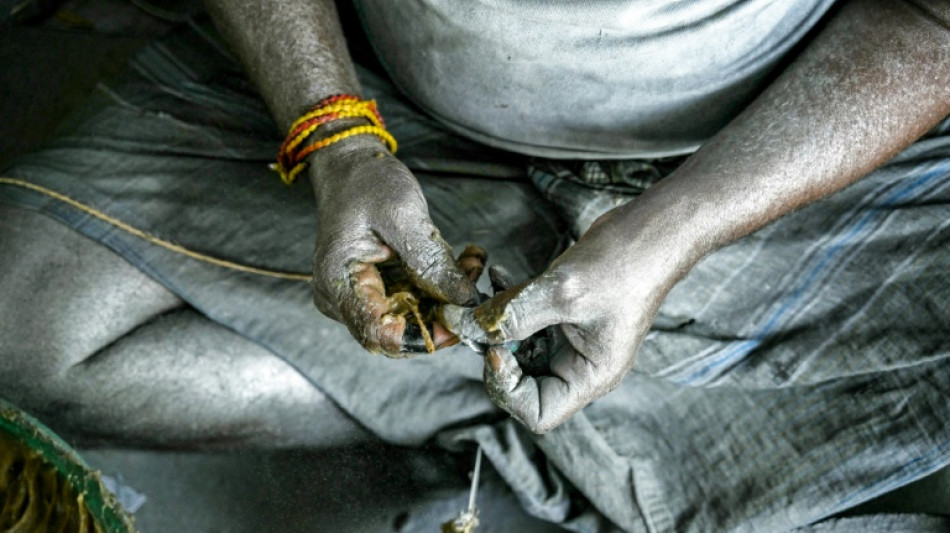
Wrapping heaps of cone-shaped sparklers in red paper and trimming lengths of silver fuse by the hundreds, workers at an Indian fireworks factory race to meet orders for Diwali, the Hindu festival of lights.
Authorities regularly impose bans on the smoky pyrotechnics to reduce the hazardous pollution they cause, but to many, firecrackers are an integral part of the holiday's celebrations.
Toxic chemical fumes hang heavy in the air at the factory in Sivakasi, a city in the southern state of Tamil Nadu, the heartland of India's fireworks production.
It is a risky job, with deadly explosions in factories taking place each year in India, but workers say they have little choice.
"There is no other job opportunity in the area", said 49-year-old Rajathi, pausing from the rapid work of sealing explosives in garish wrapping.
Rajathi, who uses only one name, said she did not want her children to follow in her footsteps at a job where she earns up to 800 rupees ($9.50) a day.
Cigarette lighters and mobile phones are often banned inside the factory, where conditions are bare-bones.
Workers, sitting on the floor, dip fuses with bare hands into pots of a silver-coloured mixture.
Others spread glue onto wrappers with their fingers, while others scatter the handmade paper shells of the fireworks out on mats to dry in the sun.
Sivaraj, aged 29, is new to the job.
"I know there have been accidents in the factories before, but I need to work to eat," he said.
Without formal education, he had few options.
"That is why I came to work in a fireworks factory", Sivaraj said, who also uses one name.
Diwali this year falls on November 1, and workers are busy packing boxes to meet the nationwide surge of demand.
- 'Curb high air pollution' -
The potent chemicals used to give the sparkling explosives their colour and noise add to the deadly toxic haze of vehicle emissions and factory fumes in cities that regularly rank among the worst in the world for air quality.
India's capital New Delhi on Monday ordered a "complete ban" on all firecrackers -- both their manufacture and sale -- in view of the "public interest to curb high air pollution".
But for many, Diwali would not be the same without the colourful and thunderous roar of crackers, and past bans have been widely flouted.
The spectacular and colourful festival celebrates the Hindu goddess Lakshmi and symbolises the victory of light over darkness.
The national holiday is marked by the exchange of gifts -- and of course, the setting off of fireworks.
In addition to the usual factory and vehicle emissions, smog in Indian cities this time of year is exacerbated by seasonal agricultural fires clearing harvest stubble for ploughing.
But pollution levels surge even more around Diwali, driven by the extra fumes from fireworks.
In New Delhi, levels of fine particulate matter -- cancer-causing microparticles known as PM2.5 pollutants that enter the bloodstream through the lungs -- often hit more than 30 times the World Health Organization's danger limits.
Prolonged exposure can trigger strokes, heart disease, lung cancer and other respiratory diseases, according to the WHO.
More than seven percent of all deaths in 10 of India's biggest cities are linked to air pollution, according to a study published last year in The Lancet Planetary Health journal.
G.Frei--VB