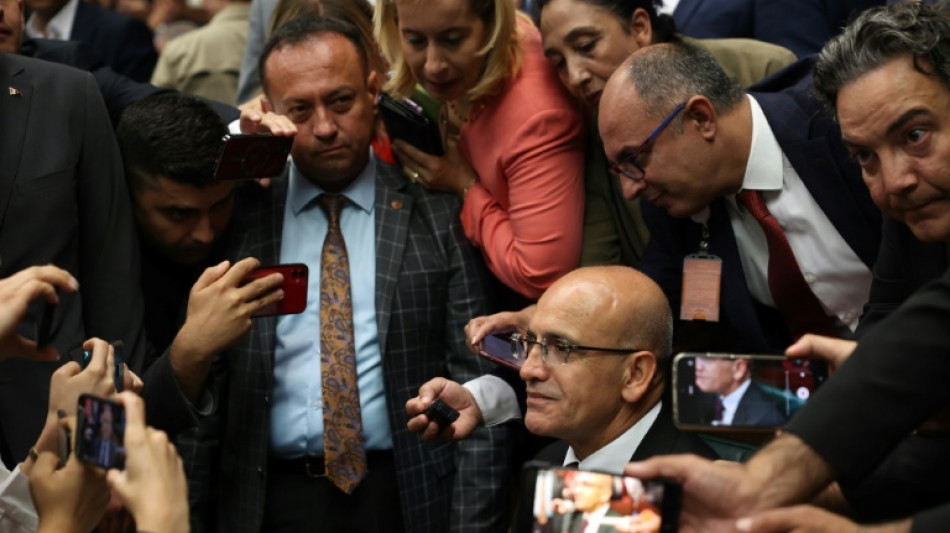
Turkish govt defends tax plan to fund defence industry / Photo: © AFP

 Energy bill plan could use HMRC income data to target support

 Business owner earning £6,000 a month tackles £70,000 debt

 Nvidia chief faces inquiry after disclosing affair with suspected Chinese agent

 Comet returns as online electrical marketplace 14 years after collapse

 Aston Villa Defy History With Rare Victory at Old Trafford

 Qatar Airways Launches Bogotá-Caracas-Doha Route Linking Energy Markets

 Marc Almond to Close Soft Cell Era After Final 'Danceteria' Tour
The Turkish government defended a proposed tax on credit cards on Tuesday, saying it was needed to fund the arms industry and protect the country as conflict rages in its neighbourhood.
Indignant Turks, who already face double-digit inflation, called their banks to lower their credit limits after the ruling AKP party submitted the tax bill to parliament on Friday.
The legislation comes as Israel's conflicts with Tehran-backed Islamist militants in Gaza and Lebanon, and missile strikes by Iran, have raised global concerns that a broader war could erupt in the Middle East.
"Our country has no choice but to increase its deterrent power. There's war in our region right now. We are in a troubled neighbourhood," Finance Minister Mehmet Simsek told private broadcaster NTV.
The bill stipulates that people with a credit card limit of at least 100,000 liras (nearly $3,000) will have to pay an annual 750 lira ($22) in tax from January to bolster the defence industry.
"The purpose (of the bill) is obvious," Simsek argued.
"If we increase our deterrent power, then our ability to protect against fire in the region will increase," he said, though he added that the bill was in the hands of parliament and the ruling party could "re-evaluate" it.
AKP's parliamentary group chairman, Abdullah Guler, said when he proposed the tax on Friday that Israel's next target would be Turkey, an argument often cited by President Recep Tayyip Erdogan.
"While we are in the middle of all these hot developments geographically, we need to make our defence industry stronger than ever," Guler said.
- Weapons industry -
A vocal critic of Israel's offensive in Gaza and Lebanon, Erdogan has warned that Israel's military operations could soon target Turkey, prompting the opposition to demand an emergency session in parliament for the government to elaborate.
Turkey's defence industry has enjoyed a boom in recent years but Simsek said the sector needed a boost.
The defence industry is planning to invest in 1,000 projects, including a air defence system that would protect Turkey from missile assaults, Simsek said.
"This requires resources," he added.
Turkey has allocated 90 billion lira from the budget to fund the defence industry last year, he added.
"This year, we increased it to 165 billion lira. Maybe we will need to double this even more."
Turkey's defence companies signed contracts in 2023 worth a total of $10.2 billion, according to Haluk Gorgun, the head of Turkey's state Defence Industry Agency (SSB).
The top 10 Turkish defence exporters contributed nearly 80 percent of total export revenue, he said.
Sales of Turkish Baykar drones, used in Nagorno-Karabakh or Ukraine, amounted to $1.8 billion.
- 'Disguise the economic crisis' -
Last week, parliament held behind-closed-doors session for the government to explain why it saw Israel as a potential threat, but the opposition said it was not convinced.
The spokesman for Turkey's main opposition CHP party, Deniz Yucel, said Monday the government was exploiting national feelings to sweep an "economic crisis" under the rug.
Inflation has spiralled over the past two years, peaking at an annual rate of 85.5 percent in October 2022 and 75.45 percent in May 2023.
Official data showed it slowed to 49.4 percent in September.
"The AKP is trying to create a fake 'foreign threat and war agenda' with the rhetoric of 'Israel may attack us'," Yucel said on Monday.
"We know and see that they are trying to disguise the economic crisis they caused."
T.Suter--VB

