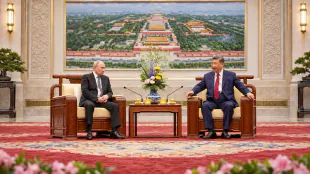
Taiwan's president to deliver key speech for National Day / Photo: © AFP

 Energy bill plan could use HMRC income data to target support

 Business owner earning £6,000 a month tackles £70,000 debt

 Nvidia chief faces inquiry after disclosing affair with suspected Chinese agent

 Comet returns as online electrical marketplace 14 years after collapse
 Aston Villa Defy History With Rare Victory at Old Trafford

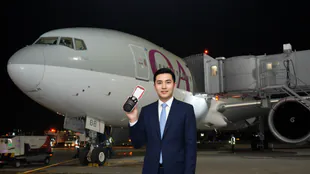 Qatar Airways Launches Bogotá-Caracas-Doha Route Linking Energy Markets

 Marc Almond to Close Soft Cell Era After Final 'Danceteria' Tour
Taiwanese President Lai Ching-te is set to deliver a key speech on Thursday as part of the self-ruled island's National Day celebrations that is likely to elicit an angry response from China.
China claims Taiwan as part of its sovereign territory and has not ruled out using force to bring the island under its control.
Beijing has been increasing military and diplomatic pressure on Taiwan, which split from China in 1949 after a civil war and has since transformed into a vibrant democracy.
Relations have remained tense under Lai, who took office in May and has been more outspoken than his predecessor Tsai Ing-wen in defending Taiwan's sovereignty.
Beijing calls him a "separatist" and accuses him of escalating hostilities.
Despite his stance on Taiwan's sovereignty, Lai will likely use his National Day speech to "project predictability and pragmatism", said Wen-Ti Sung, a nonresident fellow at the Atlantic Council's Global China Hub.
Lai is due to deliver his speech in front of the Presidential Office in Taipei at 0230 GMT.
He is expected to talk about Chinese actions towards Taiwan, peace and democracy, and domestic social and economic issues.
Among the foreign guests expected to attend are three members of the US Congress, along with senior officials from some of the 12 states that still have diplomatic relations with Taiwan.
The United States switched diplomatic recognition from Taipei to Beijing in 1979 but has remained Taiwan's most important partner and its biggest arms supplier.
Taiwan was on alert for Chinese military drills near the island on National Day after observing "some maritime deployments", a senior security official told AFP on Wednesday.
China maintains a near-daily military presence around Taiwan and has held three rounds of large-scale war games in the past two years, deploying aircraft and ships to encircle the island.
Beijing accused Lai on Tuesday of "malicious intent to escalate hostility and confrontation" after he said China was not the "motherland" of Taiwan.
Lai said at his inauguration in May that the Republic of China -- the island's official name -- and the People's Republic of China "are not subordinate to each other".
"Lai will signal to Beijing that Taiwan's door is always open, that the Lai government stands ready to hold dialogue with Beijing, so long as the cross-strait dialogue can take place on the basis of equality and mutual respect, rather than on terms unilaterally dictated to by Beijing alone," the Atlantic Council's Sung told AFP.
Beijing severed high-level communications with Taipei in 2016 when Tsai, also a member of Lai's Democratic Progressive Party, took power.
E.Gasser--VB