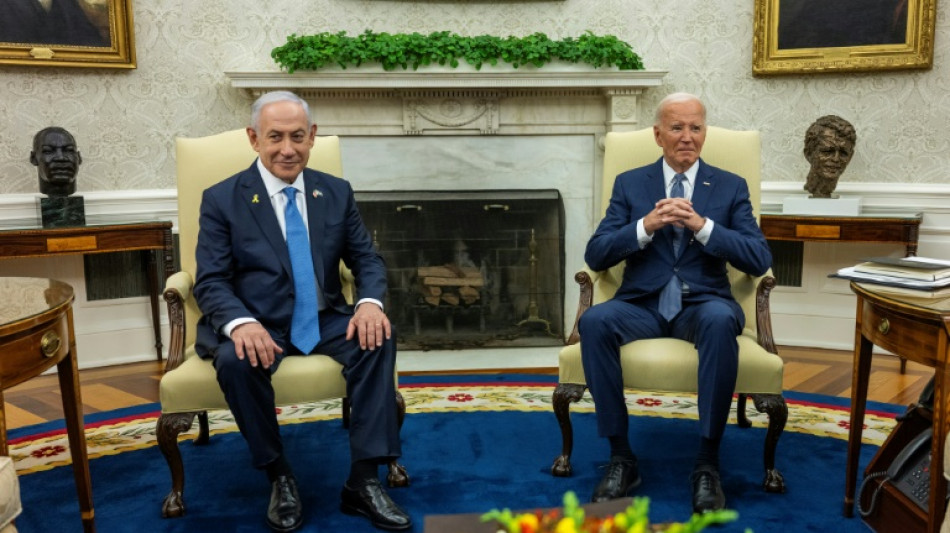
US urgently tries to shape Israel's response to Iran / Photo: © AFP/File

 Energy bill plan could use HMRC income data to target support

 Business owner earning £6,000 a month tackles £70,000 debt

 Nvidia chief faces inquiry after disclosing affair with suspected Chinese agent

 Comet returns as online electrical marketplace 14 years after collapse

 Aston Villa Defy History With Rare Victory at Old Trafford

 Qatar Airways Launches Bogotá-Caracas-Doha Route Linking Energy Markets

 Marc Almond to Close Soft Cell Era After Final 'Danceteria' Tour
The United States knows Israel will retaliate after Iran's major missile attack, and even says it supports such a move, but is trying to influence the nature of the response, warning against targeting Tehran's nuclear facilities.
US President Joe Biden, who consulted with his G7 counterparts on Wednesday after the Islamic republic fired off about 200 ballistic missiles, set a clear red line for Israeli Prime Minister Benjamin Netanyahu.
"All seven of us agree that they have a right to respond, but they should respond in proportion," Biden said, without going into detail about what such a response might look like.
All sides are aware that any retaliatory strike against Iran's nuclear or oil installations would send the Middle East spiralling even more towards chaos, but Israel seems not to have made a decision yet.
US Secretary of State Antony Blinken conferred with his French, British, German and Italian counterparts to convey that message, the State Department said.
In Washington and elsewhere, a sinking feeling of dread is prevailing as officials wait to see if Netanyahu, under pressure at home to act, will be tempted to strike hard and deeper into Iran, taking the fight to his country's sworn enemy.
After dealing the Iran-backed Hezbollah a serious blow in Lebanon by assassinating its leader last week, and after subduing Hamas in the Gaza Strip, will Netanyahu see this as a unique opportunity to go big? It's the million-dollar question.
On Wednesday, former Israeli premier Naftali Bennett called for a decisive strike to destroy Iran's nuclear facilities and thus "fatally cripple this terrorist regime."
- Avoid all-out war -
On Wednesday, State Department spokesman Matthew Miller said Washington has "made clear for some time that we do not want to see a full-blown regional escalation."
"Israel has a right to respond... and we are going to continue to discuss with them what that response might look like, but we don't want to see any action that would lead to a full-blown regional war," he told reporters.
Miller refuted any notion that Washington no longer had influence over its ally.
When Iran first struck Israel in April, a move that Tehran basically telegraphed to the world, Israel responded with limited strikes, thanks in part to US pressure, says Sina Toossi, a senior fellow at the Center for International Policy in Washington.
"I do see this concerted effort by US officials and Israeli officials to downplay this in a sense," Toossi said, while acknowledging that Iran's action this time was stronger.
In April, Biden made a concerted effort to demonstrate Washington's support for Israel, quickly calling Netanyahu.
This time, the White House has thus far made no such outreach, with Biden on Wednesday visiting southeastern states hit hard by Hurricane Helene.
When asked when he might speak to Netanyahu, Biden replied, using his nickname: "We've been talking to Bibi's people the whole time. And it's not necessary to talk to Bibi. I'll probably be talking to him relatively soon."
Nevertheless, after nearly a year of war in Gaza with Hamas, Israel is certainly dictating the moves, and Washington, its primary diplomatic and military ally, is in crisis management mode, and has thus far refused to play the military aid card to bring Israel in line.
"Everything right now hinges on Israel's response, whether it escalates in a regional war," Toossi said, while adding that both Netanyahu and Iran were "taking huge gambles."
O.Schlaepfer--VB