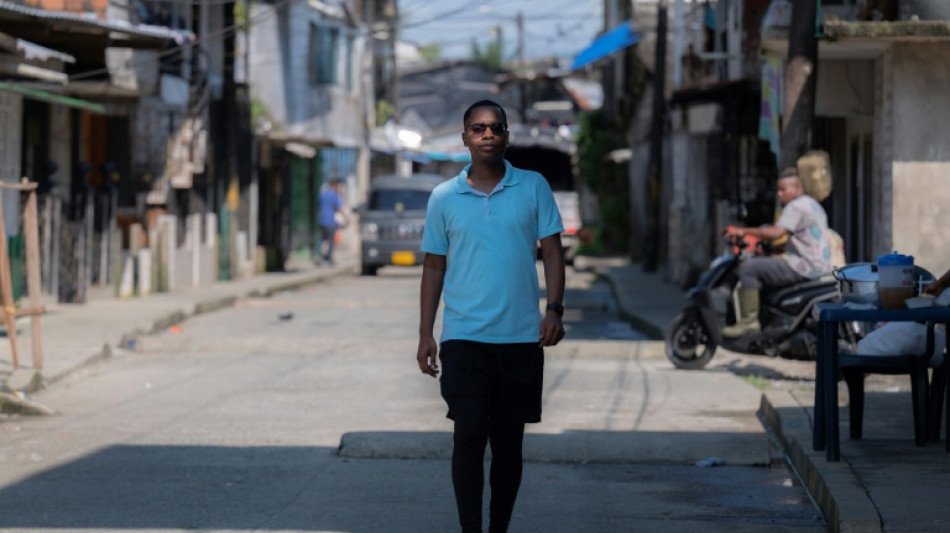
In Colombia, paying at-risk youngsters 'to not kill' / Photo: © AFP

 Indonesia accepts Malaysia's help to tackle wildfires

 Indians living in Japan on stand-by to house Asian Games athletes

 Trump signs bill authorizing sweeping Russia sanctions

 Protesters form human chain at Kennedy Center after Trump threat

 Death toll from attack at police HQ in Pakistan rises to 31

 Trump says Denmark to give US 'permanent control' over Greenland security

 Kennedy Center: future unclear for iconic Washington arts hub

 Trump claims 'infinite' Greenland security deal with Denmark

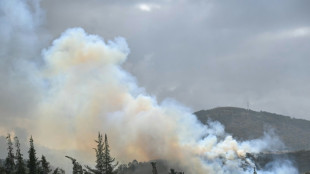 Helicopters battle wildfire threatening Ecuador's capital

 Brentford batter Chelsea to undo Alonso's promising start
 Kane hits Bundesliga century as Bayern rout Union
 Trump says CNN, MS NOW, Politico banned from White House
 Hushing and hedging: US companies retreat on climate

 Springboks to face Fiji before 2027 Rugby World Cup
 Nigeria miners struggled to breathe in cell before 37 died: survivors

 McIlroy on the charge at PGA Championship as Reed withdraws

 McIlroy on the charge at PGA Championship

 Crisis-wracked Volkswagen warns of 10-bn-euro hit to profits

 Costa Rica's Grynspan tops third informal poll for UN chief: diplomat

 Stock markets retreat after central bank rate hikes
 Russia labels director of Cannes Grand Prix winner a 'foreign agent'

 Macron warns of Russian 'hybrid' threat after meeting presidential hopefuls

 UN holds third informal poll for new chief

 Kulusevski return can spark Spurs: De Zerbi

 Shakira to cap off world tour with Madrid 12-gig run

Growing up in a rough Colombian neighborhood governed by criminals and their mob law, Franklin Mina was destined to become a gangster.
Instead, the 27-year-old today studies social work at a technical college and runs a small business in gang violence-plagued Buenaventura, on Colombia's Pacific coast.
Mina is a beneficiary of a new government plan to pay young people aged 14-28 in at-risk areas to stay out of trouble.
He receives the equivalent of about $250 per month, with which he bought a computer, a printer and supplies to open a stationery shop.
"Since I was a small boy I've known what a gun is, what a bullet is," Mina told AFP of growing up in Buenaventura in the Valle de Cauca department.
The city of 324,000 people, like many others in Colombia, is at the mercy of a violent dispute between criminal gangs.
That kind of childhood, said Mina, "leaves scars which affect a young person's being, his thinking."
- 'For my family' -
Launching the program "Youth in Peace" last year, Colombia's first-ever leftist President Gustavo Petro said thousands of young people with few options, like Mina, will receive money "to not kill, to not participate in violence, to study."
The government did not say how much money had been set aside for the initiative or how long it will run.
Since it started last October, nearly 3,000 young Colombians have become beneficiaries.
Some are in big cities like Bogota, the capital, or Medellin where the government is negotiating a peace with drug gangs heir to the cocaine empire of fallen kingpin Pablo Escobar.
Others hail from smaller settlements in the departments of Cauca and Valle del Cauca, where gangs and other armed groups finance themselves with drug trafficking, extortion and other illegal businesses.
In Buenaventura, where the majority of people are of African descent, about 40 percent of people live in poverty and one in four is unemployed.
Many young people have no alternative but to join the world of crime -- whether by choice or by force.
"I have been able to invest the (grant) money... to generate income not only for myself, but also for my family," said Mina, who also uses some of the grant towards his studies.
Many friends and family members, he said, were not so lucky and ended up in the clutches of gangs.
"We hope that this (initiative) can be expanded and generate opportunities for other young people like me," he told AFP.
- 'Want to change' -
To qualify, beneficiaries must come from poverty and live in circumstances where they are at high risk of being recruited by gangs.
They can have no outstanding warrants.
They receive payments for up to 18 months, and the grant can be stopped if a recipient gets into trouble with the law or stops attending class, for example.
The project has had its detractors.
Colombia's right-wing opposition has claimed, without providing evidence, that it is in fact a ruse for funding armed groups with state money.
It has also alleged corruption in the selection of beneficiaries.
Petro is trying to extricate Colombia from six decades of armed conflict between leftist guerrillas, right-wing paramilitaries, drug cartels and the military.
He is seeking to negotiate peace with several groups, while also attacking the root causes of the violence with projects such as "Youth in Peace."
For Mina, violence "is a structural problem. But this is the beginning of being able to transform ourselves."
Another Buenaventura beneficiary, 21-year-old hotel and tourism student Patricia Riascos, says she uses the grant money to pay for her transport to class.
She also helps her younger brother, who she is desperate to steer away from a criminal life.
"We are people who are at risk of becoming gangsters, but in reality we are not gangsters," she told AFP.
"We are people who want to change our lives."
T.Egger--VB