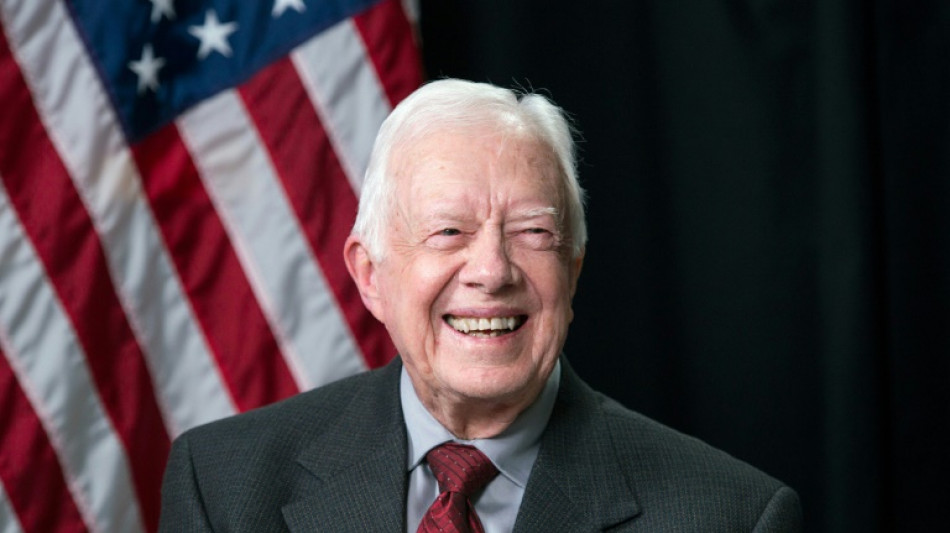
Jimmy Carter: president, global mediator, Nobel laureate / Photo: © LBJ Library/AFP

 Indonesia accepts Malaysia's help to tackle wildfires
 Indians living in Japan on stand-by to house Asian Games athletes

 Trump signs bill authorizing sweeping Russia sanctions

 Protesters form human chain at Kennedy Center after Trump threat

 Death toll from attack at police HQ in Pakistan rises to 31

 Trump says Denmark to give US 'permanent control' over Greenland security

 Kennedy Center: future unclear for iconic Washington arts hub

 Trump claims 'infinite' Greenland security deal with Denmark

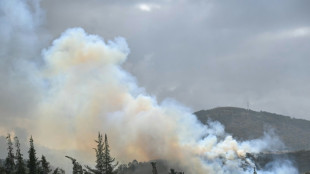 Helicopters battle wildfire threatening Ecuador's capital

 Brentford batter Chelsea to undo Alonso's promising start
 Kane hits Bundesliga century as Bayern rout Union

 Trump says CNN, MS NOW, Politico banned from White House

 Hushing and hedging: US companies retreat on climate
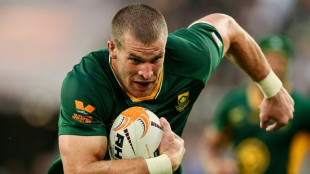 Springboks to face Fiji before 2027 Rugby World Cup
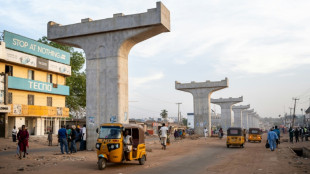 Nigeria miners struggled to breathe in cell before 37 died: survivors

 McIlroy on the charge at PGA Championship as Reed withdraws
 McIlroy on the charge at PGA Championship

 Crisis-wracked Volkswagen warns of 10-bn-euro hit to profits

 Costa Rica's Grynspan tops third informal poll for UN chief: diplomat

 Stock markets retreat after central bank rate hikes
 Russia labels director of Cannes Grand Prix winner a 'foreign agent'

 Macron warns of Russian 'hybrid' threat after meeting presidential hopefuls
 UN holds third informal poll for new chief

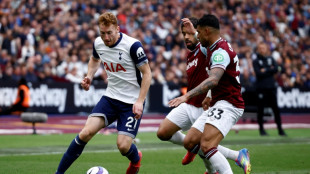 Kulusevski return can spark Spurs: De Zerbi

 Shakira to cap off world tour with Madrid 12-gig run

Jimmy Carter holds a unique place in US politics: he is the oldest former president and a Nobel peace laureate, who left office under a cloud of unpopularity and has seen his star rise ever since.
Carter -- who turned 100 on Tuesday -- arguably wielded his greatest influence not during his 1977-1981 term, but in the decades following when he served as a global mediator, rights activist and elder statesman.
The southern Democrat, who left the White House in 1981 after a crushing election loss to Ronald Reagan, was perceived as naive and weak in the dog-eat-dog world of Washington politics.
Even within his own party, the Georgia native with the broad toothy grin -- a "born-again" Christian who taught Sunday school well into his 90s -- was long persona non grata.
But as the years passed, a more nuanced image of Carter has emerged, one that took in his post-presidential activities and reassessed achievements like the brokering of a peace deal between Israel and Egypt.
He placed human rights and social justice at the core of his tenure as the 39th president of the United States.
That later served as the cornerstone of The Carter Center he founded in 1982 to pursue his vision of world diplomacy, to broad international praise.
The elderly president entered hospice care 19 months ago, but his longevity has defied all expectations.
According to family, Carter remains keenly interested in politics and is determined to vote in the November election for fellow Democrat Kamala Harris.
- From farm to White House -
James Earl Carter Jr -- the full name he rarely used -- was born on October 1, 1924 in the small farm town of Plains, Georgia, south of Atlanta -- the same town where he is spending his golden years.
After seven years in the Navy, where he worked on the nuclear submarine program and rose to the rank of lieutenant, he returned home to run the family peanut farm.
Eventually, politics came calling.
He served in Georgia's state senate and took over as governor in 1971, representing a new generation of white Southern men who were more tolerant and progressive on race.
"I am a Southerner and an American," said Carter, still a virtual unknown on the national political scene when he launched his presidential campaign ahead of the 1976 election.
Carter narrowly defeated incumbent Gerald Ford and arrived in Washington in 1977, sworn in to head a country mired in the gloom left over from Vietnam, Watergate and a deep recession.
For the first time since 1968, Democrats controlled the White House and Congress, so hopes were high.
- 'Extraordinarily difficult' -
Carter enjoyed a strong first two years.
A shining moment was the historic 1978 Camp David Accords signed by Israel's Menachem Begin and Egypt's Anwar Sadat, leading to a peace treaty the following year.
Carter also established diplomatic relations with China following a rapprochement initiated by then president Richard Nixon, and endorsed solar energy, even installing solar panels on the White House.
But his administration hit numerous snags, the most serious being the Iran hostage crisis and the disastrous failed attempt to rescue the 52 captive Americans in 1980.
His handling of the oil crisis in 1979-1980 was also sharply criticized. Images of cars lined up at gas stations were long associated with his presidency.
Even now, few Democrats claim to be picking up Carter's mantle.
In a 2010 biography, Princeton University historian Julian Zelizer said Carter had fallen victim to "an extraordinarily difficult set of circumstances that would have challenged any president."
- 'Best ex-president' -
But Carter bounced back in perhaps the most spectacular reinvention of any US leader, and is often called America's "best ex-president."
He founded his eponymous center in Atlanta and emerged as a prominent international mediator, tackling some of the most intransigent global dilemmas -- including North Korea and Bosnia in the 1990s.
He supervised dozens of elections around the world, from Haiti to East Timor, and went to Cuba in 2002 for a historic meeting with communist leader Fidel Castro on human rights.
Carter has won a host of awards including the 2002 Nobel Peace Prize and the highest US civilian award, the Presidential Medal of Freedom. He won three Grammys for his audiobooks.
Carter maintained a busy schedule into his 90s. He and wife Rosalynn helped build houses for the charity Habitat for Humanity for decades.
Rosalynn died in November 2023 at age 96. The couple had three sons and a daughter.
In 2015, Carter revealed he had brain cancer and was undergoing treatment.
At the time of his diagnosis, Carter said while the presidency was the "pinnacle" of his political career, "life since the White House has been personally more gratifying."
H.Kuenzler--VB