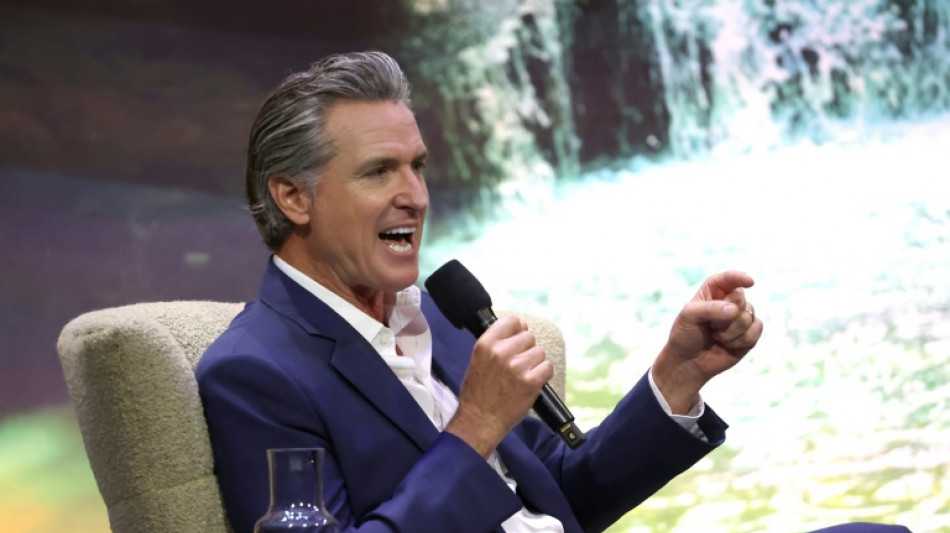
California enacts law to protect brain data / Photo: © GETTY IMAGES NORTH AMERICA/AFP/File

 Inter Milan and Italy icon Mazzola dies aged 83

 Saudi capital issues first air raid alert since renewed fighting in Yemen

 Martin edges title rival Marquez for Austrian MotoGP pole

 Indonesia accepts Malaysia's help to tackle wildfires
 Indians living in Japan on stand-by to house Asian Games athletes

 Trump signs bill authorizing sweeping Russia sanctions

 Protesters form human chain at Kennedy Center after Trump threat

 Death toll from attack at police HQ in Pakistan rises to 31

 Trump says Denmark to give US 'permanent control' over Greenland security

 Kennedy Center: future unclear for iconic Washington arts hub
 Trump claims 'infinite' Greenland security deal with Denmark
 Helicopters battle wildfire threatening Ecuador's capital

 Brentford batter Chelsea to undo Alonso's promising start

 Kane hits Bundesliga century as Bayern rout Union

 Trump says CNN, MS NOW, Politico banned from White House

 Hushing and hedging: US companies retreat on climate
 Springboks to face Fiji before 2027 Rugby World Cup

 Nigeria miners struggled to breathe in cell before 37 died: survivors

 McIlroy on the charge at PGA Championship as Reed withdraws
 McIlroy on the charge at PGA Championship

 Crisis-wracked Volkswagen warns of 10-bn-euro hit to profits

 Costa Rica's Grynspan tops third informal poll for UN chief: diplomat
 Stock markets retreat after central bank rate hikes

 Russia labels director of Cannes Grand Prix winner a 'foreign agent'

 Macron warns of Russian 'hybrid' threat after meeting presidential hopefuls
A new California law extends consumer privacy protection to brainwave data gathered by implants or wearable devices.
Governor Gavin Newsom over the weekend signed into law a bill amending the California Consumer Privacy Act, the state's spin on the GDPR in Europe, to classify "neural data" as protected personal information along the lines of precise geolocation, genetics and biometrics.
Neurorights Foundation medical director Sean Pauzauskie called the Califoria law "an enormous victory" for patients suffering from mental health disorders as well as for consumers simply looking to enhance their lives with new technologies.
The NGO co-sponsored the bill with a state senator.
"The essential privacy guardrails it ensures should only boost confidence in all varieties of these revolutionary neurotechnologies, the great majority which are based in California," Pauzauskie said in a release.
California is the second state to extend data protections to brainwaves, on the heels of Colorado putting in place a law requiring privacy safeguards along the lines of what is done for fingerprints.
The California law sends "a clear signal to the fast-growing neurotechnology industry" to protect people's mental privacy, NeuroRights Foundation general counsel Jared Genser said in a release.
Genser argued for a national brainwave data privacy law.
Protections under the California law include the right to know what brain data is being collected, limit its disclosure, and to be able to opt-out or have it deleted.
The law applies to devices capable of recording or altering nervous system activity, whether they be implanted or worn, the NGO said.
The potential for devices to tap into how people feel or think has raised concerns they could be used to manipulate feelings or thoughts.
"In the coming years, the sensitivity of neural data will increase alongside surging investments...resulting in increased resolution of brain scans and larger datasets of brain data being collected," the NGO predicted.
"Meanwhile generative artificial intelligence will continue accelerating the ability to accurately decode these scans."
Billionaire Elon Musk with his Neuralink startup is among those striving to link brains and computers.
Musk envisions Neuralink implants going beyond restoring sight to the blind to giving people infrared or ultraviolet vision or letting them share concepts with others telepathically.
"We want to give people superpowers," Musk said. "Not just that we're restoring your prior functionality, but that you actually have functionality far greater than a normal human."
L.Wyss--VB