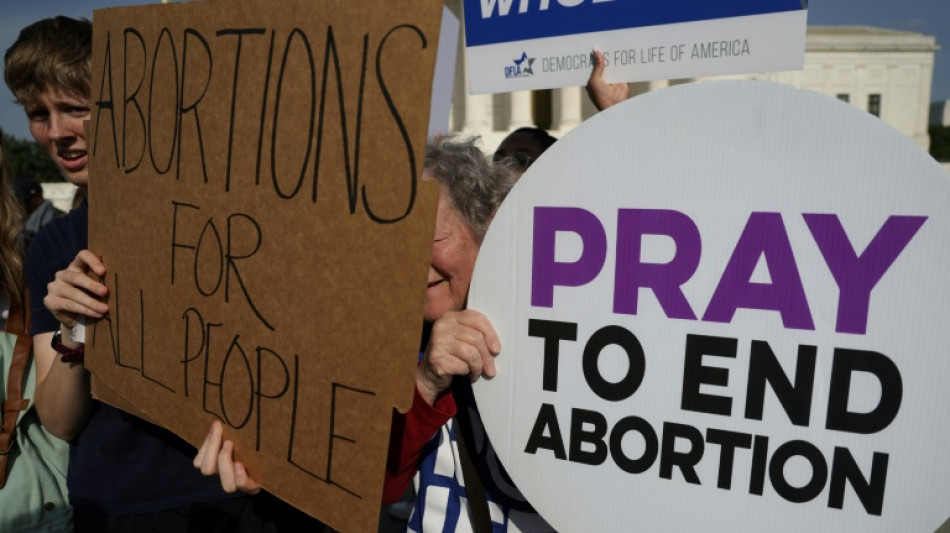
Georgia judge overturns US state's six-week abortion ban / Photo: © GETTY IMAGES NORTH AMERICA/AFP

 Energy bill plan could use HMRC income data to target support

 Business owner earning £6,000 a month tackles £70,000 debt

 Nvidia chief faces inquiry after disclosing affair with suspected Chinese agent

 Comet returns as online electrical marketplace 14 years after collapse

 Aston Villa Defy History With Rare Victory at Old Trafford

 Qatar Airways Launches Bogotá-Caracas-Doha Route Linking Energy Markets

 Marc Almond to Close Soft Cell Era After Final 'Danceteria' Tour
A Georgia judge on Monday overturned the southern US state's ban on performing abortions for women who are more than six weeks pregnant.
Fulton County Superior Court Judge Robert McBurney ruled that Georgia's so-called "heartbeat" abortion law is unconstitutional.
The state law banned abortions after an embryo's cardiac activity can be detected, which is usually around six weeks, before many women even know they are pregnant.
It was passed by the Republican-dominated state legislature in 2019 and went into effect in 2022 after the US Supreme Court struck down the nationwide right to the procedure.
The Supreme Court's abortion ruling unleashed a wave of restrictions in nearly two dozen of the 50 US states, and abortion rights have become a key issue in the November presidential election between Republican Donald Trump and Democrat Kamala Harris.
McBurney's ruling once again allows abortions in Georgia up until viability, which is around 22 weeks of pregnancy.
"Liberty in Georgia includes... the power of a woman to control her own body, to decide what happens to it and in it, and to reject state interference with her healthcare choices," the judge said.
"That power is not, however, unlimited," he added. "When a fetus growing inside a woman reaches viability, when society can assume care and responsibility for that separate life, then -- and only then -- may society intervene."
The nonprofit Center for Reproductive Rights welcomed McBurney's ruling but noted that Georgia Attorney General Chris Carr, a Republican, may ask the state supreme court to block it and reinstate the strict abortion ban.
"If he does so, abortion providers and advocates will fight to preserve this ruling and to ensure every Georgian can make the personal medical decisions that are best for their health, their futures and their families," the Center for Reproductive Rights said in a statement.
Monica Simpson, executive director of the group which brought the case, the SisterSong Women of Color Reproductive Justice Collective, called the judge's ruling a "significant step in the right direction" but said it came too late for two women in Georgia who died because they were denied timely abortion access.
T.Zimmermann--VB