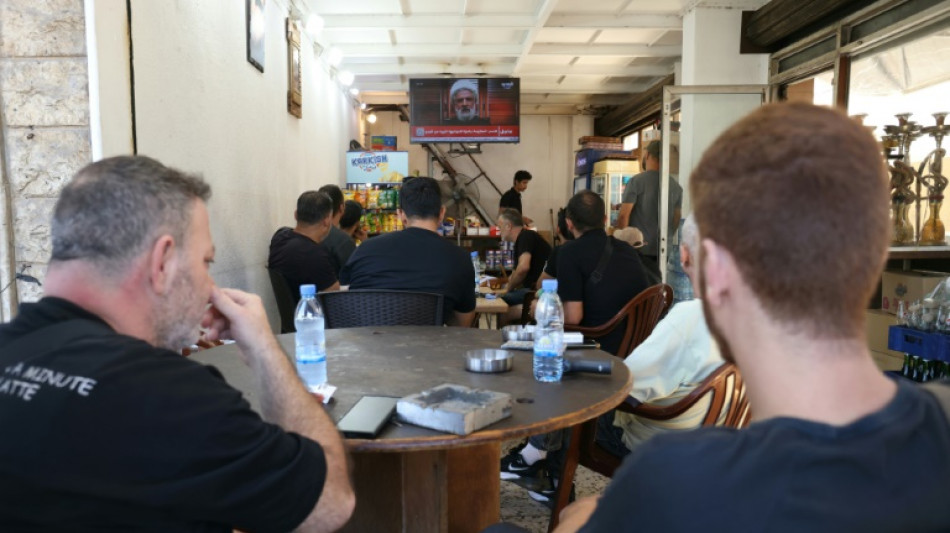
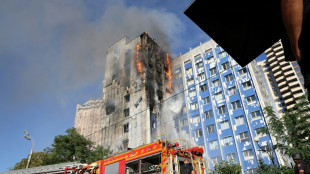
Hezbollah vows to keep fighting Israel after Nasrallah killing / Photo: © AFP

 Brigitte Bardot widower slams sale of star's belongings

 Aston Villa compound Tottenham's misery despite late rally

 Asian Games offer 'deepest apologies' for South Korea anthem blunder
 Inter Milan and Italy icon Mazzola dies aged 83

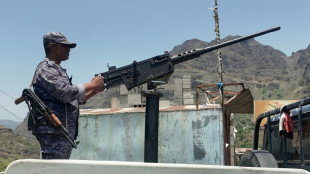 Saudi capital issues first air raid alert since renewed fighting in Yemen

 Martin edges title rival Marquez for Austrian MotoGP pole

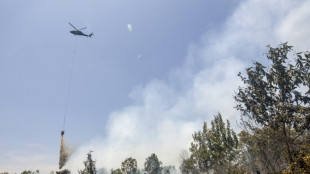 Indonesia accepts Malaysia's help to tackle wildfires
 Indians living in Japan on stand-by to house Asian Games athletes
 Trump signs bill authorizing sweeping Russia sanctions

 Protesters form human chain at Kennedy Center after Trump threat
 Death toll from attack at police HQ in Pakistan rises to 31

 Trump says Denmark to give US 'permanent control' over Greenland security

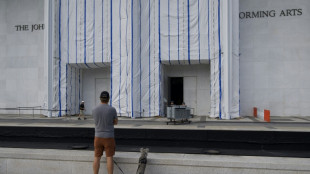 Kennedy Center: future unclear for iconic Washington arts hub

 Trump claims 'infinite' Greenland security deal with Denmark

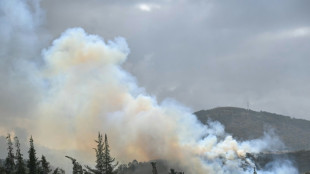 Helicopters battle wildfire threatening Ecuador's capital

 Brentford batter Chelsea to undo Alonso's promising start
 Kane hits Bundesliga century as Bayern rout Union
 Trump says CNN, MS NOW, Politico banned from White House
 Hushing and hedging: US companies retreat on climate

 Springboks to face Fiji before 2027 Rugby World Cup
 Nigeria miners struggled to breathe in cell before 37 died: survivors

 McIlroy on the charge at PGA Championship as Reed withdraws

 McIlroy on the charge at PGA Championship

 Crisis-wracked Volkswagen warns of 10-bn-euro hit to profits

 Costa Rica's Grynspan tops third informal poll for UN chief: diplomat

Hezbollah vowed on Monday to keep fighting Israel in support of Gaza after its leader was killed in a massive wave of air strikes on Lebanon that dealt the group a seismic blow.
In a televised address on Monday, the Iran-backed group's deputy chief Naim Qassem said a new leader to replace Hassan Nasrallah, who enjoyed cult status among his supporters, would be selected "at the earliest opportunity".
He also said the group was ready for any Israeli ground offensive, even though Israel's bombardment of its strongholds has in the past week killed a large number of its top commanders and officials.
Hezbollah began low-intensity cross-border strikes on Israeli troops a day after its Palestinian ally Hamas staged its unprecedented attack on Israel on October 7, triggering war in the Gaza Strip.
Israel said earlier this month that it was shifting its focus from Gaza to securing its northern border with Lebanon, in order to allow Israelis displaced since October to return to their homes.
It has also not ruled out a ground offensive in order to achieve its goals.
The strikes on Lebanon have killed hundreds and forced hundreds of thousands more to flee their homes, and left people across the region fearful of more violence to come.
Qassem said Hezbollah would continue "confronting the Israeli enemy in support of Gaza and Palestine, in defence of Lebanon and its people, and in response to the assassinations and the killing of civilians".
"We will face any scenario and we are ready if Israel decides to enter by land, the resistance forces are ready for any ground confrontation," he added.
- Beirut strike -
Most of Israel's strikes have targeted Hezbollah strongholds in eastern and southern Lebanon and the southern suburbs of Beirut, the group's main bastion.
On Monday, a drone strike hit a building in the Cola district in central Beirut, with an armed Palestinian group saying it had killed three of its members.
The strike, the first in the centre of the city in years, sparked panic, with 41-year-old resident Mohammed al-Hoss saying "the kids were in shock" after his house was damaged.
"Our country is in a wretched state. They (Israel) finished with Gaza and they have come to Lebanon."
Lebanon's health ministry also reported the strike, saying it had killed four people and wounded four others. Israel has yet to comment.
Palestinian Islamist group Hamas later announced that its leader in Lebanon, Fatah Sharif Abu al-Amine, had been killed along with his wife and two children in another strike on Al-Bass refugee camp in south Lebanon.
The Israeli military confirmed it had "eliminated" Sharif in a strike.
Around Lebanon, Israeli strikes killed 105 people on Sunday, according to the Lebanese health ministry.
Lebanon's Health Minister Firass Abiad said Saturday that 1,030 people including 87 children had been killed since September 16.
UN refugee agency chief Filippo Grandi said "well over 200,000 people are displaced inside Lebanon", while more than 100,000 have fled to neighbouring Syria.
Prime Minister Najib Mikati said up to one million people may have been uprooted, in potentially the "largest displacement movement" in Lebanon's history.
- Yemen strikes -
The violence in Lebanon has raised fears of a much wider conflagration in the region.
On Monday, the Israeli army said it "successfully intercepted a suspicious aerial target that crossed from Lebanon into Israeli territory".
Israel said it also carried out strikes in Yemen on Sunday, targeting Iran-backed Huthi rebel positions.
Huthi media reports said those strikes killed four people and wounded 33.
The raids in Yemen came a day after the Huthis said they launched a missile at Israel's Ben Gurion airport, trying to hit it as Prime Minister Benjamin Netanyahu was returning from New York.
The Israeli military has said its operations in Lebanon aim to eliminate Hezbollah's leadership and capacity to attack Israel.
Hezbollah on Monday confirmed that Israel also killed Nabil Qaouq, a member of the group's central council, in a Beirut strike on Saturday.
Lebanon began a three-day national mourning period for Nasrallah on Monday, with flags flying at half-mast.
Iran has said Nasrallah's killing would bring about Israel's "destruction", though the foreign ministry said Monday it would not deploy any fighters to confront Israel.
In Israel, some had mixed feelings about the Hezbollah chief's killing.
"Nasrallah was responsible for the deaths of many Israelis, so it is good news," said Matan Sofer, 24, in the northern town of Rosh Pina.
"But do we risk it getting worse, who knows?"
- Calls for halt -
World leaders have called for a de-escalation.
French Foreign Minister Jean-Noel Barrot met with the Lebanese premier in Beirut Monday, and said his government sought "an immediate halt" in the strikes.
He is the first high-level foreign diplomat to visit since the Israeli strikes intensified.
US President Joe Biden, whose government is Israel's top arms supplier, said Sunday a wider war "really has to be avoided".
In Gaza, AFP journalists said the number of air strikes across the territory has dropped significantly in recent days, particularly since Nasrallah's killing.
Hamas's unprecedented October 7 attack on Israel resulted in the deaths of 1,205 people, mostly civilians, according to an AFP tally based on Israeli official figures that include hostages killed in captivity.
Israel's retaliatory military offensive has killed at least 41,615 people in Gaza, most of them civilians, according to figures provided by the Hamas-run territory's health ministry. The UN has described the figures as reliable.
burs/ser/jsa
A.Ammann--VB