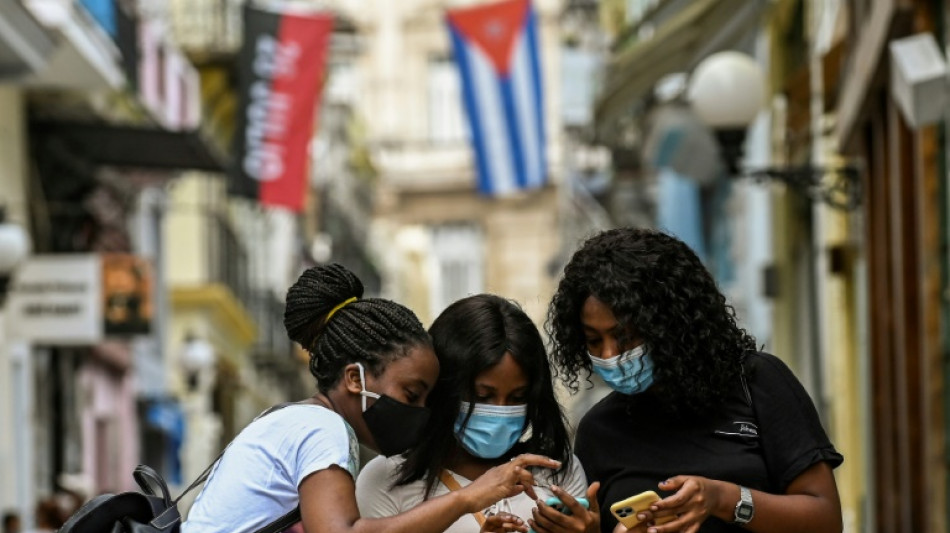
New Cuban penal code 'turning the screw' on dissent, critics say / Photo: © AFP/File

 Oil prices jump as US-Iran deal hopes falter

 Newly crowned world's best pastry chef stays true to artisan roots
 Johnson signs for Everton in McNeil swap deal
 Syria sentences Bashar al-Assad to death in absentia over atrocities

 Hong Kong's tech index plans expansion with AI and robotics themes
 The Infantino saga -- What they said
 Economic losses from natural disasters fall to $100 bn in first half of 2026: Swiss Re
 Colombia scrambles to find survivors as quake kills 132

 Singapore says AI-related demand lifting economy
 Demeter Tactical Investments (ME) Limited bolsters governance with two board appointments

 Russian barrage on Ukraine kills 9, wounds dozens

 Schools closed as Indonesia battles wildfires

 Swiatek dominates Shnaider to set up Toronto semi with Svitolina

 Oil prices rise further as hopes for Hormuz deal fade

 One year after Putin-Trump summit, 'spirit of Anchorage' dissipated

 Farage vs Count Binface: What to know about UK snap poll

 Torment of Afghan fathers as daughters deprived of education
 Return of displaced Syrian Kurds to hometown suspended after violence
 Swiatek races past Shnaider into Toronto semi-finals
 Meta pushes global AI vision amid race with OpenAI, Anthropic and China

 US judge ends graft case against India's Adani

 Anderson retires after 10 MLB seasons after 'too much pain'

 Colombia in state of emergency as quake kills 111

 Britain's Amy Hunt wins European women's 100m gold

 Trump order pushes for overhaul of childhood vaccine schedule
Ten months after unprecedented anti-government protests rocked Cuba, the government is pushing through a penal reform opponents say is designed to pre-emptively quell any future displays of growing public discontent.
The new code, set to be approved at an extraordinary session of parliament Saturday, will criminalize "propaganda" spreading and foreign funding for activities that threaten the "security of the state."
Also punishable by up to two years in prison will be demonstrations by one or more people "in breach of provisions."
Why?
To "protect the political and state socialist system from all actions and activities that are committed against the constitutional order and with the purpose of creating a climate of social instability and a state of ungovernability," states the draft published on the website of the public prosecutor's office.
The penal code reform is part of a slew of laws that need to be passed to give execution to Cuba's new constitution, approved in 2019.
But unlike other draft laws -- including a new family code that will legalize same-sex marriage and surrogacy -- there was no public consultation, and there will be no referendum.
"It is striking that... this new body of legislation was drafted in secret," Rene Gomez Manzano, a 77-year-old lawyer, former political prisoner and dissident activist, told AFP.
With the code, "the regime is turning the screw, intensifying the repression of citizens," said Gomez, who heads a body of dissident Cuban lawyers.
- Communications offenses -
The code creates 37 brand new offenses related to the use of "telecommunications, information and communication technologies."
This is an apparent response to the arrival of the mobile internet on the island in 2018, which has revolutionized the way people express discontent and organize themselves in a one-party state known for its dislike of dissent.
Last July, thousands of Cubans spontaneously spilled into the streets of numerous cities and towns, demanding "freedom" and denouncing their plight as the country reeled from its worst economic crisis in nearly three decades.
Such a mass public outpouring of dissent had never been seen in the 60 years since Fidel Castro's revolution.
The response by security forces left one person dead, dozens injured and more than 1,300 people detained.
Hundreds have since been sentenced, some to jail terms of as much as 30 years for crimes such as public disorder and sedition -- both of which remain on the statute book.
- 'Propaganda' -
The draft penal code foresees a prohibition on foreign funding of activities perceived as being targeted "against the security of the state"
This means independent or opposition media, activists and dissident groups will become punishable as "mercenaries" for receiving money from agencies and NGOs abroad.
They will risk prison sentences ranging from four to 10 years.
"In a country where private media is illegal and journalists have no possibility of obtaining local funding, prohibiting foreign funding is a death sentence to independent journalism," said the Committee to Protect Journalists (CPJ).
The existing crime of "enemy propaganda" will be changed to "propaganda against the constitutional order," and the "dissemination of false news or malicious predictions with the aim of causing alarm, discontent or disinformation" will also become punishable.
The code's "hardening of penalties... is designed to have a notable impact on Cuban political activism," said jurist Harold Bertot, a Cuban law professor now in Madrid for research.
He pointed out that it comes "in a time of political and social tension in Cuba" and was clearly "designed to have a notable impact on Cuban political activism".
Bertot said the draft text foresees "a significant number of crimes punishable by the death penalty" -- a punishment not meted out in almost 20 years.
Cuba has maintained a de facto moratorium on capital punishment -- previously carried out by shooting -- since 2000, broken only in 2003 with the execution of three Cubans who had hijacked a passenger boat to escape the island.
M.Furrer--BTB