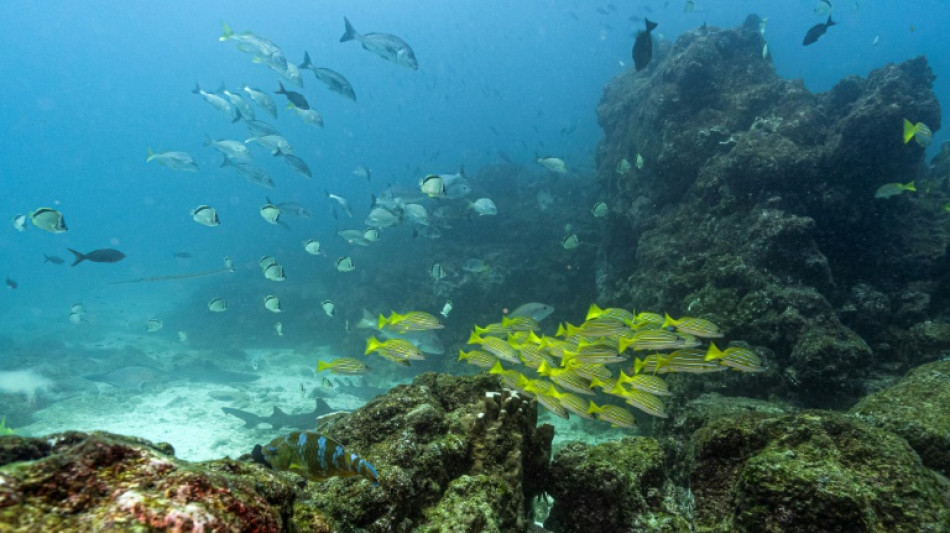
World's oceans near critical acidification level: report / Photo: © AFP

 Sbírka Haupt: Co o nás lidech prozrazují peníze
 North and South Korea fight out draw in niggly Asian Games clash

 Officials say man shot, wounded by ICE agent in Texas

 豪普特收藏:金錢如何揭露人類的本質

 Kolekcja Haupta: Co pieniądze mówią o nas, ludziach

 The Haupt Collection: What Money Reveals About Us as Human Beings

 Barcelona enter new era aiming to retain Women's Champions League crown

 US has deported 25,000 to third countries under secretive deals: report

 Three South Korean soldiers injured in DMZ blast: military

 New Zealanders pick endangered black robin as Bird of the Year

 Asia stocks rise on AI, US-China trade talks optimism

 Malaysia's 'elephant whisperer' fights to save Borneo's endangered giants

 'I live in fear': 1.5 million Pakistani children sexually exploited online

 Cowboys beat Commanders, Vikings down Bears as star QBs injured

 Braves clinch division title as Red Sox reach MLB playoffs

 Bordeaux-Begles hammer Stade Francais despite Jalibert injury

 Milan and Juventus end blips with home wins

 Bridgeman wins PGA Biltmore title with sizzling 61

 Williams injured as Bears shut down by Vikings

 US warns of rapid escalation in Middle East war

 Germany's far-right AfD celebrates another state election win

 Russia vows revenge for election-day attacks as poll shows ruling party win

 Spaun late shows snatches PGA Championship win

 Conceicao strikes as Juventus beat Atalanta

 Britain, Zverev-inspired Germany, Spain complete Davis Cup finals

The world's oceans are close to becoming too acidic to properly sustain marine life or help stabilise the climate, a new report said on Monday.
The report by the Potsdam Institute for Climate Impact Research (PIK) details nine factors that are crucial for regulating the planet's ability to sustain life.
In six of these areas, the safe limit has already been exceeded in recent years as a result of human activity.
The crucial threshold for ocean acidification could soon become the seventh to be breached, according to the PIK's first Planetary Health Check.
The safe boundaries that have already been crossed concern crucial -- and related -- factors including climate change; the loss of natural species, natural habitat and freshwater; and a rise in pollutants, including plastics and chemical fertilisers used in agriculture.
The sustainable level of ocean acidification is now also set to be exceeded, largely as a result of ever-increasing emissions of carbon dioxide (CO2) created by burning fossil fuels like oil, coal and gas.
"As CO2 emissions increase, more of it dissolves in sea water... making the oceans more acidic," Boris Sakschewski, one of the lead authors, told reporters.
"Even with rapid emission cuts, some level of continued acidification may be unavoidable due to the CO2 already emitted and the time it takes for the ocean system to respond," he explained.
"Therefore, breaching the ocean acidification boundary appears inevitable within the coming years."
- Tipping points -
Acidic water damages corals, shellfish and the phytoplankton that feeds a host of marine species.
This means it also disrupts food supplies for billions of people, as well as limiting the oceans' capacity to absorb more CO2 and thus help limit global warming.
The only one of the nine planetary boundaries that is not close to being crossed concerns the state of the planet's protective ozone layer.
Man-made chemicals have damaged this shield, causing acid rain, but it has started recovering since a number of these chemicals were banned in 1987.
A ninth threshold -- concerning concentrations of minute particles in the atmosphere that can cause heart and lung diseases -– is close to the danger limit.
But the researchers said the risk showed signs of receding slightly due to efforts by several countries to improve air quality, such as banning the most pollutant petrol and diesel cars.
They warned, however, that concentrations of fine particles could still soar in countries that are rapidly industrialising.
The PIK set these nine planetary danger levels to warn humans against tipping Earth's natural systems past points of no return.
"These tipping points... if crossed, would lead to irreversible and catastrophic outcomes for billions of people and many future generations on Earth," they said.
All nine planetary boundaries are "interconnected" so breaching one crucial limit can destabilise Earth's entire life system, Sakschewski said.
But that also presents an opportunity because addressing one problem -– such as preventing the Earth's average temperature rising more than 1.5 degrees Celsius above pre-industrial levels -- "can lead to significant benefits across different issues", the report said.
D.Bachmann--VB