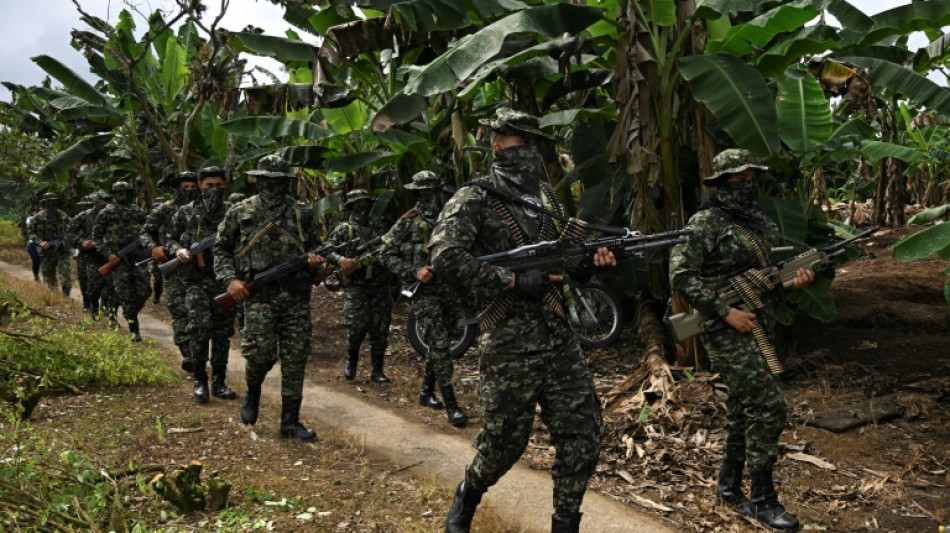
Colombia rebel group imposes control in restive coca zone / Photo: © AFP

 Mbappe says having Zidane as France coach 'like a film'

 Palmer, Rice out of England Nations League squad
 German auto workers stage mass protests in bid to save jobs

 Embattled Merz vows to keep ruling for 'democratic future' of Germany

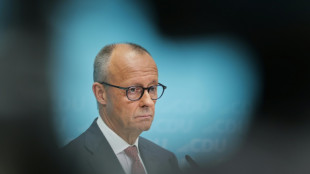 Merz vows to keep ruling coalition together for 'democratic future' of Germany
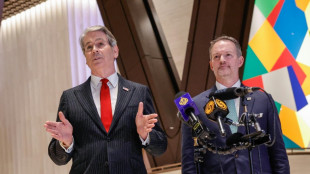
 Spain coach De la Fuente gets new deal after World Cup success

 Pressure grows on Germany's Merz after election defeats

 China's Zhang beats Japan rivals to Asian Games gymnastics gold
 Samlingen Haupt: Vad pengar avslöjar om oss människor

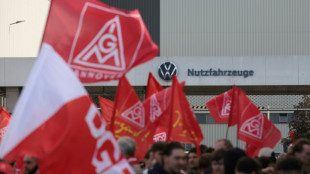 Tens of thousands of German auto workers protest to save jobs

 हॉप्त् कलेक्शन: पैसा हमारे बारे में एक इंसान के रूप में क्या प्रकट करता है

 Συλλογή Haupt: Τι αποκαλύπτει το χρήμα για εμάς τους ανθρώπους
 TradersYard Shifts Focus to Futures Trading

 ハウプト・コレクション:お金が人間について明かすこと
 하우프트 컬렉션: 돈이 우리 인간에 대해 드러내는 것

 Indonesia doing 'everything' but struggling to curb fires

 Sbírka Haupt: Co o nás lidech prozrazují peníze
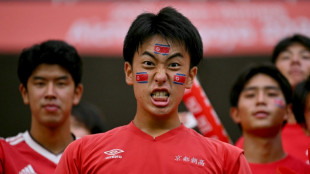 North and South Korea fight out draw in niggly Asian Games clash
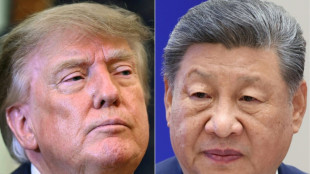
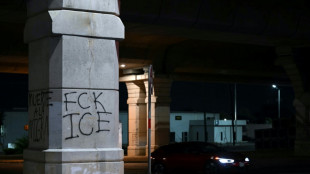 Officials say man shot, wounded by ICE agent in Texas

 豪普特收藏:金錢如何揭露人類的本質

 Kolekcja Haupta: Co pieniądze mówią o nas, ludziach
 The Haupt Collection: What Money Reveals About Us as Human Beings

 Barcelona enter new era aiming to retain Women's Champions League crown

 US has deported 25,000 to third countries under secretive deals: report
 Three South Korean soldiers injured in DMZ blast: military
A veneer of calm has settled over Narino, one of the most violent regions of Colombia, where armed groups until recently waged bloody battles for control of vast coca fields.
The guerrilla group Segunda Marquetalia has taken control of the southwestern region -- roughly the size of Belgium -- using financial backing from Mexican cartels to unify myriad armed outfits, analysts say.
"The change has been spectacular, the groups have united, the violence has reduced considerably," said Jerson David, the president of a local association of subsistence farmers who work in the coca fields.
"Here, people grow coca according to the rules of the Segunda Marquetalia," he added.
Nearby, workers carry sacks filled with vivid green coca leaves that will be crushed and mixed with gasoline and chemicals in a makeshift laboratory, making a paste that will later become cocaine.
Coca fields stretch as far as the eye can see around the town of Zavaleta. In 2022, the Narino region grew some 40 percent of the total coca in Colombia -- the world's main cocaine producer.
In the town's center, packs of motorbikes roar down the main street, and men dripping in gold chains and with handguns at their sides stare suspiciously at strangers.
At the entrance to the town hangs an old banner: "Segunda Marquetalia wishes you a Merry Christmas."
- 'Cauldron of violence' -
Until 2016, it was the Marxist Revolutionary Armed Forces of Colombia (FARC) guerrilla group that held a monopoly over the profitable region.
When the group signed a landmark peace agreement with the government that year, "there was a rush to occupy this space," explained Elizabeth Dickinson, an analyst for the International Crisis Group (ICG).
Narino became a "cauldron of violence and competition around drug trafficking."
Segunda Marquetalia was formed by the chief FARC peace negotiator, Luciano Marin -- alias Ivan Marquez -- who launched a new rebellion in 2019.
Dickinson said one of the group's commanders had links with Mexican cartels who provided the capital to recruit forces from other regions.
"The Segunda Marquetalia, with that influx of money and fighters, swept through Narino with remarkable speed," in the last two years, she said.
The takeover also involved a bloody war with another FARC dissident group, the EMC (Central General Staff) in 2023.
Since then, Segunda Marquetalia has reigned supreme in this Pacific coastal region, where the Andes descend into the foothills of the Amazon, towards scorching savannah and seaside mangroves.
Narino in 2023 accounted for 27.3 percent of all victims of conflict in Colombia, according to the Indepaz think tank.
About 30 massacres have been committed there and 130 community leaders killed since 2016.
- 'Pact' with locals -
In the baking afternoon heat in Zavaleta, coca workers and guerrillas, with beers in hand, flock to bars like "El Patron", bearing the image of the late narco kingpin Pablo Escobar.
The police and army are totally absent, entrenched behind sandbags at their bases dozens of kilometers away.
The guerrillas keep a close watch over coca production and development projects such as road building.
Like several of Colombia's armed groups, Segunda Marquetalia has been involved in stop-start peace negotiations with the government.
"Peace, and the abandonment of coca, requires a transformation of the land, that is to say road construction, electricity networks," the group's second-in-command and chief negotiator, Walter Mendoza, told AFP surrounded by gun-toting men.
The group says it works in the interest of local communities, but experts refer to coercive control of the population.
Local journalist Winston Viracacha described the relationship as a "pact" in which locals carry out projects for the benefit of both sides, in return for payment from the guerrillas who "ensure order and social control."
One reason for the respite from violence is that the armed group is no longer interested in taking on the government directly.
"What interests them is local control to facilitate illegal economic activity. Rather than fighting the army, they want to control the population," said Dickinson.
Segunda Marquetalia has enforced its authority in other towns too, such as coastal Tumaco with its mainly Afro-Colombian population and long history of extreme poverty and violence between armed groups.
Until 2023, "no foreigner could set foot" in Bajito, a neighborhood of Tumaco with a pretty beach where mutilated bodies used to turn up, said municipal councillor Duvan Mosquera Cortes.
Now, "tourists can come here in peace."
However, Dickinson warns that "the situation remains extremely fragile," as a rival armed group could try and edge out the Segunda Marquetalia at any time.
P.Vogel--VB