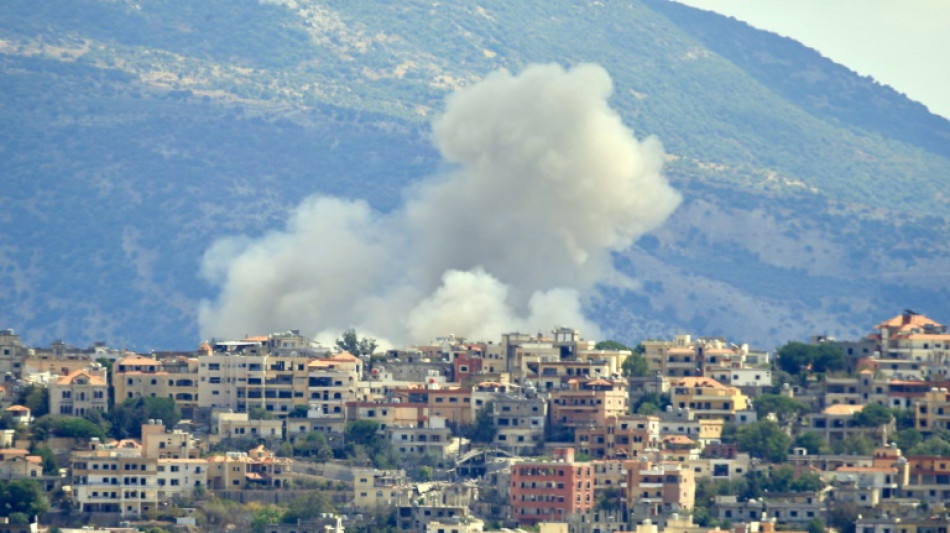
Why is Israel focusing on border with Lebanon? / Photo: © AFP

 UK agrees support for Saudi in struggle with Houthis: reports

 EU foreign policy chief calls for continued sanctions on Russia

 Flights scrapped, evacuations urged as Typhoon Dujuan wallops Japan

 Fonseca to take break from tennis

 A Cuban zoo, and its animals, in epic battle for survival

 Infantino proposes consulting federations to reform FIFA

 El Nino weather pattern enters record territory: scientist
 OpenAI calls for US to lead global effort on AI standards

 South African ostriches plucked alive for luxury fashion: report
 US networks halt Trump coverage in revolt over White House ban

 Paramount settles with US states to clear Warner Bros. mega-merger

 Climate crisis a job for world leaders, not just activists: UK FM

 US networks halt Trump coverage over White House ban
 French singer accuses Miley Cyrus of plagiarism

 EU fines Google 403 mn euros for location data breach

 'Best is yet to come,' says De la Fuente after Spain extension

 Why diesel prices are rising more than crude oil

 COP31 host says AI's climate footprint to be a summit priority

 Renewables hit record in 2025, but world must move faster: report

 US media outlets to sue Trump administration after White House ban

 Global stocks rally on lower oil prices, US-China hopes

 EU proposes energy rating for data centres

 Schoolgirl Yu scorches to second gold as doping case rocks Games

 Putin's party secures record score in Russia election

 Haupt Koleksiyonu: Paranın Biz İnsanlar Hakkında Anlattıkları

A series of deadly explosions targeting Hezbollah members this week in Lebanon came only days after Israel announced plans to expand its war in Gaza to its northern border with Lebanon.
Hezbollah and its main backer Iran have blamed Israel for the blasts, but Israeli officials have neither confirmed nor denied responsibility.
The explosions have raised the likelihood of full-scale war with Hezbollah, and experts interviewed by AFP offered insights on how that might unfold.
- Why now? -
Since the Gaza war began almost a year ago, Israel and Hamas ally Hezbollah have engaged in near-daily cross-border clashes.
Hundreds have been killed in Lebanon, mostly Hezbollah militants, and dozens have died in Israel, with tens of thousands displaced on both sides.
Prime Minister Benjamin Netanyahu and other Israeli officials have stressed the need to secure the north so uprooted residents can return home.
"We will use all means necessary to restore security to our northern border and to safely return our citizens to their homes," Netanyahu said during a recent trip to the north.
But a return to peace in the north remains unlikely in the short term, said Calev Ben-Dor, a former Israeli foreign ministry analyst.
Ben-Dor said both Israel and the United States had hoped a Gaza ceasefire would lead to calm in the north, but the chances of such a ceasefire were fading.
"The chances for a ceasefire in Gaza are receding" just as "most of Israel's military goals in Gaza have been achieved", leaving Israel room to reassign units, he said.
Kobi Michael, an analyst for the Institute for National Security Studies and Misgav think-tanks, said the army had more flexibility to shift its forces to the northern front.
"(The army) can run the situation with less forces, and therefore we can move the focus and the concentration to the north," he told AFP.
"The idea that Israel cannot realise its sovereignty over the northern parts of the country is something that cannot be tolerated".
- What are Israel's goals? -
There have been calls from within the Israeli government to push Hezbollah out of southern Lebanon, beyond the Litani river, but Israel's current strategy remains unclear.
The United States, through its envoy Amos Hochstein, favours a diplomatic solution that keeps Hezbollah and its vast arsenal of rockets away from the border.
Ben-Dor said neither the United States, France nor Lebanon's government held enough sway over Hezbollah to push it back from the border, as called for in a UN resolution that urges its withdrawal from south of the Litani river.
For Michael, the Israeli military objectives would be to clear Hezbollah militants from the area between the Litani and the border, and to prevent their return.
He compared the situation to Israel's 18-year occupation of southern Lebanon until 2000, saying he expected a different form of "military control over south Lebanon" this time.
Without a diplomatic solution, he predicted a ground invasion.
- How much support for war? -
Hezbollah's removal from the border was widely supported by the Israeli public, said Ben-Dor.
But he acknowledged the Netanyahu government "suffers from a deficit of trust which may make it harder to undertake a major military operation".
Michael, for his part, said: "The Israeli constituency fully supports an all-out war against Hezbollah".
A survey by INSS, conducted in August, showed 44 percent of Israelis supported a wide-scale military operation in Lebanon, rising to 52 percent for Jewish Israelis.
Meanwhile, 23 percent preferred "limited military action", and 21 percent a "limited" response to avoid an escalation, the survey published on Tuesday found.
E.Burkhard--VB